
Michigan Dump, Garbage, and Construction Truck Accident Claims
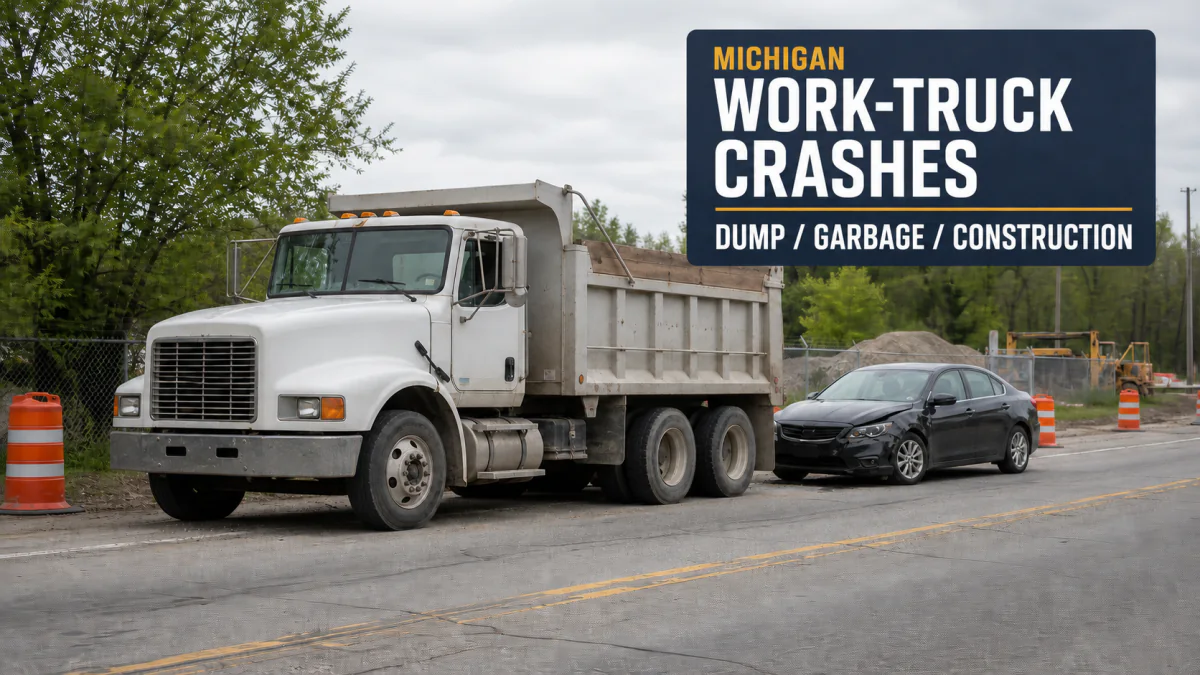
What changes after a dump, garbage, or construction truck crash in Michigan?
A Michigan work-truck crash may involve No-Fault personal protection insurance (PIP) benefits and a separate bodily injury claim against whoever caused the crash. The main difference is the investigation: several companies or a public agency may control evidence needed to identify who is legally responsible.
Why does a work-truck crash require a broader investigation?
The driver may be working within an employer's route, project, or service plan. The crash can also involve public or private ownership, maintenance responsibility, loading work, or traffic control. Those factors can lead to records that do not exist in an ordinary car accident, including:
- route, GPS, and dispatch data
- onboard, dash, or backing-camera footage
- maintenance, inspection, and repair records
- load tickets, scale tickets, and delivery paperwork
- traffic-control plans and project records
- company, contractor, or municipal policies
A backing crash may require evidence about the driver's lookout, spotter procedures, alarms, and video. A brake, tire, lighting, or camera failure may require maintenance and repair records. Falling material may require evidence about the load, loader, tailgate, tarp, and truck owner.
Who may be legally responsible?
The evidence may point beyond the driver. Depending on how the truck was owned, operated, loaded, and maintained, the investigation may include:
- the truck driver
- the truck owner, employer, or motor carrier
- a private waste hauler or sanitation company
- a construction company, contractor, subcontractor, or project owner
- a city, county, road commission, public works department, or state agency
- a maintenance or inspection vendor
- a loader, gravel pit, demolition company, or materials supplier
- a traffic-control contractor
- a vehicle or equipment manufacturer, if a defect contributed to the crash
- another driver or third party whose conduct contributed to the crash
A construction truck may be owned, operated, loaded, and maintained by different companies. A truck with municipal markings may belong to a public agency or a private contractor. Michigan's owner-liability statute, MCL 257.401, can make ownership and permission to use the vehicle relevant, subject to statutory exceptions. Contracts, ownership documents, employment records, route assignments, and maintenance agreements can help establish each party's role.
Is a city or municipal garbage truck crash different?
A city or municipal truck crash can involve different liability and timing rules. Under MCL 691.1405, a governmental agency may be liable when its officer, agent, or employee negligently operates a government-owned motor vehicle. A public name or logo does not establish ownership, operation, employment, or liability by itself.
Government-related claims can involve separate notice and service requirements. Preserve photos of the truck's markings, the report number, exact location, route or service area, and communications from the agency or its insurer. These claims should be reviewed promptly.
What evidence should you preserve?
Save the evidence already available to you. Important video, electronic data, records, and physical evidence can disappear or change quickly.
- Photograph the truck, license plate, unit number, company or public markings, USDOT number if displayed, and trailer number.
- Photograph the scene, work zone, debris, spilled material, signs, skid marks, and vehicle damage.
- Save witness names and contact information.
- Preserve dashcam, doorbell, business, traffic-camera, or other available video.
- Keep the police report number and responding agency information.
- Keep medical records, discharge instructions, wage-loss documents, insurance papers, and insurer communications.
The truck owner, employer, public agency, contractor, loader, maintenance company, or data vendor may hold route data, dispatch records, maintenance files, load tickets, project records, traffic-control plans, and camera footage. Truck or trailer repairs can also alter physical evidence. Michigan Legal Center can send preservation notices and request necessary records before that evidence is lost.
Michigan Legal Center's guide to preserving evidence after a Michigan truck accident explains the process in more detail.
What if gravel, dirt, or construction material fell from the truck?
A falling-load or roadway-debris claim may involve the driver, truck owner, loader, contractor, materials supplier, or maintenance vendor. Useful evidence can include photos of the material, load and scale tickets, the tarp or cover, tailgate condition, route records, and witness accounts.
Federal cargo rules may help frame the investigation, but they do not apply the same way to every truck. For covered commercial vehicles, 49 CFR 393.100 generally requires cargo to be secured against leaking, spilling, blowing, falling, or dangerous shifting. Section 393.106 treats some bulk materials, including sand and gravel transported in a qualifying vehicle structure, differently.
Michigan adopts many federal motor-carrier safety regulations through MCL 480.11a, subject to state modifications and exceptions. Federal 49 CFR 390.3T also generally excludes transportation performed by government entities. The vehicle, cargo, route, ownership, and actual operation determine which rules may apply.
For a deeper discussion, read about cargo falling from a truck in Michigan.
What benefits and injury claims may apply?
How do Michigan No-Fault PIP benefits apply?
No-Fault PIP benefits and a third-party bodily injury claim are separate. Under MCL 500.3105, PIP benefits are payable without regard to fault for qualifying accidental bodily injury arising from the ownership, operation, maintenance, or use of a motor vehicle as a motor vehicle.
Subject to the No-Fault Act, selected coverage, eligibility, exclusions, and priority rules, PIP may help pay medical expenses, medical mileage, wage loss, replacement services, and attendant care. MCL 500.3107 describes major PIP benefit categories.
Read who pays medical bills after a Michigan car accident for more about PIP priority.
Can you sue for pain and suffering after a work-truck crash?
Possibly. Under MCL 500.3135, a person generally must have suffered death, serious impairment of body function, or permanent serious disfigurement to recover noneconomic damages from a motor-vehicle crash. Serious impairment requires an objectively manifested impairment of an important body function that affects the person's general ability to lead a normal life.
Comparative fault can affect damages. Under MCL 600.2959, damages are reduced by the injured person's percentage of fault. If that percentage is greater than the combined fault of the other persons, noneconomic damages are not awarded. This rule does not automatically eliminate PIP benefits or every category of damages.
Do not assume a ticket, early fault allegation, or first version of the police report ends the claim. Liability should be reviewed using the complete evidence.
What if the crash happened in a construction zone?
A construction-zone crash may involve a road contractor, subcontractor, traffic-control company, materials supplier, public entity, or project owner. Relevant evidence may include traffic-control plans, lane-closure records, work orders, site logs, inspection records, and communications between agencies and contractors.
What if you were working when the crash happened?
Workers' compensation may be a separate issue from No-Fault PIP benefits and any third-party bodily injury claim. Under MCL 418.827, accepting workers' compensation benefits does not necessarily prevent a qualifying claim against a responsible third party, but reimbursement and coordination may matter.
What if the truck was uninsured or left the scene?
Uninsured motorist (UM) or underinsured motorist (UIM) coverage may matter if the truck had no usable liability insurance, could not be identified, or did not have enough liability insurance for the proven damages. UM/UIM coverage is separate from PIP, must have been purchased, and depends on the full insurance policy and available evidence.
Read more about Michigan uninsured and underinsured motorist coverage.
What deadlines apply after a work-truck crash?
Different claims can have different deadlines, so do not rely on one general time limit.
For No-Fault PIP claims, MCL 500.3145 generally requires an action to be filed within one year after the accident unless proper written notice was given within one year or the insurer previously paid benefits. Recovery can also be limited by when losses were incurred, and statutory tolling rules may apply.
The PIP deadline is separate from the deadline for a third-party bodily injury claim. MCL 600.5805 provides a three-year general limitation period for many Michigan injury actions, but exceptions and claim-specific rules may apply. Public-entity claims, workers' compensation matters, and insurance policies can have separate notice, service, or filing requirements. Early legal review is safer than assuming one deadline protects every claim.
What should you do after a work-truck crash?
- Move to a safe location if possible and call 911.
- Get medical care and follow the discharge instructions.
- Report the crash and keep the report number.
- Photograph the truck, identifying numbers and markings, scene, debris, work zone, and vehicle damage.
- Save witness information and any available video.
- Keep medical, wage-loss, employment, and insurance records.
- Notify your insurer promptly without guessing about liability or long-term injuries.
- Get legal advice before signing a release or giving a recorded statement. Your obligations can depend on which insurer is asking and the insurance policy language.
For more immediate steps, see Michigan Legal Center's guide to what to do after a Michigan car accident.
Talk to Michigan Legal Center about a work-truck crash
Michigan Legal Center can identify responsible parties, preserve truck data and video, and request route and maintenance records. The firm's attorneys can also investigate public or private ownership, review applicable insurance policies, and evaluate the PIP and third-party claims.
Michigan Legal Center is the Law Offices of Christopher J. Trainor & Associates and reviews accident claims statewide, including Metro Detroit, West Michigan, Mid-Michigan, Northern Michigan, and the Upper Peninsula.
If a dump truck, garbage truck, construction truck, municipal truck, or contractor vehicle injured you or a family member, contact Michigan Legal Center for a case review.