
Who Pays Medical Bills After a Michigan Car Accident Claim?
Who Pays Medical Bills After a Michigan Car Accident?
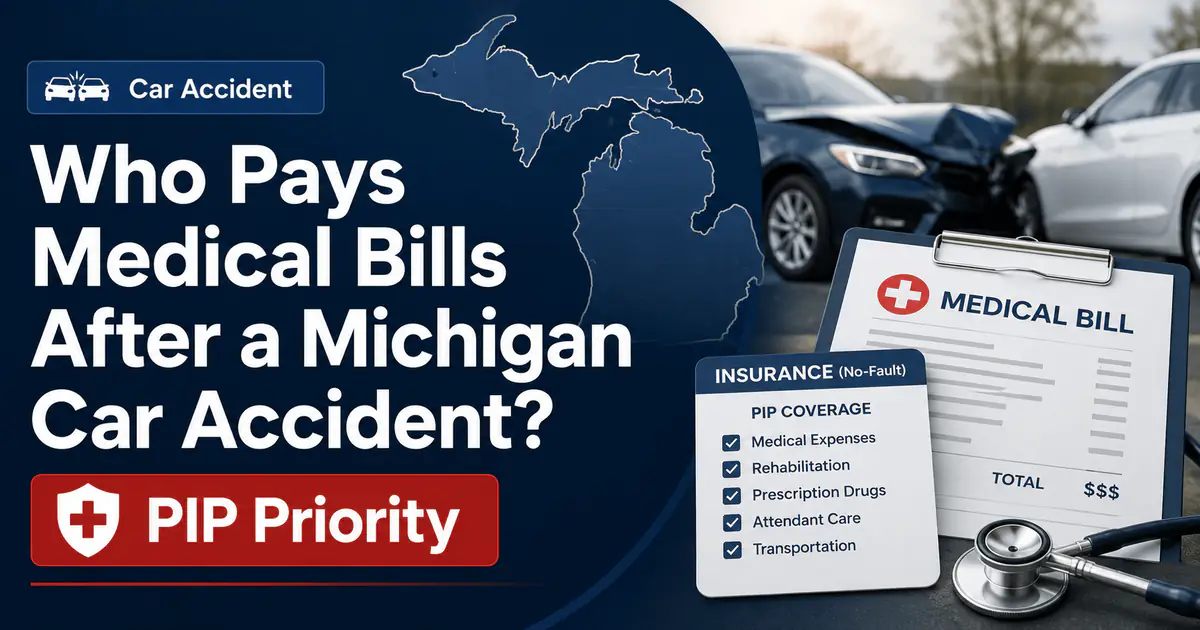
Short answer: in Michigan, medical bills after a car accident are usually handled through No-Fault personal protection insurance benefits, often called PIP benefits.
PIP is a first-party benefit, meaning it may pay allowable medical expenses regardless of who caused the crash, subject to the policy, the selected PIP medical coverage level, and Michigan's No-Fault Act. Sometimes the harder question is which insurer has to pay first.
Michigan's No-Fault priority rules can sometimes point to different insurers depending on whether the injured person was a driver, passenger, pedestrian, bicyclist, motorcyclist, rideshare passenger, employee in a work vehicle, or someone with no available auto policy. The answer can also change if the injured person opted out of PIP medical coverage, selected a reduced PIP limit, was excluded from a policy, or if an uninsured vehicle was involved in the crash.
At a Glance
- PIP medical benefits are separate from fault.
- The responsible insurer depends on Michigan's priority rules.
- Your own policy, a spouse's policy, or a resident relative's policy will likely apply.
- Lower PIP limits, opt-outs, exclusions, uninsured vehicles, motorcycles, rideshare vehicles, and assigned claims can change the answer.
- Written notice and lawsuit deadlines need to be protected early.
What Does Michigan PIP Pay For?
Michigan PIP benefits are governed in part by MCL 500.3107. Depending on the facts, the policy, and the No-Fault Act, PIP may cover:
- Allowable medical expenses for reasonably necessary care, recovery, or rehabilitation.
- Medical mileage and transportation related to treatment.
- Attendant care when help with daily activities is reasonably necessary.
- Work loss, subject to statutory limits.
- Replacement services, up to $20 per day.
- Survivor's loss benefits in fatal crash cases under MCL 500.3108, when the statute applies.
PIP does not pay everything. It will not pay pain and suffering. For allowable medical expenses, it will not pay above the selected PIP medical coverage level. It does not replace the separate third-party claim against the at-fault driver.
How PIP Medical Coverage Limits Affect Bills
Before Michigan's No-Fault reform, most Michigan drivers carried unlimited PIP medical coverage. That changed. Michigan law now allows different PIP medical coverage choices and, for eligible people, certain exclusions or opt-outs.
The policy may include:
- Unlimited PIP medical coverage.
- $500,000 in PIP medical coverage.
- $250,000 in PIP medical coverage.
- $250,000 in PIP medical coverage with exclusions for eligible people with qualified health coverage.
- $50,000 in PIP medical coverage when the Medicaid eligibility requirements are met.
- A PIP medical opt-out for eligible Medicare participants when statutory eligibility requirements are met.
Even when a person has selected a PIP medical exclusion or Medicare-based PIP medical opt-out, other PIP benefits such as wage loss and replacement services may still require review.
The declarations page, full policy, PIP selection forms, household coverage, health coverage, and exclusions all may affect available benefits, which is why contacting Michigan Legal Center as soon as possible is important.
How Michigan PIP Priority Works
The key question is not, "Who caused the crash?" The first question is usually, "Which insurer is highest in priority under the No-Fault Act?"
Michigan priority rules are found mainly in MCL 500.3114 and MCL 500.3115. They can be technical. The correct insurer depends on the injured person's role and the available coverage.
| Injured person | Common PIP priority issue |
|---|---|
| Driver in a personal vehicle | Usually start with the driver's own policy, spouse's policy, or resident relative's policy; assigned claims or exclusions may follow. |
| Passenger | Usually start with the passenger's own policy, spouse's policy, or resident relative's policy; assigned claims or special vehicle rules may matter. |
| Pedestrian or bicyclist | Usually start with household coverage; assigned claims may apply if no coverage is available. |
| Motorcyclist | Motorcycle crashes have special priority rules when a motor vehicle is involved. |
| Rideshare passenger | Passenger or household coverage may come first; special rideshare vehicle rules also need review. |
| Person with no available policy | The Michigan Assigned Claims Plan may need to be evaluated, and statutory limits can apply. |
If bills are sent to the wrong insurer, payment can be delayed while the real deadline keeps running.
Who Pays if You Were Driving Your Own Vehicle?
If you were driving your own insured vehicle, your own No-Fault policy is usually the first place to look for PIP benefits.
But "usually" is not the same as "always." The full analysis may require review of the vehicle's owner and registrant, named-insured status, spouse or resident-relative coverage, the selected PIP medical level, any qualified health coverage exclusion or opt-out, excluded-driver language, and whether the required security was in effect.
Who Pays if You Were a Passenger?
Under MCL 500.3114, a passenger's own auto policy, a spouse's policy, or a resident relative's policy may be relevant first. If no such coverage applies, the Michigan Assigned Claims Plan may need review. Special rules can apply in commercial, employer-owned, rideshare, taxi, bus, or transportation cases.
Who Pays if You Were a Pedestrian or Bicyclist?
Pedestrian and bicycle crashes are also No-Fault cases when a motor vehicle is involved. Medical bills may still be handled through PIP benefits.
For pedestrians and bicyclists, MCL 500.3115 can be part of the priority analysis. If the injured person is covered by their own No-Fault policy, a spouse's policy, or a resident relative's policy under MCL 500.3114, that coverage will apply first. If no such coverage applies, the Michigan Assigned Claims Plan will likely apply.
The at-fault driver's liability insurer will still matter for a pain-and-suffering claim.
Who Pays if You Were on a Motorcycle?
When a motorcycle crash shows evidence of the involvement of a motor vehicle, PIP priority is analyzed under the motorcycle provisions in MCL 500.3114. The order generally looks to:
- The insurer of the owner or registrant of the motor vehicle involved in the accident.
- The insurer of the operator of the motor vehicle involved in the accident.
- The motor vehicle insurer of the motorcycle operator involved in the accident.
- The motor vehicle insurer of the motorcycle owner or registrant involved in the accident.
Opt-outs, exclusions, and unavailable coverage can change what happens next, including whether the Michigan Assigned Claims Plan has to be considered.
Motorcycle policies do not themselves provide Michigan No-Fault PIP. Insurers must offer optional first-party medical benefits under MCL 500.3103. When a motor vehicle is involved, separate PIP priority rules may apply. If no motor vehicle was involved, review motorcycle medical coverage, health insurance, and any liability claim.
Do not assume that a motorcycle crash follows the same PIP priority rules as a passenger-car crash. Vehicle type, ownership, registration, insurance, and crash facts all matter.
Who Pays if the Crash Involved Uber, Lyft, or Another Rideshare Vehicle?
Rideshare crashes add another layer. The driver's app status may affect which insurance coverage applies.
If the driver was logged off, Uber or Lyft coverage usually does not apply. If the driver was logged in and available for ride requests, or engaged in a prearranged ride, Michigan's transportation network company insurance rules may apply under MCL 257.2123.
For a rideshare passenger, PIP priority may still start with the passenger's own coverage, a spouse's policy, or a resident relative's policy. If no such coverage is available, the rideshare vehicle's insurer may become important because MCL 500.3114 has special language for transportation network company vehicles. App records, trip receipts, timestamps, GPS information, and insurance documents can be important.
What If You Do Not Have Auto Insurance?
Not having auto insurance does not always mean there is no path to PIP benefits, but it can create serious problems.
If no insurer is available under the ordinary priority rules, the injured person may need to apply through the Michigan Assigned Claims Plan under MCL 500.3172. Assigned claims may apply when no PIP coverage applies, no applicable insurer can be identified, insurers dispute priority, or an insurer cannot meet its obligations. Assigned claims have special application requirements, proof requirements, offsets, and statutory limits.
However, some people are not entitled to PIP benefits. Under MCL 500.3113, an owner or registrant of a motor vehicle or motorcycle involved in the crash can be barred when the insurance required for that vehicle was not in effect. This can apply even when the owner was a passenger rather than the driver.
Uninsured status can also affect the separate pain-and-suffering claim. Under MCL 500.3135, operating your own uninsured vehicle can bar noneconomic recovery even when another driver caused the crash.
This is a high-risk area. Ownership, registration, household coverage, exclusions, assigned claims eligibility, and the third-party claim should be reviewed before assuming benefits are available or barred.
What If the Health Insurer Paid First?
Sometimes a health insurer pays medical bills before the No-Fault priority issue is resolved. That does not necessarily end the PIP claim.
There may be coordination-of-benefits issues, reimbursement claims, liens, or disputes between the health insurer and the No-Fault insurer. The answer depends on the auto policy, health plan language, ERISA issues when applicable, Medicare or Medicaid involvement, and the timing of payments. Medical billing, PIP submissions, and reimbursement claims should be reviewed before signing a release or assuming the issue is resolved.
What If the No-Fault Insurer Denies the Medical Bills?
No-Fault insurers may deny or delay medical bills for many reasons. Common disputes include:
- The insurer says it is not first in priority.
- The insurer says another policy should pay.
- The insurer says the treatment was not related to the crash.
- The insurer says the treatment was not reasonably necessary.
- The insurer says the PIP medical limit has been exhausted.
- The insurer says the injured person opted out or was excluded.
- The insurer says notice or proof was late.
A response often requires identifying the correct priority source, gathering medical proof, documenting the relationship between the crash and the treatment, tracking bills and EOBs, and filing suit when the insurer refuses to pay benefits owed under the No-Fault Act.
Michigan PIP Deadlines for Medical Bills
PIP deadlines are separate from the bodily-injury lawsuit deadline against the at-fault driver.
Under MCL 500.3145, a PIP benefits lawsuit generally must begin within one year after the crash unless the insurer received written injury notice within that year or previously paid PIP benefits for the injury. Timely notice or prior payment can permit later filing, but other one-year limits, claim-specific tolling, and the date each loss was incurred still affect recovery. Have the crash date, notices, payment requests, and denials checked promptly.
The general three-year personal injury statute under MCL 600.5805 does not protect a PIP claim. The PIP timeline and the separate bodily-injury timeline both need to be tracked.
How Michigan Legal Center Helps
When Michigan Legal Center handles a car accident medical-bills case, our attorneys can:
- Identify the correct No-Fault insurer and send written notice.
- Review policies, declarations pages, PIP selection forms, exclusions, health coverage documents, and special vehicle rules.
- Determine whether MCL 500.3114, MCL 500.3115, MCL 500.3172, or another priority rule controls.
- Submit medical bills, records, wage-loss documentation, replacement-service claims, and needed trip or app records.
- Address provider billing, health-insurance coordination, reimbursement issues, and MCL 500.3145 deadlines.
- File suit for overdue or wrongfully denied PIP benefits when necessary and evaluate any separate third-party injury claim.
The goal is simple: get the right insurer identified early, protect the medical benefits, and build the liability claim without letting coverage disputes damage the case.
Talk to Our Michigan Car Accident Attorneys
Michigan Legal Center handles car accident, No-Fault PIP, medical-bill, and personal injury claims throughout Michigan. With offices in Metro Detroit, Marquette, Lansing, Grand Rapids, Flint, Ann Arbor, White Lake, Southfield, Kalamazoo, and Bay City, we represent clients in Detroit, Grand Rapids, Flint, Lansing, Ann Arbor, Kalamazoo, Wayne County, Oakland County, Macomb County, Genesee County, Kent County, Washtenaw County, and across the Upper Peninsula.
Call (248) 886-8650 for a free consultation. No attorney fee unless we recover money for you. Case costs and fee terms are governed by the written fee agreement.