
What Evidence Must Be Preserved After a Michigan Semi-Truck Accident?
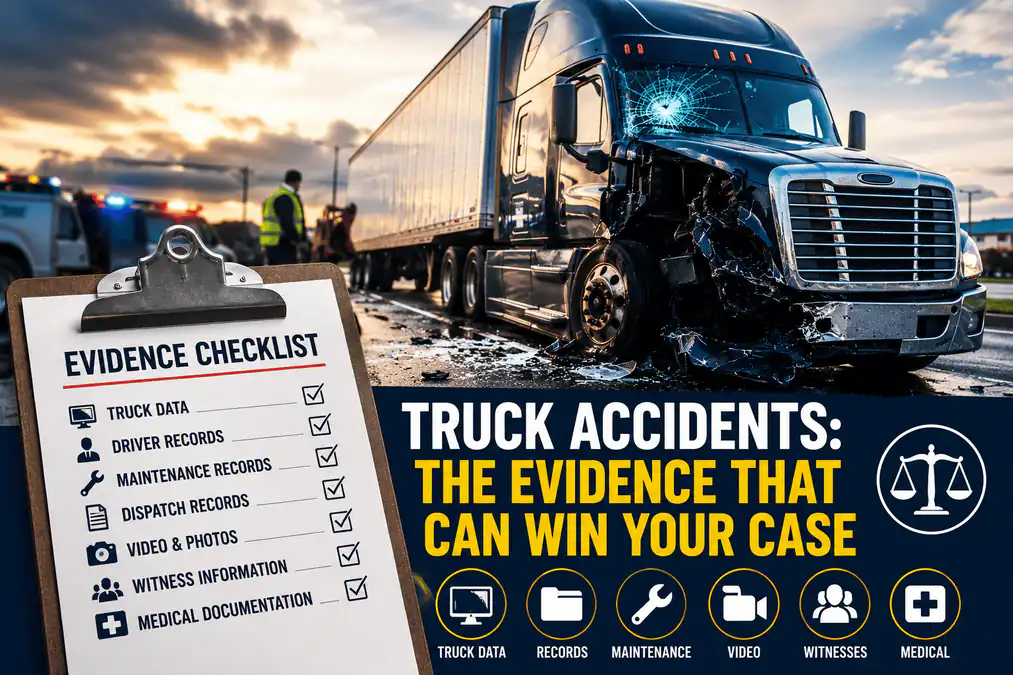
Semi-truck crash evidence may include electronic truck data, driver records, motor-carrier records, maintenance files, dispatch communications, video, photographs, witness information, and medical documentation.
After ensuring safety and notifying emergency services, get medical care and preserve any evidence you already have. A legal team can identify responsible parties, request preservation, and pursue available inspection or discovery before important records or physical evidence disappear.
Michigan semi-truck accident evidence often sits with the motor carrier, trucking company, tractor or trailer owner, maintenance provider, cargo loader, shipper, broker, insurer, or a third-party data vendor. A party belongs in the liability analysis only when its conduct or legal responsibility is supported by the facts.
This guide is for semis, tractor-trailers, 18-wheelers, big rigs, and covered motor-carrier operations. For a package-route cargo van, step van, delivery box truck, or courier, use our delivery truck accident page. For a company car, work or service van, employer vehicle, non-semi retail fleet, utility truck, contractor, garbage truck, or municipal vehicle, use our commercial vehicle accident page.
Why does evidence matter more in truck accident cases?
Semi-truck and tractor-trailer cases can involve evidence spread across several companies. The motor carrier, tractor owner, trailer owner, maintenance provider, and cargo parties may hold different records.
The carrier may hold driver files and dispatch records. A vehicle owner may hold maintenance records. A broker, shipper, loader, or consignee may hold load documents, trip instructions, or communications. An insurer may contact the injured person before the full evidence picture is clear.
What truck data and electronic evidence should be preserved?
Truck data can show how the vehicle was moving before and during the crash. The available data depends on the vehicle, carrier, equipment, and facts.
Depending on the facts, important electronic evidence may include:
- Event data recorder or truck accident black box data
- Engine control module data
- Electronic logging device records
- GPS and telematics data
- Speed, braking, throttle, and hard-stop data
- Dashcam or inward-facing camera footage
- Cell phone or communication records
Not every truck has the same data. Some systems record only limited information. Others may overwrite or store data in a format that requires fast expert access.
What driver records may matter after a truck crash?
Driver records may show whether the driver was qualified, trained, rested, supervised, or communicating with dispatch before the crash.
Depending on the facts, relevant driver evidence may include:
- Driver qualification file
- Hours-of-service records
- Logbooks or electronic logging device records
- Truck driver logs and supporting documents
- Training records
- Prior safety history
- Drug and alcohol testing records
- Communications with dispatch
These records can help investigators evaluate contributing factors such as fatigue, distraction, poor training, unsafe scheduling, or other facts that may require review.
What trucking company and dispatch records should be preserved?
Motor-carrier and dispatch records can show timing, instructions, trip decisions, and control. They can also help test whether scheduling or dispatch pressure contributed to the crash.
Records to preserve may include:
- Dispatch instructions
- Trip schedule
- Route information
- Load documents
- Bills of lading
- Trip records
- Company safety policies
- Post-crash internal reports
- Communications between the driver, dispatcher, motor carrier, shipper, broker, or other involved trucking entity
These records can matter even when the driver caused the immediate collision. A truck crash investigation often asks whether a company decision, schedule, route, load, or communication contributed to the risk.
What maintenance and inspection evidence should be preserved?
Maintenance evidence may show whether the vehicle itself, trailer, tires, brakes, lights, or safety equipment were in proper condition. It should be preserved before repairs change the condition of the vehicle.
Important records may include:
- Maintenance records
- Repair history
- Pre-trip and post-trip inspection reports
- Brake records
- Tire records
- Lighting records
- Underride guard condition
- Out-of-service history
These records may help determine whether the vehicle's condition mattered.
What evidence from the scene should be saved?
Evidence from the scene can disappear quickly. Weather changes, road markings fade, vehicles are moved, debris is cleared, and nearby video may be overwritten.
Useful scene and witness evidence may include:
- Crash scene photos
- Vehicle damage photos
- Skid marks or gouge marks
- Debris field
- Road and weather conditions
- Traffic camera or nearby business video
- Police report
- 911 calls
- Witness names and contact information
If you can take photos safely, do so. If you cannot, focus on medical care and let counsel investigate.
What medical and personal evidence should the injured person save?
The injured person should save medical, insurance, work, and vehicle-damage documents. These records help connect the crash to the injuries and losses.
Save:
- Emergency room and follow-up records
- Diagnosis and treatment notes
- Photos of injuries
- Medication lists
- Work restrictions
- Missed-work records
- Pain or symptom notes
- Insurance letters
- Repair or total-loss documents
Keep the notes simple and accurate rather than guessing about medical causation, fault, or long-term prognosis.
Why can prompt attorney action matter?
Fast attorney action matters because video can be overwritten, electronic data can be lost, trucks can be repaired, maintenance records can become harder to obtain, and witnesses can become difficult to find.
Counsel can send appropriate preservation requests to responsible parties. Counsel can also identify the motor carrier, trucking company, tractor owner, trailer owner, maintenance provider, shipper, broker, loader, and insurers before the case depends only on company-controlled records.
Deadlines and preservation issues can move quickly and depend on the facts. This article is general information, not legal advice about any specific deadline or case.
What should you not do after a truck accident?
After ensuring safety and notifying emergency services, get medical care. Michigan Legal Center can help identify evidence holders, request preservation, and pursue available inspection or discovery.
- Giving a recorded statement without legal advice
- Signing releases
- Posting details online
- Delaying medical care
- Relying on the trucking company or insurer to preserve evidence voluntarily
How can a Michigan truck accident attorney help preserve evidence?
A Michigan truck accident attorney can take over the evidence work while you focus on treatment.
An attorney can:
- Identify responsible parties
- Seek preservation of truck data and video
- Investigate driver and company records
- Review maintenance and inspection issues
- Work with experts when needed
- Handle insurer communication
- Determine whether the facts support a claim
For related information, see Michigan Legal Center's pages on truck accidents, delivery truck accidents, tanker and hazmat truck accidents, and personal injury claims.
Talk to a Michigan truck accident attorney
If you were injured in a Michigan semi-truck, tractor-trailer, 18-wheeler, or big-rig crash, contact Michigan Legal Center / Christopher Trainor & Associates for a free consultation. Michigan Legal Center can help identify the records, video, truck data, and witness evidence that may matter.
Contact Michigan Legal Center to discuss your case.