
Who Is Responsible When Cargo Falls From a Truck in Michigan?
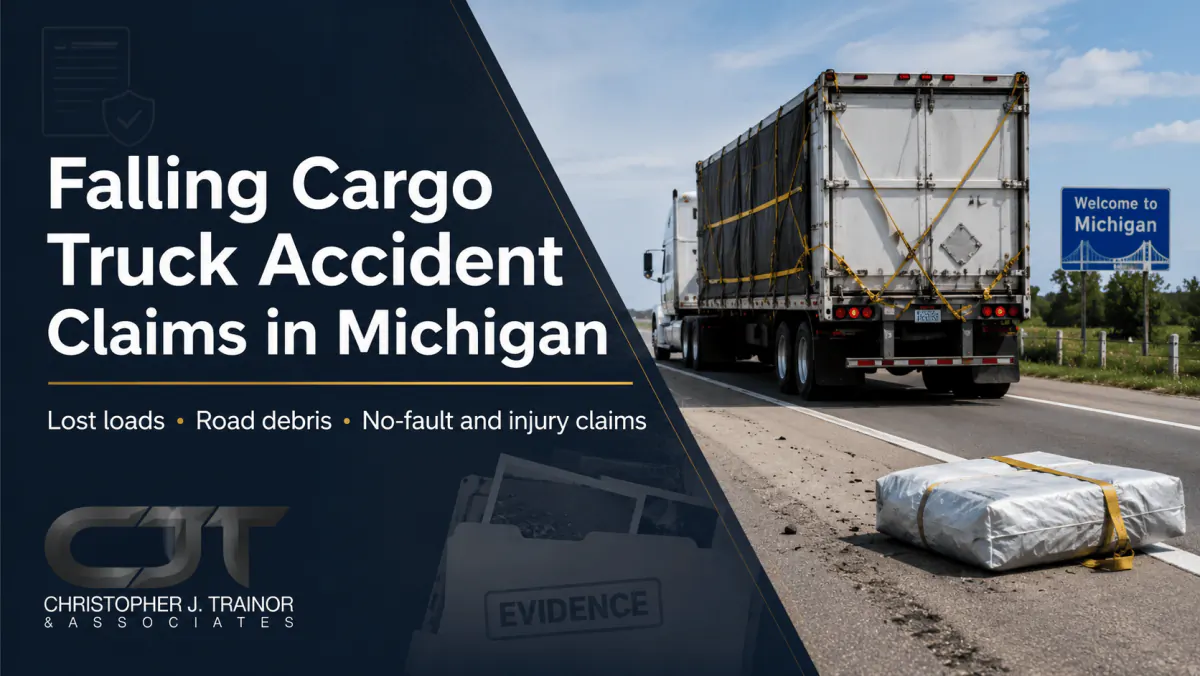
Can you bring a claim if cargo falls from a truck in Michigan?
Yes. If a crash was caused by falling or unsecured cargo, you may be able to file a claim depending on the facts. The success of a claim like this depends on proof of where the cargo came from, who controlled the truck or load and whether the injuries fit the correct legal track.
Crashes involving falling cargo can become more complicated depending on the facts of the case. The load may have been prepared by a warehouse, loader, shipper, contractor or another company before the truck entered the road. The condition of the vehicle, trailer, cargo records and loading instructions may matter as much as the police report.
That does not mean every company connected to the shipment is legally responsible. The claim should be investigated by an attorney before cargo is cleared, vehicles are repaired, dashcam footage is overwritten or company records become harder to obtain.
Who is responsible when a truck loses cargo or debris?
There are several parties that may be held responsible depending on the facts of the case including:
- the truck driver
- the motor carrier or trucking company
- the truck, tractor or trailer owner
- a loading company, warehouse or contractor
- a maintenance company
- a broker, shipper or cargo-related company
- another driver or third party
Michigan law generally requires highway vehicles to be constructed and loaded so contents do not drop, sift, leak, blow off or otherwise escape.
Federal motor carrier regulations may also apply. For covered commercial motor vehicles, federal cargo rules may address cargo securement standards. Trucks, semitrailers and other commercial vehicles must be properly packed and inspected to avoid leaking, spilling, blowing, falling or shifting enough to affect stability or maneuverability.
Federal rules may apply differently depending on the vehicle, carrier, cargo, route and exemptions. The right evidence can show whether a lost load was just a sudden event or the result of poor loading, weak securement, defective equipment, missed inspections or company decisions.
What evidence can show where the cargo came from?
A claim like this will need evidence connecting the cargo to the truck it came from. If the truck kept going, if debris scattered across lanes, or if multiple vehicles hit the same object, the injured person may need evidence that connects the cargo to a particular truck, trailer, company or load.
Useful evidence can include:
- photos of the cargo, debris field, skid marks, vehicle damage and final resting positions
- dashcam, traffic-camera, doorbell-camera, business-surveillance or onboard truck video
- witness names and statements
- truck company name, USDOT number, license plate, trailer number, unit number, logo or markings
- police report number and any crash reconstruction information
- 911 audio, dispatch records and tow records
- cargo descriptions, packaging, labels, seals, bills of lading, load sheets or delivery paperwork
- nearby business records showing the truck before or after the crash
- insurer letters or messages from trucking representatives
Public agencies may remove vehicles and cargo from the roadway when they are blocking traffic or may endanger public safety. That removal may be necessary for safety, but it also means it is important to gather photos, video and other evidence early.
Save any available photos, videos, documents, messages, witness names or insurance papers immediately. Michigan Legal Center can assist with collecting and preserving necessary evidence before records, video, cargo, vehicle evidence and witness memories are lost.
What if the load shifted, spilled or caused a no-contact crash?
Not every cargo-related crash involves an object striking another vehicle. A load can shift inside a trailer and contribute to a rollover, jackknife, sudden lane change or loss of control. Cargo can spill onto the road and cause a chain of crashes from drivers swerving to avoid debris and crashing without touching the truck or debris.
The investigation may need to answer:
- Did the object or debris come from a specific truck?
- Did the truck stop, continue driving or return to the scene?
- Was the load covered, tied down, sealed or otherwise secured?
- Were doors, latches, tarps, straps, chains, binders or anchor points defective or missing?
- Did the driver inspect the load or securement devices when required?
- Did a warehouse, loader, contractor, shipper or customer control how the cargo was loaded?
- Did another vehicle strike the cargo first and move it into the injured person's path?
In a Michigan injury claim, the determining factors are often evidence, injury proof, insurance coverage and who can be tied to the hazard.
Comparative fault may also become an issue if an insurer argues that the injured driver reacted unsafely, followed too closely, drove too fast for conditions or could have avoided the debris. Michigan's comparative-fault statute can reduce damages based on the injured person's percentage of fault and can bar noneconomic damages if the injured person's fault is greater than 50%.
How does Michigan no-fault and an injury claim fit together?
Michigan no-fault benefits and a third-party injury claim are separate types of claims.
PIP benefits may apply to accidental bodily injury arising out of the ownership, operation, maintenance or use of a motor vehicle as a motor vehicle. PIP benefits are generally payable without regard to fault under MCL 500.3105.
A separate third-party injury claim asks whether another person or company is legally responsible for the crash and resulting harm. Noneconomic damages such as pain and suffering after a Michigan motor-vehicle crash generally require death, serious impairment of body function or permanent serious disfigurement.
A vehicle owner may be liable for injuries caused by negligent operation of the vehicle, depending on the facts of the case. The owner of the vehicle is not necessarily the company whose logo is on the side, and they are not automatically negligent just for owning the vehicle.
What should you do after a crash involving falling cargo or a lost load?
After any serious crash, first make sure you are safe, get medical care if necessary and notify emergency services. Then preserve whatever evidence you can legally and safely obtain without putting yourself in danger.
Useful steps include:
- Photograph the cargo, debris, vehicle damage, roadway, skid marks, lane position, traffic controls and visible injuries.
- Save dashcam footage and ask nearby witnesses or businesses to preserve video.
- Write down the truck company name, USDOT number, license plate, trailer number, vehicle markings and driver information if available.
- Keep the police report number, tow records, repair records, medical paperwork, discharge instructions, insurance letters and adjuster messages.
- Save any cargo labels, packaging details, bills of lading, delivery paperwork or photos showing where the cargo may have come from.
- Avoid signing a release before an attorney reviews the correct claim path, available insurance and evidence-preservation needs.
A Michigan Legal Center attorney can identify responsible parties, preserve truck data and video, request cargo and loading records, review no-fault/PIP issues, evaluate the third-party injury claim and determine if any related issues require special review.
Related Reading
- Preserving truck accident evidence - for truck data, video, dispatch records, maintenance records, and company-controlled evidence.
- Michigan truck accident lawyers - for serious commercial truck, semi-truck, tractor-trailer, and heavy-vehicle claims.
- Who pays medical bills after a Michigan car accident - for the separate No-Fault/PIP medical-bill track.
If unsecured cargo, a lost load, or truck debris injured you or someone in your family, contact Michigan Legal Center so our attorneys can review the evidence before it disappears.