
Hit by a Truck Making a Wide Turn in Michigan: Who Is at Fault?
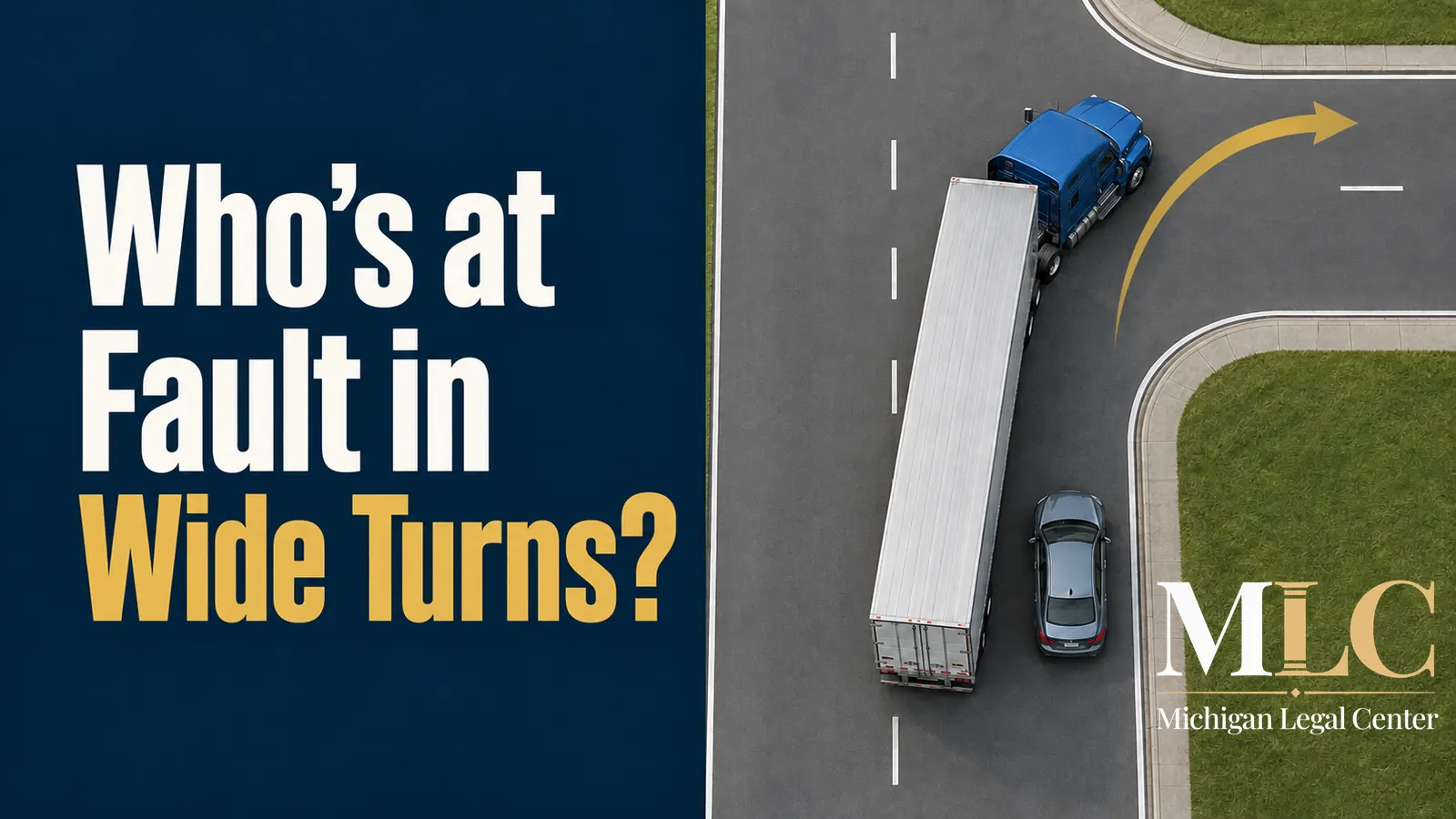
Semi-trucks need more space to turn than other vehicles. So, if a truck crashes while making a turn, fault usually depends on if they got the timing and spacing right.
Needing extra room to take a turn does not mean they can’t be found at fault for a crash. Depending on the facts of the case, the truck driver, the driver of the other vehicle or another party could be fully or partially at fault.
How do vehicle positions affect fault?
If a car was already beside the truck which then crossed into their lane, the truck driver is required to check if there is enough space before moving. Under MCL 257.642, failing to make that check may be evidence of fault.
Sometimes these crashes happen because a smaller car moved into the lane beside the semi as it was turning.
Just because there is open space doesn’t make passing on the right lawful. Any pass must fit one of the circumstances listed in MCL 257.637. Failing to meet those conditions can contribute to your share of fault.
Both drivers can share fault in a crash. In Estate of McDuffie-Connor v Neal, a car was passing a right-turning truck in a parking lane. Disputed evidence about the truck's signals and the crash sequence left questions about both drivers' fault. The truck had passed the car seconds earlier. The court said a jury should decide whether the truck driver should have seen the car approaching on the right.
Drivers aren’t expected to anticipate every unknown hazard, but they must account for hazards reasonably apparent in the circumstances. The question is whether negligent driving caused the crash, not simply whether the truck made contact.
What rules must a truck driver follow when turning?
Under MCL 257.648, before turning, drivers need to be sure the turn can be made safely and give the required signal. A turn signal warns others but doesn’t establish that the space beside the truck is clear.
On a road with clearly marked lanes, MCL 257.642 requires the truck to stay within one lane until the driver determines the movement is safe while following lane directions.
At an intersection, MCL 257.647 requires the approach and right turn to be as close as practicable to the right curb or roadway edge, unless official signs or markings direct a different course.
What evidence helps establish fault?
Fault is often established by evidence that shows the conditions before the turn, not just the conditions during the crash. There may be a difference between a car that is already right beside a truck and a car that is entering a gap while the truck is still turning.
Preserve any evidence you can legally obtain including:
- Video showing positions and timing such as the original dashcam recording and footage from nearby cameras that may have captured the approach, signal and turn.
- Photographs showing the available space such as capture lane lines, turn arrows, signs and vehicle damage so the turning path can be compared with the road layout.
- Save witness details and contact information, keep track of what witnesses saw before impact, including whether a signal was blinking. Keep the crash report or report number.
Ask an attorney about preserving truck camera footage and records relevant to the turn, including signal inspection records. Recordings may be overwritten, and repairs can change the evidence. Michigan Legal Center explains which records may need to be requested from others when discussing evidence preservation after a Michigan truck accident.
How does shared fault affect compensation?
If you were partially but not entirely at fault, you may be assigned a percentage that show exactly how much of the crash can be blamed on you. Your recoverable damages are reduced by that same percentage in a pain and suffering claim. Being more than 50% at fault stops you from recovering anything according to Michigan's noneconomic-damages rules under MCL 500.3135(2)(b).
Pain-and-suffering recovery claims are only applicable in cases involving death, serious impairment of body function or permanent serious disfigurement. Other restrictions apply, including when an injured owner was driving their own vehicle without the required insurance.
Michigan no-fault personal injury protection benefits don’t take fault into consideration and are subject to the act's eligibility and coverage requirements under MCL 500.3105. Depending on eligibility and coverage, these benefits can pay medical expenses and replace some lost wages.
If a turning truck injured you, Michigan Legal Center's Michigan truck accident attorneys can help protect your claim from the loss of evidence by seeking relevant footage and records before they disappear.