
Michigan Utility Truck Accident Claims: Who May Be Responsible?
How Can a Michigan Utility Truck Accident Lawyer Help?
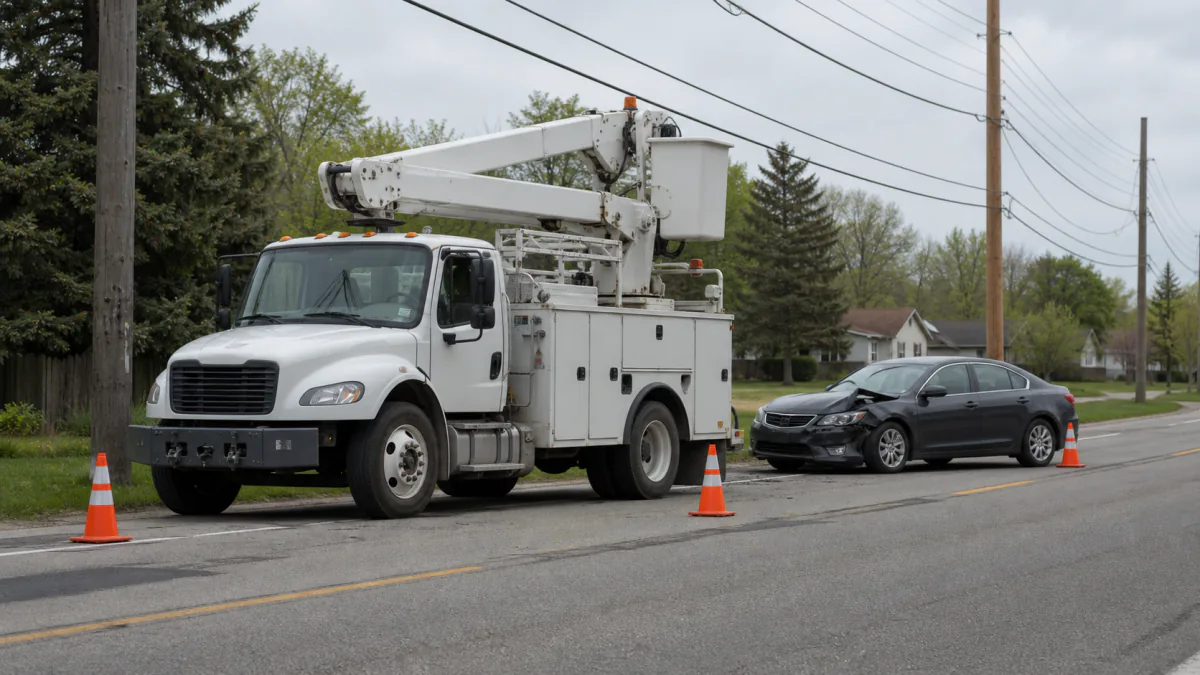
After a Michigan utility-truck crash, a lawyer can investigate who employed the driver, owned the vehicle, controlled the work, provided applicable insurance coverage, and likely holds relevant records. Counsel can then take appropriate steps to preserve available work-order, crew, vehicle, and project evidence. A utility logo is an important lead, but it does not prove ownership, job control, or legal responsibility.
Does a DTE or Consumers Energy Logo Prove Who Is Responsible?
No. A utility logo is an investigation lead, not necessarily the identity of the driver's employer, vehicle owner, work controller, contractor, or insurer. Utility work can involve more organizations than the name visible on the truck. The potentially relevant roles include:
- the driver and the driver's employer;
- the owner of the truck, trailer, or attached equipment;
- the utility that requested or directed the work;
- a contractor, subcontractor, or other project participant;
- a maintenance provider when its work is connected to the crash;
- insurers covering different people, companies, or vehicles; and
- a public body if the vehicle or project was actually governmental.
Those roles are not interchangeable. DTE's own company materials distinguish DTE Electric and DTE Gas from other DTE businesses. The Michigan Public Service Commission separately lists DTE Electric and Consumers Energy as electric utilities and lists DTE Gas and Consumers Energy as gas utilities. Those sources identify utility names and structures, not the parties responsible for a particular collision.
Michigan's vehicle-owner statute can make actual ownership and permitted use relevant when negligent operation causes an injury, subject to the statute's exceptions and limits. MCL 257.401. Separately, Michigan's general employer rule can make an employer responsible for an employee's tort committed within the scope of employment, but the employment relationship and the driver's work purpose still must be established. Hamed v Wayne County.
Vehicle registrations, title records, employment records, contracts, work orders, dispatch data, project files, and insurance policies can help show which organization had which role. A familiar logo starts that investigation; it does not finish it.
Which Work-Order, Crew, Vehicle, and Project Records May Matter?
Utility-job evidence may be divided among a dispatch center, the truck, the driver's employer, a utility, one or more contractors, an equipment owner, and a road or public agency. Depending on the job and how the crash happened, the investigation may include:
- service requests, work orders, dispatch records, and the reason the crew was sent;
- driver, crew, truck, trailer, bucket, and equipment assignments;
- contracts, subcontracts, purchase orders, leases, and project responsibilities;
- GPS, telematics, onboard video, mobile-device data, and vehicle-event information;
- inspection, maintenance, repair, and equipment records;
- project plans, daily reports, supervisor notes, photographs, and communications;
- traffic-control plans, lane-closure records, permits, and road-agency communications; and
- insurance policies and documents identifying the people, companies, and vehicles covered.
No single record belongs in every utility-truck claim. Record existence, relevance, retention, and control depend on the actual crash and job. MDOT's work-zone materials show that traffic-control and utility-permit materials can exist when work affects a state road. A MISS DIG 811 ticket is relevant only when underground or excavation work is connected to the incident.
Safety and medical care come first. If it is safe, photographs or video can preserve legal company names, contractor markings, license plates, and unit or trailer numbers. They can also show a displayed USDOT number, visible work or project identifiers, vehicle positions, damage, cones, signs, cameras, and the work-area layout. Save witness contact information, the police incident number, and any dashcam or phone video already available to you. Do not enter traffic, approach unstable equipment, or enter a marked work area to collect evidence.
Michigan Legal Center's guide to evidence that may need to be preserved after a Michigan truck crash explains the broader fleet-evidence problem. A records request seeks access to information; it is not the same as asking a likely holder to preserve evidence. An attorney can identify the likely holders and direct the appropriate preservation work.
How Are PIP Benefits Different From a Claim Against a Utility or Contractor?
Michigan No-Fault PIP benefits and a third-party bodily injury claim are separate legal categories.
PIP benefits can be payable without regard to fault for accidental bodily injury arising from the ownership, operation, maintenance, or use of a motor vehicle as a motor vehicle, subject to Michigan's No-Fault Act. MCL 500.3105. The correct PIP insurer depends on the priority rules and policies in effect, not on the utility logo or which driver appears responsible.
A possible claim against a negligent driver, employer, vehicle owner, utility, contractor, or another legally responsible party is evaluated separately under Michigan's motor-vehicle tort law. MCL 500.3135. The available claim and losses depend on the evidence, legal relationships, injuries, coverage, and statutory conditions.
Michigan Legal Center's guide to who pays medical bills after a Michigan car accident explains the detailed PIP-priority question. The Michigan car accident page explains the broader motor-vehicle liability and injury framework.
What Changes With a Municipal Utility, Cooperative, or Contractor Vehicle?
The Michigan Public Service Commission distinguishes investor-owned utilities, member-owned electric cooperatives, and community-owned municipal utilities operated through local government. A cooperative is not governmental merely because it is member-owned. A contractor working for a municipal or private utility does not automatically share that utility's legal status.
If a municipal utility vehicle is involved, first verify the owner, operator, driver's employer, and proper public entity. MCL 691.1405 addresses bodily injury resulting from negligent operation by an officer, agent, or employee of a government-owned motor vehicle. That rule does not establish that every municipal-looking or contractor vehicle is government owned, and it does not answer every defendant, immunity, forum, notice, or procedure question.
If the injured person was working, workers' compensation and a claim against a legally distinct third party may coexist, depending on the facts and coordination rules. MCL 418.827. Michigan Legal Center's personal injury case guide explains how a workplace injury may also involve a third-party claim.
Utility pickups, service vans, bucket trucks, and larger work vehicles do not all raise the same business-use or trucking questions. Michigan Legal Center's commercial vehicle accident page explains the broader business-use category, while its truck accident lawyers address semis, carriers, and regulated-trucking questions.
Find Utility-Truck Help Near You
- White Lake utility truck accident lawyer
- Southfield utility truck accident lawyer
- Detroit utility truck accident lawyer
- Grand Rapids utility truck accident lawyer
- Lansing utility truck accident lawyer
- Flint utility truck accident lawyer
- Ann Arbor utility truck accident lawyer
- Gaylord utility truck accident lawyer
- Kalamazoo utility truck accident lawyer
- Bay City utility truck accident lawyer
- Marquette utility truck accident lawyer
Why Choose Michigan Legal Center for a Utility-Truck Claim?
A utility-truck claim should be built around the actual driver, vehicle, work assignment, companies, insurance, and records, not just the logo. Michigan Legal Center is the Law Offices of Christopher J. Trainor & Associates. Since 1989, our Michigan attorneys have worked as a team to investigate serious injury claims and connect the evidence to the medical, wage-loss, and long-term harm caused by a crash.
If Michigan Legal Center accepts the matter after a case-specific review, our attorneys can:
- Use police materials, registrations, vehicle markings, work identifiers, and company records to map the driver, employers, owners, utility, contractors, project, insurers, and any public body.
- Identify likely evidence holders and send appropriate preservation requests before relevant video, digital information, vehicle evidence, or project records change or disappear.
- Review work orders, dispatch and crew assignments, contracts, project files, vehicle and equipment records, traffic-control materials, and available insurance documents.
- Keep the PIP claim separate from any supported third-party claim while identifying work-injury, public-vehicle, coverage, and timing questions that need case-specific analysis.
You do not need to identify every company or find every record before asking for help. Tell us what was on the truck, where the crash happened, and what injuries or medical care followed.
You do not have to sort through utilities, contractors, insurers, and records alone. Start your free case review or call Michigan Legal Center at (248) 886-8650. Our team will listen, answer your questions, and help you understand what comes next. If we accept your case on a contingency-fee basis, you will not owe an attorney fee unless we recover compensation for you. Your written agreement will explain attorney fees and case expenses.