
Does Michigan no-fault cover attendant care after a crash?
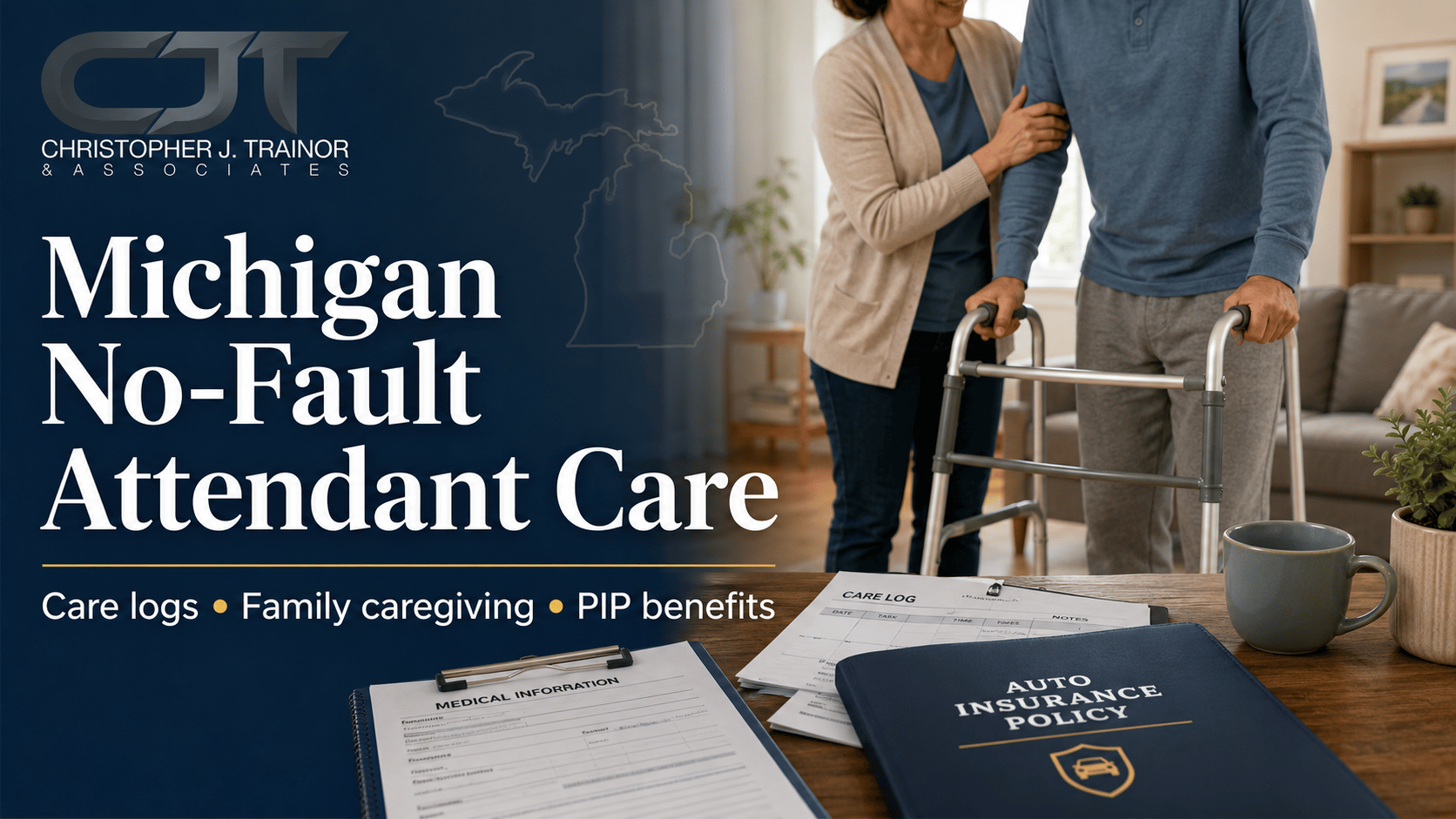
Getting your medical bills paid is one thing, but you may be dealing with costs of your injury for years to come. Attendant care is one aspect of an injury that an injured person could be paying for long after they’ve left the hospital.
No-fault personal injury protection (PIP) insurance could be used to cover some of those costs like attendant care.
What counts as attendant care in a no-fault claim?
When a crash leaves a person so injured that they can no longer perform daily tasks which they now need help with, attendant care can get them consistent help managing their life.
Attendant care is specifically for the injured person, not general help in their household. It is meant specifically for tasks related to the injured person’s body, safety, supervision or medical needs.
This could be for people who need help bathing, dressing, moving safely, taking medication, using medical equipment, getting to medical appointments or who need supervision.
If the task is about chores the injured person would have done around the home, it may be a different no-fault benefit issue, such as replacement services.
The exact label matters because insurers may review attendant care differently from wage loss, replacement services, medical mileage or other PIP benefits. A Michigan Legal Center attorney can evaluate which category fits the facts, what documentation is needed and whether the claimed care is payable under the applicable policy and Michigan law.
What records help support attendant care benefits?
Attendant care claims depend heavily on records. When care is being provided consistently, memory alone isn’t enough to track relevant information. Claimants may need to show exactly what care was provided, when it was provided and why it was needed.
Keep track of things like:
- doctor notes or discharge instructions showing the need for care
- care logs showing dates, times, tasks and who provided the care
- bills, invoices, schedules or agency records
- notes about changes in symptoms, restrictions or supervision needs
- insurance letters, claim forms, denials and adjuster messages
- photos, videos or records that show the injured person's limitations
A Michigan Legal Center attorney can show how these records connect the care to the crash and demonstrate need for the care.
Can a family member provide attendant care?
Yes. A family member may be able to provide the needed attendant care, but that can raise special proof and payment issues. Just because a family member is providing care doesn’t automatically make that care payable.
The injured person still has to show that the care is related to the crash, reasonably necessary, properly documented and covered under the applicable no-fault policy and Michigan law.
There has to be evidence that the caregiver was providing the services with an expectation of payment. This doesn’t require a formal bill or written contract, but there must be some evidence of the arrangement.
Attendant care may be covered even if family members or others are helping. Proving the need for it is less dependent on whether the injured person can get help from friends and family, and more about whether the reason for care is tied to the crash.
This means proving that they can’t perform the tasks themselves because of the crash.
This is one reason early documentation matters. What care was provided, when it was provided, how long it took and why the injured person needed it are all important things to document.
Michigan law under MCL 500.3157 has special rules for attendant care provided at home by family members, people who live with the injured person or people who already had a business or social relationship with the injured person before the crash. In many cases, the insurance company may only have to pay for up to 56 hours per week of this type of care unless it agrees to pay for more.
If more care is needed, a caregiver outside these groups may provide additional covered hours, subject to the applicable PIP medical coverage limit.
However, the Michigan Supreme Court held that this limit does not apply to people injured while covered by an insurance policy issued before June 11, 2019.
How can PIP medical limits or health coverage affect attendant care?
Attendant care is generally treated as part of Michigan no-fault allowable-expense benefits, which means it can be affected by the injured person’s PIP medical coverage limit. The injured person’s selected PIP medical coverage can affect how much coverage may be available for attendant care and other accident-related care, recovery or rehabilitation expenses.
According to the Department of Insurance and Financial Services (DIFS), Michigan drivers can choose among PIP medical coverage options, and Medicare, Medicaid, qualified health coverage and household coverage facts can affect which options are available.
Health insurance can affect which PIP medical option or exclusion was selected, but it may not provide the same type or amount of attendant care coverage that no-fault PIP medical coverage can provide. Families should not assume that health insurance will replace no-fault attendant care benefits.
Timing is important in these claims. Under MCL 500.3145, a claimant generally cannot recover benefits for losses incurred more than one year before the suit is filed. However, tolling, which pauses the time limit, may apply after a specific claim is submitted and before the insurer formally denies that claim. Tolling may not apply if the claimant does not pursue the claim with reasonable diligence.
What if the insurer delays, disputes or denies attendant care payment?
If the insurer delays, disputes, denies, reduces or stops attendant care payment, the injured person or their family should preserve every record connected to the care and the insurer's decision. Phone calls or informal explanations are useful but cannot be relied on alone.
Helpful records may include:
- denial letters, formal notices and explanation-of-benefits documents
- adjuster emails, claim portal messages and call notes
- care logs and provider records
- medical records, prescriptions or provider notes supporting the need for care
- prior payment history, including any reduction or cutoff dates
- invoices, schedules and caregiver information
DIFS maintains information on Attendant Care Complaints and describes access to care concerns as an issue it may help consumers address with insurers. A DIFS complaint process does not replace legal review. If benefits are being delayed, reduced or stopped, timing, proof, policy language and no-fault procedures can all make a difference.
How is attendant care different from replacement services or wage loss?
Attendant care, replacement services and wage loss are different categories of no-fault benefits.
Attendant care concerns hands-on help, monitoring or supervision needed for the injured person's care. Replacement services generally concern ordinary household tasks the injured person would have performed for themselves or their dependents if they had not been injured. Wage loss concerns income the injured person could not earn because of crash-related injuries.
Replacement services are limited to $20 per day for up to three years after the accident. Work loss benefits are also limited to the first three years after the accident and are subject to a monthly maximum that changes over time.
Talk to Michigan Legal Center about an attendant care dispute
Attendant care disputes can involve medical records, care logs, family caregiving, policy selections, PIP medical limits, health coverage issues and insurer disputes. A safer next step is to preserve the records you already have and get legal guidance before the dispute becomes harder to prove.
Michigan Legal Center can review the no-fault claim history, identify what records are missing, evaluate insurer letters and help preserve the proof needed for an attendant care claim. If you have questions about attendant care after a Michigan crash, contact Michigan Legal Center to discuss the situation.