
Is the rear driver always liable in a Michigan rear-end accident?
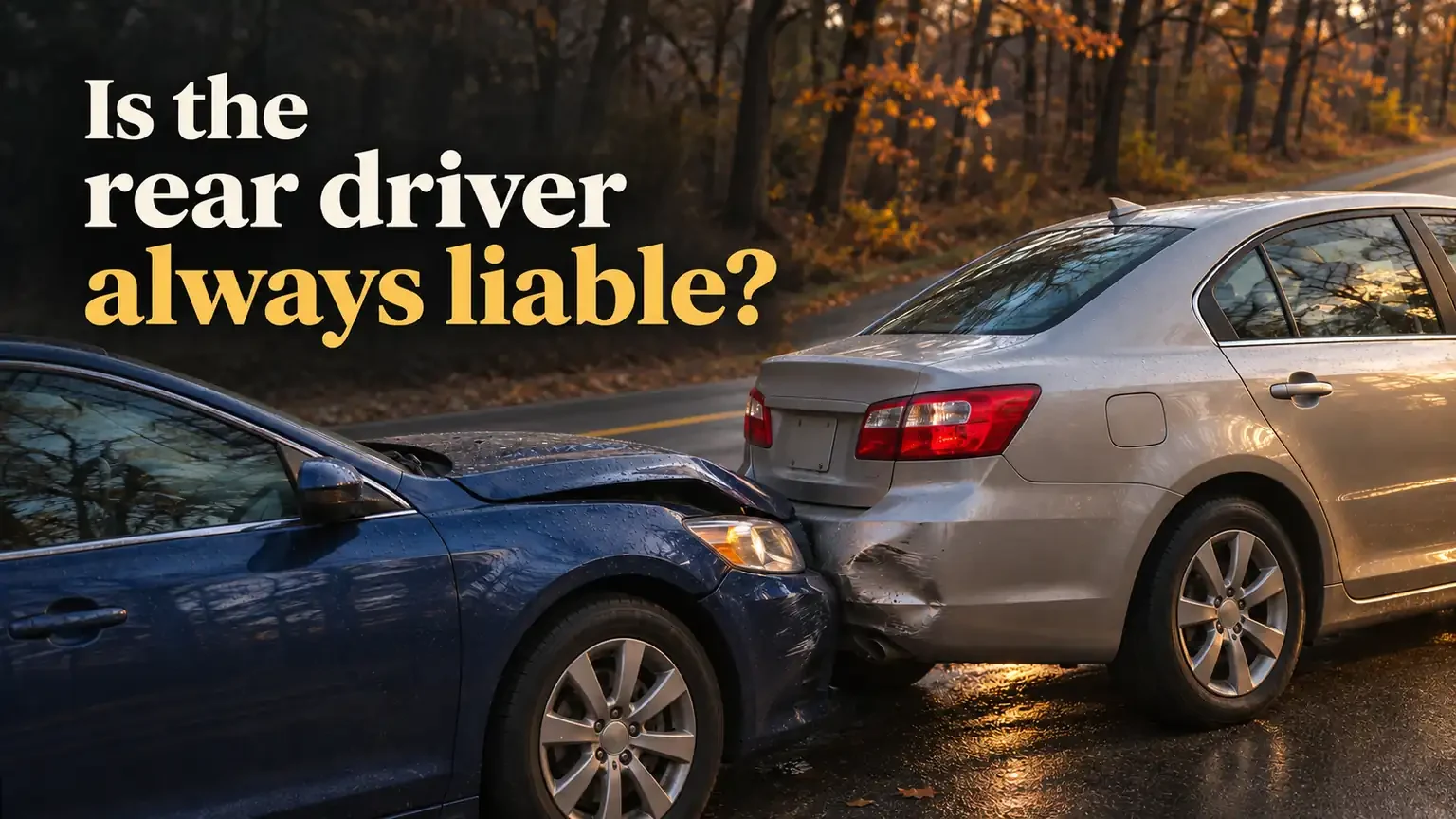
No. In Michigan, rear-end collisions follow the concept of prima facie negligence, meaning the driver in the back that rear-ended the other one is presumed negligent. That presumption can be overturned with evidence, however.
Presumed negligence doesn’t automatically establish liability, prove that the crash caused an injury or determine the available benefits and insurance coverage. Liability needs to be proven for third-party claims to be successful.
How does Michigan's rear-end collision law work?
Michigan’s rear-end collision rule in MCL 257.402 treats rear-end collisions as prima facie negligence, meaning the rear driver is presumed negligent until proven otherwise.
Even when the statute applies, it does not automatically prove:
- who is ultimately at fault
- whether the crash caused an injury
- whether an injury qualifies as a serious impairment of body function
- the amount of recoverable damages
- which insurer or policy may apply
The presumption of negligence can be overturned if there is evidence showing the driver in front or another party is at fault.
The Michigan Supreme Court has recognized in cases such as White v. Taylor Distributing Co. that a sudden emergency not of the rear driver’s own making can rebut the presumption of negligence. In that case, the driver said the collision was caused by him unexpectedly blacking out. The court left the issue for a jury because the evidence raised questions about whether the blackout was truly unexpected and whether he was negligent in continuing to drive.
The statute also has a nighttime limitation. From one hour after sunset until one hour before sunrise, the owner of the front vehicle cannot invoke that presumption of negligence if the vehicle didn’t have a lighted lamp or lantern reasonably visible to drivers approaching from behind. The rear driver could still be negligent or have some degree of comparative fault depending on the evidence.
Other facts that could impact the outcome include whether the front vehicle was moving in the same direction or not moving, a sudden lane change, an unsafe stop or another vehicle's role. If the injured person shares fault, Michigan's comparative-fault statute generally reduces tort damages by that percentage and generally bars noneconomic damages if the injured person's fault is greater than 50%.
No-fault PIP benefits
Personal injury protection (PIP) benefits are no-fault insurance benefits available to eligible people under MCL 500.3105. After an auto accident, PIP benefits may be claimed to cover economic damages from an injury, without establishing who was at fault. How much can be recovered and which insurer pays the benefits depend on the facts of the case and the insurance coverage available to the injured person.
Under MCL 500.3107, PIP may pay for reasonable and necessary medical expenses, work loss and replacement services. Attendant care and mileage for medical treatment may be part of an allowable-expense claim.
Third-party bodily injury claim
A third-party claim is when someone injured in a crash files a claim against the other driver or a separate at-fault party. These claims, under MCL 500.3135, are used to recover noneconomic damages related to an injury, or excess economic loss beyond what can be recovered through PIP. This could be pain and suffering, emotional distress, loss of enjoyment or other factors.
Claims for noneconomic damages require an injury that results in death, permanent serious disfigurement or a serious impairment of body function. For a Michigan resident, that injury threshold does not apply to a claim for excess economic loss. Serious impairment is an objectively manifested impairment of an important body function that affects the person's ability to lead a normal life.
The vehicle owner may also be liable if the driver was using the vehicle with the owner's consent. This vehicle-owner liability rule does not apply to every lease or shared-vehicle arrangement.
Crashes involving a government vehicle, commercial carrier, rideshare platform or work vehicle can involve added notice rules, insurance layers, statutory defenses or federal regulations. Michigan Legal Center's Michigan car accident claim guide explains how PIP benefits, vehicle damage and an injury claim can proceed along different paths.
What evidence matters after a Michigan rear-end accident?
The most useful evidence shows how the impacts happened, what each driver could see and do and whether the injuries followed the collision. The first priority at the scene of a crash is to get necessary medical help and report the crash to the police. When it is safe to do so, take photographs of the vehicles, damage, skid marks, debris, road conditions and other important details.
It often falls into one of these categories:
- Scene photos, vehicle positions, impact points, video, dashcam footage, witness accounts, road conditions and timing can determine the sequence of events in the crash.
- Damage photographs, repair estimates, salvage records, brake light evidence and other vehicle evidence can help show how the crash happened.
- Police reports, 911 calls, EMS records, admissions and recorded statements can provide leads, but they don’t automatically decide liability.
- Traffic camera footage, business surveillance, phone or app records, work records, dispatch logs and telematics may need to be preserved since they are held by other people.
In a multiple impact crash, evidence can show what the first impact was, how it led to the other crashes and who else could be at fault.
Evidence needs to be preserved before it’s lost. Video may be overwritten, vehicles may be repaired or salvaged, electronic data may be lost and witnesses may become harder to locate.
Michigan Legal Center's post crash guide provides a more detailed checklist of important evidence. An attorney can investigate the scene, request video, preserve data, interview witnesses, review insurance policies and retain qualified experts.
How are injuries and daily life changes proved?
Medical records and other evidence may be needed to prove that the crash caused a specific injury, how it affected daily life and the value of the claim. Medical evidence, a reliable treatment history and proof of how the injury affected work and daily life can all be significant.
Useful proof may include:
- when symptoms began and how they changed
- what the person reported during examinations
- objective findings in medical records and imaging
- treatment recommendations and follow-through
- work restrictions, missed time and wage records
- changes in household tasks, sleep, driving, recreation and personal care
A documented pre-existing condition does not automatically defeat a claim if the crash caused a new injury, aggravated the earlier condition or changed the person's ability to function. Records from before and after the collision may help answer that question.
For third-party noneconomic damages, the serious-impairment standard requires an objectively manifested impairment that affects the person's general ability to lead a normal life.
When should you call a Michigan Legal Center attorney?
A crash that only caused property damage may not require a lawyer. Legal help may be needed anyway if:
- fault is disputed by the rear driver
- the crash involved several impacts or several drivers
- a commercial, government, rideshare or work vehicle was involved
- the injuries required surgery, caused lasting limitations or led to significant missed work
- prior medical conditions complicate causation
- an insurer requests a recorded statement or broad release
- PIP, uninsured motorist or underinsured motorist benefits are denied or underpaid
An insurer paying for vehicle repairs does not resolve a separate injury claim. An early settlement offer may not account for every supported loss, while a signed release may waive claims and affect future recovery. Michigan Legal Center can help you avoid signing a release before your injury claims and available coverage have been reviewed. Michigan Legal Center's Settlement Review identifies offers, releases, evidence, insurance and related claims to examine before estimating a case's value.
A Michigan Legal Center attorney can:
- analyze whether the rear-end presumption applies and how it may be challenged
- identify comparative fault issues and other potentially responsible parties
- coordinate PIP, bodily injury, uninsured motorist and underinsured motorist claims
- preserve time-sensitive evidence
- collect medical, employment and daily life proof
- address insurer requests, releases and deadlines
If you were injured in a Michigan rear-end collision, contact Michigan Legal Center. Michigan Legal Center can review the crash sequence, insurance, medical evidence and deadlines that may affect your options.