
Car Accident While Working in Michigan: No-Fault, Workers' Comp, and Third-Party Claims
What claims may apply after a car accident while working in Michigan?
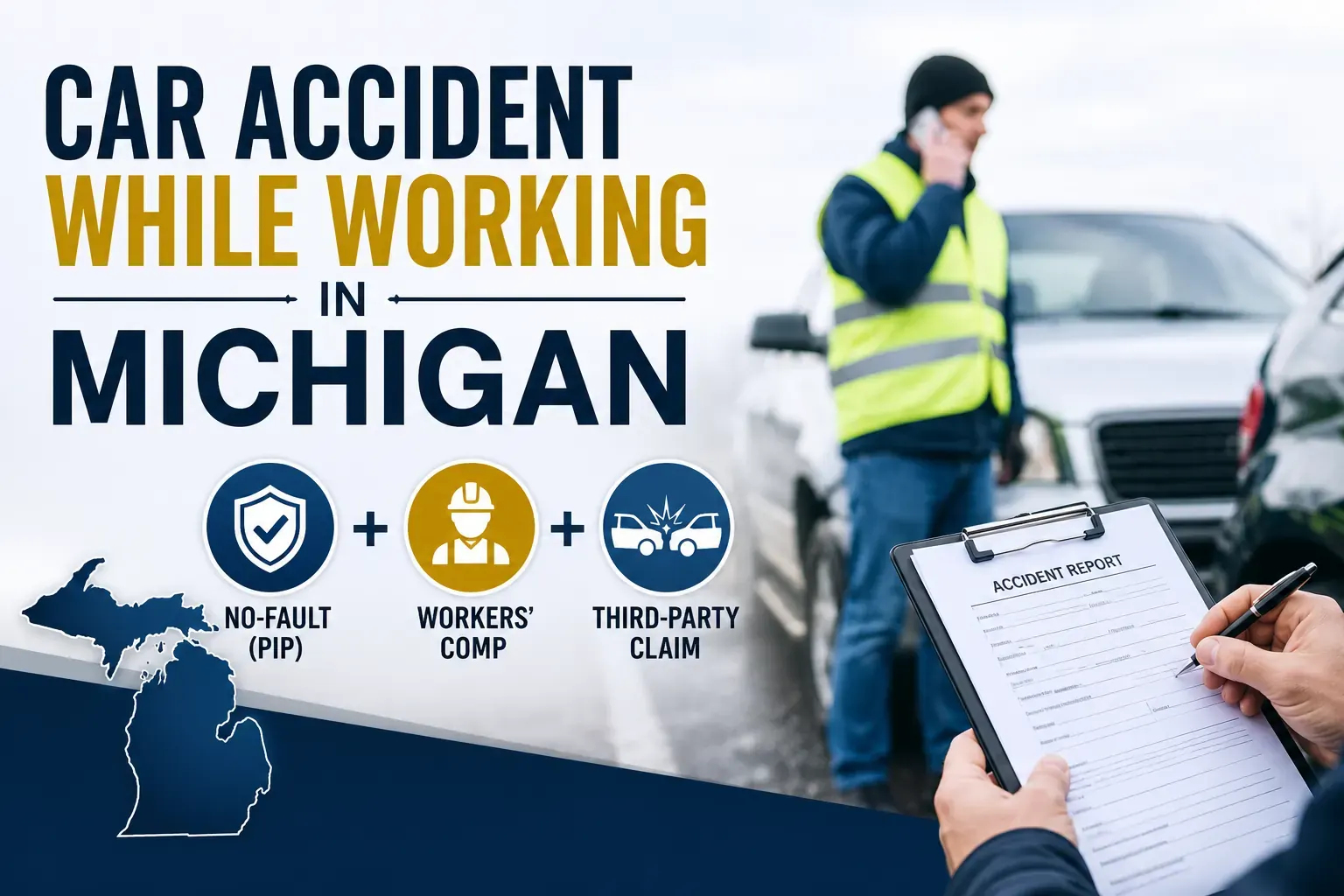
If you were hurt in a car accident while working in Michigan, workers' compensation, no-fault PIP benefits, and a third-party injury claim may all need review. Each addresses different losses and may involve different insurers, deadlines, and evidence. One open claim does not automatically protect the others.
Who this commonly affects: Delivery drivers, truck drivers, home health workers, sales representatives, employees traveling between job sites, people using company vehicles, employee passengers, roadside workers, and some app-based drivers. Which claims apply depends on the purpose of the trip, worker status, vehicle ownership, available coverage, and fault.
How do workers' comp, no-fault, and third-party claims differ?
They serve different purposes and should not be treated as a single claim.
| Claim track | What it may address | Main caution |
|---|---|---|
| Workers' compensation | A work-related injury, medical care, wage-loss benefits, rehabilitation, and work restrictions | It does not provide pain-and-suffering damages, and its payments may affect other recoveries. |
| Michigan no-fault PIP | Motor-vehicle benefits that may include allowable medical expenses, work loss, and replacement services | The responsible insurer and available medical coverage depend on priority rules, policy elections, vehicle facts, and exclusions. |
| Third-party injury claim | Fault-based damages against an outside driver or another legally responsible party | Fault, insurance, damages, Michigan's motor-vehicle threshold, and workers' comp reimbursement issues may all matter. |
The same medical bill or wage loss generally should not be paid twice. That is why the claims may need to be coordinated even when more than one is available.
When does workers' compensation apply to a work-related crash?
Under MCL 418.301, workers' compensation may apply when an employee's injury arises out of and in the course of employment. In a vehicle case, that can include making deliveries, traveling between job sites, driving a company vehicle for work, riding as a passenger for a work assignment, or performing roadside duties.
Workers' comp may provide medical, wage-loss, and rehabilitation benefits when the legal requirements are met. It does not provide damages for pain and suffering. Michigan law also makes workers' compensation the exclusive remedy against the employer for many work injuries, subject to the narrow intentional-tort exception in MCL 418.131.
An ordinary commute is different from driving as part of the job. A crash on the way to or from work does not become a workers' comp case merely because employment was the destination. But travel facts can create exceptions or disputes. For example, section 418.301 includes a limited presumption for an employee on the work premises within a reasonable time before or after work. A special work errand, travel between work locations, or employer-directed trip also deserves a fact-specific review.
Worker classification matters too. Workers' compensation should not be assumed for every contractor or gig driver; the working relationship and the facts surrounding the trip require individual review.
For a broader explanation of the work-injury system, see Michigan Legal Center's workers' compensation practice page.
How do no-fault PIP benefits fit with medical bills and wage loss?
Michigan no-fault PIP is the motor-vehicle benefit track. Under MCL 500.3105, qualifying PIP benefits do not depend on proving who caused the crash. Under MCL 500.3107, those benefits may include allowable expenses for care, recovery, or rehabilitation, work loss, and replacement services. The amount of PIP medical coverage available can depend on the coverage selected and other policy facts.
When workers' comp and PIP cover the same work-related crash, the issue is often coordination rather than choosing one claim and ignoring the other. MCL 500.3109 requires benefits provided or required under state or federal law to be subtracted from PIP benefits otherwise payable for the injury. DIFS Bulletin No. 81-03 discusses that interaction in the workers' compensation context.
Employer vehicles have a specific priority rule. Under MCL 500.3114(3), an employee, the employee's spouse, or a qualifying household relative who is injured while occupying a vehicle owned or registered by the employer receives the PIP benefits to which that person is entitled from the insurer of the furnished vehicle. Ownership, registration, occupant status, worker status, and the policy still need to be verified before assuming which insurer must pay.
Do not ignore PIP paperwork merely because a workers' comp claim is open. Medical-bill denials, wage-loss forms, insurer examinations, coverage letters, and requests for releases may affect a separate part of the case. Michigan Legal Center's guide to who pays medical bills after a Michigan crash explains PIP priority in more detail.
Can you sue the at-fault driver if you were working?
Potentially. A work-related injury does not automatically erase a claim against an outside driver or another non-employer party.
MCL 418.827 allows an injured employee to pursue certain third-party liability claims even when workers' compensation benefits are accepted. It does not treat the employer or a natural person in the same employ as an ordinary outside third party. Claims involving an employer or coworker require separate analysis under workers' compensation law.
In an auto case, MCL 500.3135 also matters. Pain-and-suffering damages generally require death, permanent serious disfigurement, or a serious impairment of body function. A third-party claim may also include certain allowable expenses, work loss, or survivor's loss that exceeds applicable no-fault limits.
Possible outside parties may include an at-fault driver, a vehicle owner when the law supports owner liability, or another company whose conduct contributed to the crash. A maintenance provider or manufacturer may be relevant only when evidence connects its conduct or a defect to the crash.
A workers' compensation carrier may have reimbursement or future-credit rights in a third-party recovery under section 418.827. That is one reason to coordinate settlement negotiations and review every release before signing it. For the broader auto-claim process, see Michigan Legal Center's car accident practice page.
What deadlines apply after a Michigan car accident at work?
The claim tracks do not share one deadline.
- No-fault PIP: MCL 500.3145 generally requires a PIP action within one year after the accident unless the insurer receives qualifying written notice within one year or previously paid PIP benefits for the injury. The statute also limits recovery for older losses and tolls certain periods from a specific claim for payment until formal denial when the claimant acts with reasonable diligence.
- Workers' compensation: MCL 418.381 generally calls for notice to the employer within 90 days and a claim within two years, although the statute contains details, extensions, and exceptions that can change the analysis.
- Third-party injury claim: MCL 600.5805 supplies a general three-year limitations period for many personal-injury actions. Other defendants and claims can have different rules. Section 418.827 also gives an employer or carrier potential enforcement rights if the employee does not commence the third-party action within one year.
These summaries do not safely calculate any one person's deadline. The accident date, notice history, payments, denials, defendant, injury, and claim type should be reviewed early.
What changes in a company, delivery, or rideshare vehicle?
The vehicle, trip purpose, worker status, and app status can change which claims and policies apply.
A company vehicle can trigger the employer-vehicle PIP rule. A delivery route can create workers' comp, PIP, third-party, dispatch-record, and commercial-insurance issues. A traveling employee may need proof that the trip served the employer rather than being an ordinary commute.
For Uber, Lyft, DoorDash, Instacart, Amazon Flex, or another platform, save screenshots showing whether the app was off, available, matched to a trip, carrying a passenger, or making a delivery. Preserve trip records, route details, messages, insurance notices, and payment records. App status can affect insurance, while worker classification can affect whether workers' compensation is available.
What evidence should you save after a work-related car accident?
Save records that establish the crash, the work connection, the injury, and every insurer's response:
- Police report number and witness information.
- Photos or video of the scene, vehicles, injuries, road conditions, and company markings.
- Employer incident report and written notice of the injury.
- Vehicle ownership, registration, and insurance information.
- Medical records, bills, work restrictions, disability slips, and therapy notes.
- Wage records, schedules, missed-work records, and benefit checks.
- Route, dispatch, delivery, load, trip, or app-status records.
- Adjuster texts, emails, letters, denials, and recorded-statement requests.
- Dashcam, surveillance, worksite-camera, tow, repair, rental, and inspection records.
- Every release, authorization, settlement paper, or benefits election sent for signature.
One of the biggest mistakes is allowing one adjuster to define the entire case. A workers' comp carrier may focus on treatment and wage checks. A PIP insurer may focus on priority, coverage, and proof. A liability insurer may seek a release before the injury, wage loss, reimbursement, and insurance picture is complete.
Do not assume that one claim protects the others. Avoid signing a broad release or medical authorization until you understand which claim it affects. Michigan Legal Center's post-crash checklist covers additional evidence and insurer-contact steps.
Michigan Legal Center, the Law Offices of Christopher Trainor & Associates, can identify the possible claim tracks, determine which insurers should receive notice, review denials and releases, coordinate workers' comp and PIP benefits, and preserve evidence for a possible third-party claim. Contact Michigan Legal Center for a case evaluation after a work-related crash.