
What if my injuries may affect me for years after a Michigan crash?
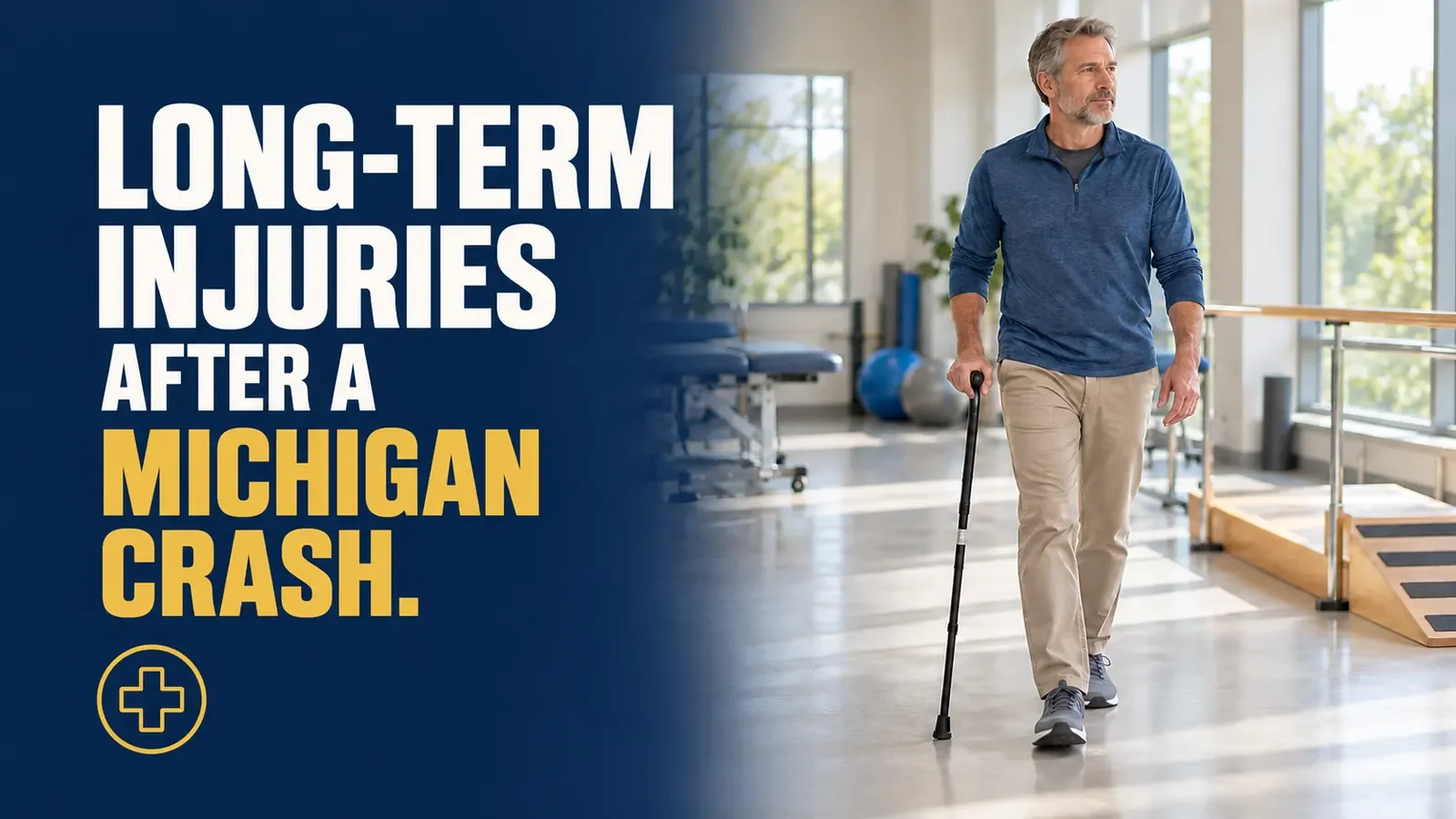
You may be able to recover damages for injuries years after a crash if they’re still affecting you. Depending on the case, you might be looking for money from insurance benefits, third-party claims or both.
What can insurance cover during a long recovery?
Michigan personal injury protection (PIP) benefits might cover necessary care as bills arise and some lost income. This applies to any accident if the injured person or their family has the proper insurance and the injury qualifies under Michigan law.
Your care may involve appointments and rehabilitation, help with personal tasks or both. If PIP applies, medical benefits can cover reasonable charges for care, recovery and rehabilitation. Just having a long-term prognosis doesn’t mean your care will be paid for life. The individual expenses need to qualify and meet the medical coverage and remaining limits available to you.
Long term payments come in the form of a projected care plan which pays out overtime instead of a lump-sum payment.
The kind of help you need also matters. Assistance with bathing, dressing or medically necessary supervision falls under attendant care. Attendant care could be provided by a family member, but how much they get paid depends on the type of care, how much it would cost, available coverage and other rules.
Ordinary household tasks, such as laundry or cleaning, qualify as replacement services if the injured person would have done it themselves but can’t now. PIP replacement services only cover expenses for the first three years after the crash, up to $20 per day. It requires a record of the task, who provided the help and how much time it took.
Ask your treating providers to explain the help they recommend, how often it is needed and when they expect to reassess it. A recommendation helps describe the need, it doesn’t guarantee that every charge will be paid.
How do PIP medical limits affect continuing care?
Michigan has different PIP medical coverage levels for insured people to choose from, and a limited policy may run out while care continues. Unlimited coverage has no aggregate medical dollar cap, but expenses must still meet the payment requirements. The coverage choices in MCL 500.3107c should be read together with the allowable-expense requirements.
Do your vehicle and role affect your PIP options?
Yes. PIP applies to injuries from using a motor vehicle depending on entitlement and available insurance. The vehicle definitions in MCL 500.3101, coverage requirements in MCL 500.3105, eligibility exclusions in MCL 500.3113 and insurer priority rules in MCL 500.3114 affect whether you can receive benefits and which insurer handles the claim.
- In a car, truck or other qualifying motor vehicle: A driver or passenger may have a PIP path, including in a van, rideshare vehicle, bus or RV when its classification and the crash facts fit. Which insurer must handle the claim, and how much medical coverage is available, require review of the applicable policies, household coverage, exclusions and elections. The PIP priority guide explains why the answer may differ from the vehicle you occupied.
- On a motorcycle: A motorcycle does not itself count as a motor vehicle under this rule. If the accident shows evidence that a separate qualifying motor vehicle was involved, the special PIP insurer priority may apply to an injured operator or passenger even if the vehicles did not collide. An accident involving only motorcycles, or a single-motorcycle crash, does not use that motor-vehicle priority. Coverage still depends on entitlement, the listed policies, exclusions and medical limits. See MCL 500.3114(5)-(7) and the motorcycle coverage guide.
- On a bicycle or e-bike: If a qualifying motor vehicle was involved, review any applicable own or household auto policy before the Michigan Assigned Claims Plan, which can assign an insurer when no higher-priority PIP coverage is available. Do not assume the striking driver's insurer pays first. If only bicycles or qualifying e-bikes were involved, the motor-vehicle trigger for PIP is absent; review other possible coverage separately. A modified e-bike's legal classification may need review. See MCL 500.3101, MCL 500.3115 and the bicycle and e-bike guide.
- Walking: A pedestrian injured in a qualifying motor-vehicle accident may also need an own or household policy review before assigned claims. PIP entitlement and exclusions still have to be checked; the driver's insurer is not automatically first. Under MCL 500.3115, an eligible person injured outside a motor vehicle claims through assigned claims when applicable own or household coverage does not apply.
The crash report, photographs, vehicle and policy information and documents showing where you lived can help resolve this fork. If no qualifying motor vehicle was involved, different liability laws might apply depending on the facts of the case.
What happens if you can’t go back to the same job?
For eligible claimants, PIP may replace some lost income during the first three years after the crash. A separate claim may recover income loss greater than PIP limits if another party is legally responsible. Whether an injured person qualifies depends on the work restrictions given by the provider, what the employer can offer within them and the actual hours and pay.
Work-loss benefits through PIP only cover the first three years after a crash. There is a maximum for each 30-day period and a 15% reduction for its tax advantage. Reasonable proof of a smaller tax advantage can reduce that adjustment under MCL 500.3107. Partial earnings and the applicable maximum also affect the benefit amount. The three-year benefit period is different from a deadline to give notice or bring a claim.
These benefits only apply to work that you would have done, not work that you could have done. In Hannay v. Department of Transportation, the Michigan Supreme Court established that statutory work loss requires evidence of income the injured person would have earned. Your former salary is not necessarily the ceiling, but a potential career change or raise needs supporting evidence.
Useful records can include pay history, tax returns, employer communications, scheduled work and documentation of an expected promotion or job offer. A self-employed person should also gather business records showing the work lost and income change. The purpose is to connect the medical restrictions to a supported earnings loss, rather than guess at a lifetime total.
What losses can a separate claim cover?
Under motor-vehicle liability rules, a third-party claim against someone legally responsible might be used to recover medical expenses and work loss beyond applicable PIP limits, including future losses. Pain and suffering has a separate injury threshold under Michigan law.
The other party isn’t responsible for a bill just because it was denied or unpaid. You still need to show that the crash caused a reasonable loss and that the other party was at fault. The excess-loss provision in MCL 500.3135 preserves specified excess-loss claims explained in the excess economic loss guide.
Ordinary household replacement services are not recoverable as excess economic loss under section 3135(3)(c), as the Michigan Supreme Court held in Johnson v. Recca. Household chores aren’t automatically considered recoverable medical care. A need for continuing household help should not be treated as automatically payable through that claim. This is another reason to distinguish household chores from personal attendant care.
What injury threshold applies to pain and suffering?
The threshold applies to serious impairment of a body function or serious permanent disfigurement. A serious impairment must be objectively manifested. Someone else must be able to observe or perceive it through actual symptoms or conditions. It must involve a body function important to that person and affect their general ability to lead their normal life. Duration can matter, but there is no minimum duration for it to apply. Temporary symptoms or a diagnosis alone do not decide it.
Permanent serious disfigurement is a separate threshold branch. Meeting a threshold also does not establish another party's liability or defeat applicable defenses. These requirements appear in MCL 500.3135.
Describe specific changes, including whether you can dress yourself, drive, care for your children, perform your job or take part in activities that mattered to you before the crash. Concrete examples make the effects easier to understand than the phrase “my life has changed.”
What records should you gather while treatment continues?
Document care, income changes and daily limitations now. You can begin a claim review while your providers are still assessing recovery. Bring what you have and identify what is still uncertain, including:
- discharge instructions, treatment recommendations, care logs, bills and records of incurred charges
- work restrictions, pay records, employer correspondence and evidence of work you expected to perform
- crash report, vehicle and scene photographs, your residence information, applicable policies, declarations, medical selection forms and endorsements
- benefit statements, denials and communications about unpaid expenses
- dated examples of activities you need help with or can no longer do as before
What should you review before settling?
If an offer arrives while your future care or work situation remains uncertain, have the proposed release and those unresolved needs reviewed together. The guide to what to review before accepting a settlement offer can help you prepare for that discussion.
Michigan Legal Center can help you review a proposed release so unresolved care and income needs are considered before you settle.
To discuss a serious road-crash injury, contact The Michigan Legal Center. Bring the records you have about your care, work, vehicles, coverage, claim dates and any offer so the review can start with your actual situation.