
Hit by Farm Equipment on a Michigan Road: Who Pays?
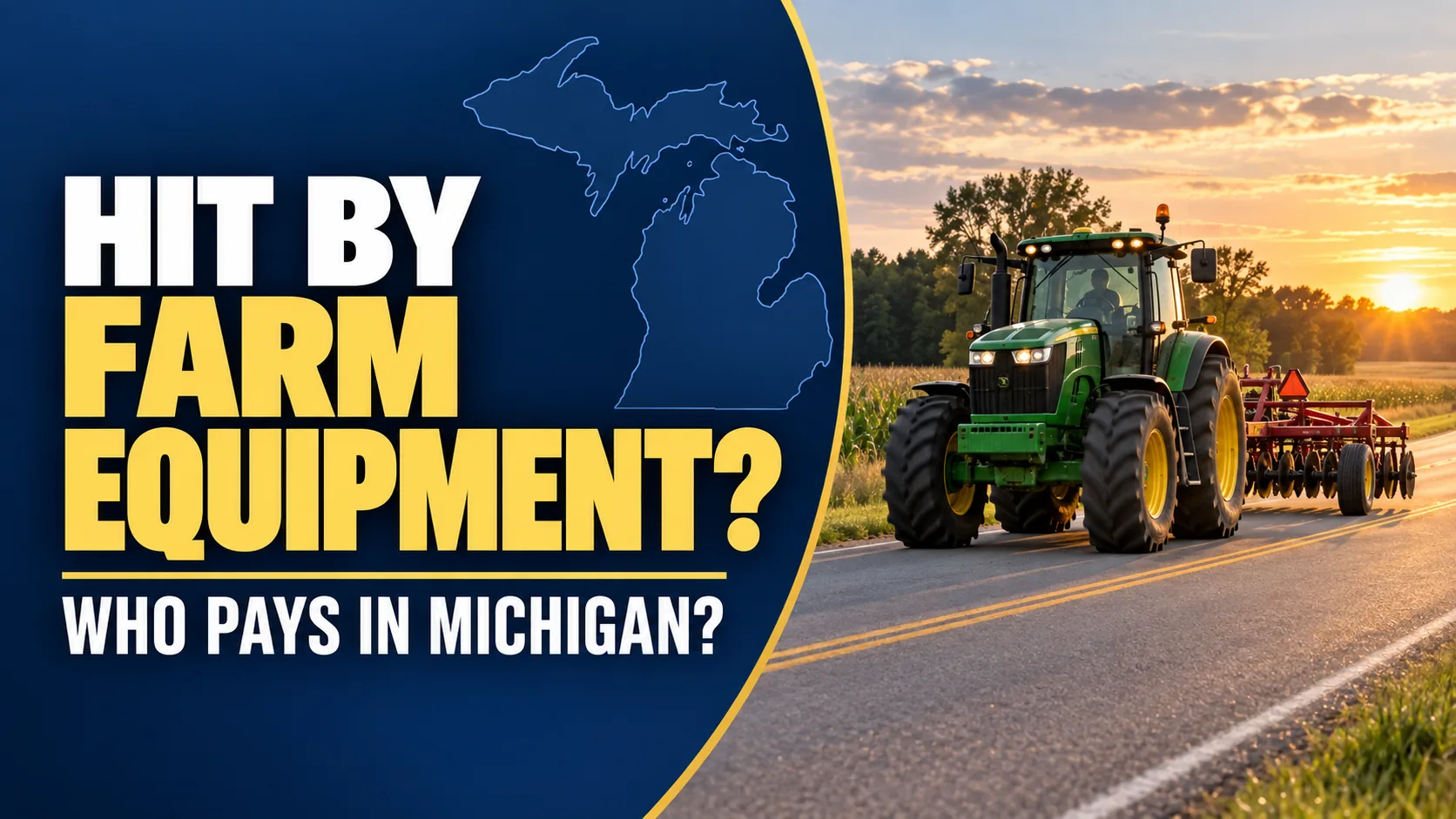
If you were injured in a collision with farm equipment, Michigan no-fault insurance may pay covered medical bills and lost wages. In some cases, you may need to file a claim against a negligent equipment driver or owner. Even though no-fault insurance requirements don’t always apply to farm equipment, someone can still be considered negligent.
Whose insurance pays your medical bills and lost wages?
For eligible Michigan residents injured in a car, personal injury protection (PIP) coverage under Michigan no-fault insurance will most likely apply. It covers the person named as the insured as well as their spouse and other family members living with them. Michigan's priority rules in MCL 500.3114 determine which coverage comes first in special cases such as employer-owned vehicles.
Under MCL 500.3105, PIP benefits don’t take fault into consideration after a crash. They are meant to cover economic damages from crash-related injuries such as medical bills and lost wages described in MCL 500.3107. Any selected coverage limit under MCL 500.3107c applies to PIP medical benefits. Wage-loss benefits have separate monthly and three-year limits under MCL 500.3107.
The tractor's insurance status does not answer your PIP question by itself. In Michigan, registration-exempt farm tractors and other qualifying agricultural equipment, called "implements of husbandry," aren’t considered motor vehicles under the no-fault law. Even when the farm equipment is excluded, a car involved in the crash can allow an eligible occupant to claim PIP benefits.
That distinction also matters if the injured person was walking, riding a bicycle or on a motorcycle. A farm-owned pickup or road truck isn’t excluded just because a farmer owns it and a collision between a farm implement and a pedestrian doesn’t automatically create a PIP claim.
If there is no applicable personal or household PIP coverage, an eligible occupant may claim benefits through the Michigan Assigned Claims Plan. Residency, required insurance and other eligibility rules can impact the coverage established under MCL 500.3114 and MCL 500.3113.
Who is at fault in a farm-equipment road crash?
Fault depends on what each driver did or could see before the collision. Three situations deserve particular attention.
A car is passing farm equipment turning left. Before turning, the equipment driver is responsible for determining that the movement can be made safely and giving the required signal. A signal alone does not make the turn safe. The passing driver needs enough visibility and room to complete the pass without interfering with oncoming traffic or the vehicle being passed according to MCL 257.648 and MCL 257.638.
The equipment's slow speed does not, by itself, permit a driver to ignore a marked no-passing zone. The no-passing zone rule in MCL 257.640 requires drivers to obey those traffic controls. Determining fault may require knowing where the pass started, if a signal could be seen, where the vehicles were and whether the road markings allowed the maneuver.
Equipment coming from a private road or driveway is required to stop and yield to approaching traffic under MCL 257.652. Photographs of the access point and the view in both directions may show what happened and prove fault.
When a driver comes up on equipment that is hard to notice, fault may depend on how visible the equipment was. Check the lights, reflectors and slow-moving vehicle triangle and make sure nothing is blocking them from view.
Michigan's agricultural-equipment rules depend partly on when the machine was made. Farm implements made before January 1, 2007, require specific front and rear lamps in low-light conditions under MCL 257.695. Newer implements need to meet the agricultural lighting and marking standards adopted in MCL 257.684a.
The approaching driver's speed and attention also matter. Michigan's basic speed law requires a careful, prudent speed and the ability to stop within the clear distance ahead.
More than one person can share responsibility. Under MCL 600.2959, an injured person's share of fault can reduce damages. Being more than 50% at fault means you won’t be able to claim anything for noneconomic damages from third-party claims.
Can you bring a claim against the operator or equipment owner?
Yes. You may have a claim against the operator if their negligence caused your injuries. The equipment owner may also be responsible depending on the circumstances. Ownership alone does not make someone a legally responsible owner.
Being exempt from ordinary no-fault requirements does not automatically protect a tractor owner from that liability. In Harder v. Harder, the Michigan Court of Appeals held that a farm tractor could be a motor vehicle for the owner-liability statute by using a different definition from the No-Fault Act.
The equipment's classification can also affect a claim for pain and suffering. Where Michigan’s motor-vehicle injury threshold applies, recovery for noneconomic losses such as pain and suffering requires death, serious impairment of body function or permanent serious disfigurement. Because the no-fault definition excludes qualifying farm implements, that threshold should not be assumed to govern every tractor or combine claim. Whether the threshold applies depends on both the machine's classification and the conduct that caused the injury.
A farm liability policy may cover a responsible operator or owner, and an auto policy may matter when a covered road vehicle contributed to the crash. Coverage depends on the policy language and each vehicle's role in the crash.
A lawyer can obtain the policies and review any written denial, even if you were told the tractor has no auto insurance.
What deadlines apply after a Michigan farm-equipment crash?
For PIP, the general deadline to file a lawsuit under MCL 500.3145 is one year after the accident. Exceptions can apply if the proper insurer or its authorized agent received written notice of the injury within that year or previously paid benefits for the injury. Even when an exception applies, waiting can put other benefits at risk.
The Assigned Claims Plan requires notifying the Michigan Automobile Insurance Placement Facility within one year of the accident under MCL 500.3174. The Michigan PIP deadline rules are separate from the deadline for a lawsuit against the operator or owner, which is generally three years after the injury.
What should you save and do after the crash?
Once emergency needs are addressed, start collecting evidence and preserve what you already have. Don’t step into traffic or put yourself in an unsafe position to collect evidence.
- Save photographs and identifying details, including the make, model and manufacturing year. Record identifying numbers and the position of any header, wagon or other attachment.
- Photograph the lights, reflectors, rear triangle and turn signals and note if any of them were blocked from view. Include road markings and the view around curves, hills and the field entrance or driveway.
- Save dashcam footage, witness names, the locations of nearby cameras, vehicle positions and the police report number to establish the sequence of events.
- Record operator and owner details, insurance information and letters or messages about the crash.
- Keep treatment records, bills, missed work information and records of help needed during recovery.
Keep original photographs and video files. If equipment is modified, repaired, sold or being used again, seek legal help to preserve evidence.
Michigan Legal Center can help preserve equipment evidence, identify potentially responsible parties and review the policies that may cover the crash. If you were injured in a Michigan farm-equipment road crash, contact Michigan Legal Center before signing a release or accepting a coverage denial as final.