
Can You Get Compensation for PTSD After a Michigan Car Accident?
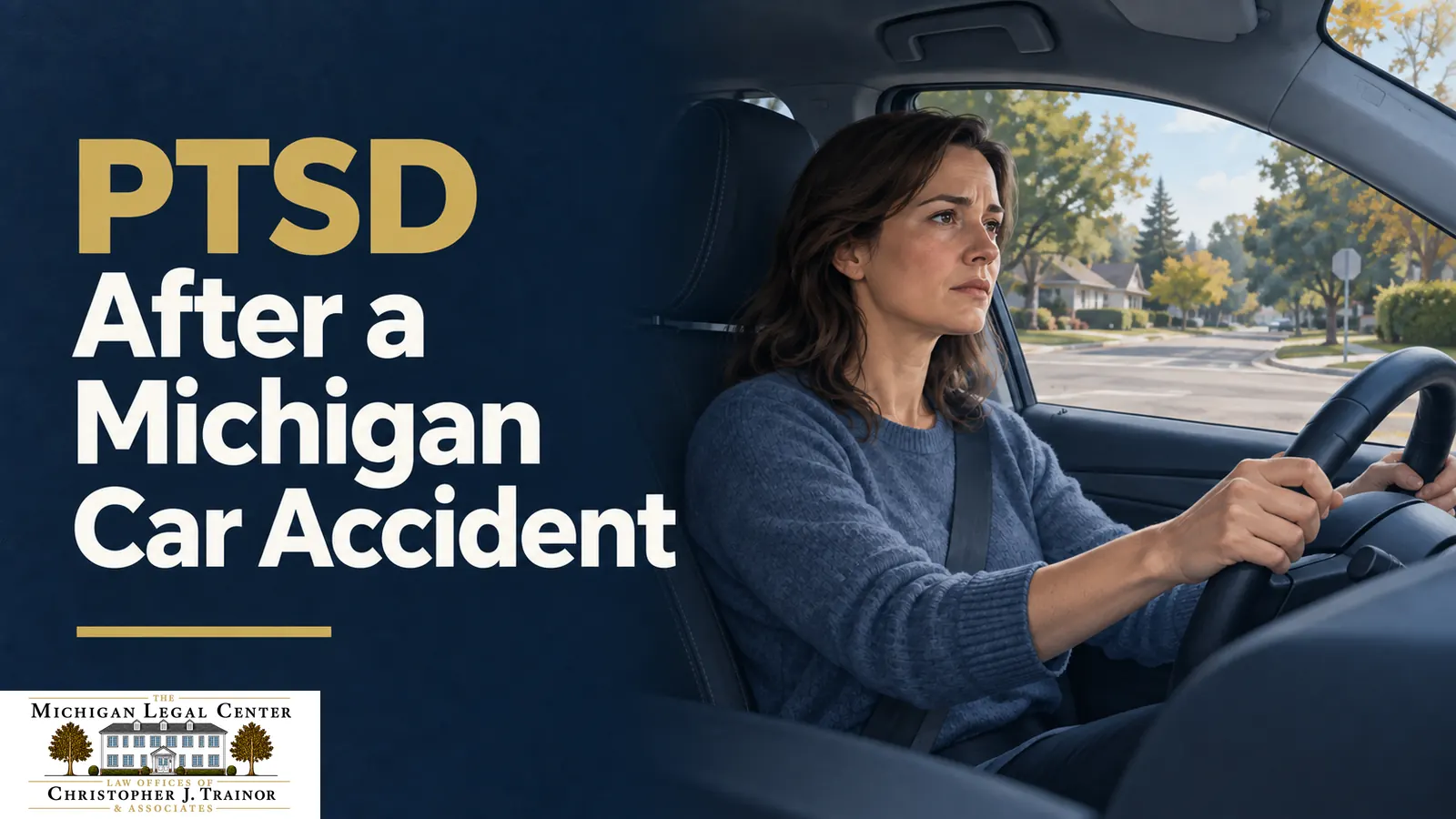
Yes. Car accidents can be stressful, dangerous and traumatic, and in some cases lead to someone developing post-traumatic stress disorder (PTSD). If you can prove that your PTSD was caused by the accident, you might have a claim.
PTSD related pain and suffering damages would have to be recovered through third-party claims against someone at fault for the crash. Qualifying personal injury protection (PIP) benefits may cover treatment.
How is PTSD diagnosed after a car accident?
Being able to walk away from a collision doesn’t mean you’re ready to drive again. You might be struggling with nightmares, avoiding the intersection where the crash happened or losing focus at work. Understanding what is causing these issues is the first step toward getting appropriate care and explaining any injury claim.
Symptoms can also emerge at different times. They could appear quickly or weeks after a crash.
Get a qualified mental health professional to evaluate your symptoms, their duration and their effect on your life. PTSD involves a particular pattern of symptoms and impairment and can’t be established from one difficult drive or a few restless nights.
The PTSD diagnostic criteria include symptoms lasting more than a month. Regardless, don’t wait to ask for help. Get medical care as soon as you need it. Tell your medical provider about symptoms that concern you now, including disrupted sleep, unwanted memories, avoidance or difficulty functioning. They can assess what’s happening and what care you need.
Some tools such as the VA National Center for PTSD assessment may identify or track possible PTSD symptoms. Tools like this can support a provisional diagnosis, but don’t replace a professional assessment.
Assessment from a medical professional matters since PTSD and a traumatic brain injury can occur together, and symptoms such as sleep problems or poor concentration can overlap. They are distinct conditions.
The separate guide to traumatic brain injury after a Michigan accident explains that injury in more detail.
How do you connect PTSD to the crash?
Proving the crash caused the condition requires more than “I felt this way after the accident.”
PIP benefits in Michigan only apply to injuries sustained from motor vehicles under MCL 500.3105. This usually means an auto accident. A PTSD diagnosis does not, by itself, establish that Michigan’s PIP injury requirement is met.
Establishing that connection usually involves giving a medical provider an honest account of what happened in the crash, when you first noticed symptoms, when you sought care and how your condition changed. Be sure to include relevant records from earlier and explain other events or conditions that may affect the assessment, including already existing anxiety, PTSD or other mental health treatment.
Damages can apply to conditions that already existed but were made worse by the crash, if evidence supports it and the other claim requirements are met. The question is what additional harm the crash caused, rather than assuming every current symptom began there.
For the broader issue, read the Michigan Legal Center guide to preexisting injuries and Michigan car accident claims.
How can PTSD meet Michigan’s serious-impairment threshold?
For a third-party pain-and-suffering claim to be valid, the injuries have to meet Michigan’s injury threshold. A diagnosis alone does not establish that threshold.
Specific before and after details give a clearer picture when establishing the crash caused the condition. Think about what you could do before, what has become difficult, how often the problem occurs and what help you now need. Useful records and observations may include:
- trips you canceled, rides you needed or routes you avoided because of symptoms
- missed shifts, documented changes in duties or problems concentrating that affected specific tasks
- recurring sleep disruption and its effect on responsibilities you previously handled
- clinical notes, treatment plans and changes over time, including improvement and remaining difficulties
- specific changes noticed by a partner, family member or coworker who knew your routines before the crash
Keep the account accurate and include better days as well as difficult ones. The point is to explain how your life changed. For a pain-and-suffering claim under Michigan’s injury-damages law relying on serious impairment of body function, that comparison is only part of the test.
Under Michigan’s serious-impairment definition, the impairment must also be objectively manifested, meaning it is observable or perceivable by someone other than you from actual symptoms or conditions. It must affect a body function that has great value, significance or consequence to you, and influence some of your capacity to live in your normal manner. A diagnosis, diary or family member’s account does not automatically establish all these elements.
The mind and nervous system count as body functions. A mental or emotional injury caused by a physical injury, or one that produces physical symptoms, may qualify as a serious impairment of body function.
The evidence must still satisfy the injury-damages requirements, including every element of the serious impairment test.
What compensation may be available?
Possible compensation depends on the type of loss and the requirements of the particular claim. Compensation for medical bills, missed income and psychological suffering follows different rules.
Treatment costs
PTSD treatment can include psychotherapy, medication or both, depending on a professional assessment of your needs.
Where PIP coverage applies under MCL 500.3107, benefits can cover charges for reasonably necessary care, recovery or rehabilitation, such as therapy or other psychological treatment. A diagnosis does not make every bill payable.
The available PIP medical coverage and its limits also matter. Michigan law allows different PIP medical coverage choices, so do not assume unlimited medical benefits are available.
Lost income
If an injury prevents you from working, PIP benefits under Michigan’s work-loss provision may cover income from work you would have performed during the first three years after the accident. Statutory reductions and monthly limits apply. Work records and clinical evidence should explain the actual income loss and why the injury prevented the work.
Pain, suffering and loss of enjoyment
Pain-and-suffering damages are noneconomic, meaning they compensate for harm beyond bills and lost wages. Michigan recognizes mental anguish and loss of social pleasure as possible injury damages, when supported by the evidence.
In a Michigan auto negligence claim, recovering those damages requires proof of legal responsibility, crash related harm and the applicable injury threshold. Under MCL 500.3135, your own fault can reduce recovery, and being more than 50% at fault bars noneconomic damages.
Those damages are also barred if you were injured while operating your own vehicle without the insurance required by Michigan law.
Losses beyond PIP limits
In some cases, a third-party claim can also be used for economic damages that aren’t covered by PIP. Like other third-party claims, this requires proving another party responsible under MCL 500.3135(3)(c). Those economic loss provisions have their own requirements. See excess economic loss after a Michigan car accident for that issue.
Speak with a qualified clinician about symptoms that are affecting you, and keep your treatment, work and insurance records together. For help identifying applicable deadlines and documenting how PTSD has affected your life, contact The Michigan Legal Center.