
RV, Motorhome, and Camper Accidents in Michigan: Who Pays?
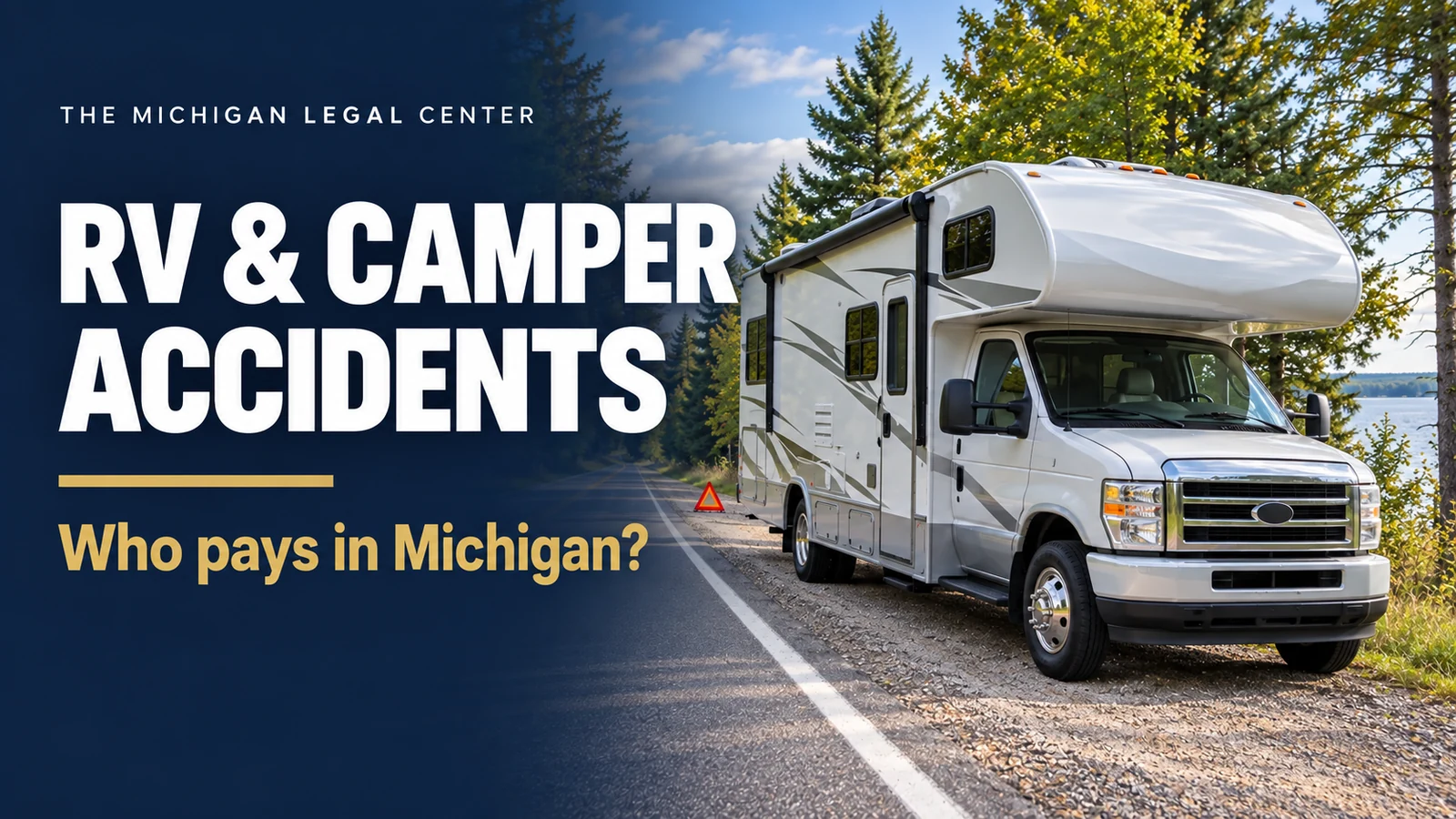
Your own or a household no-fault policy generally pays covered medical bills and lost income after a Michigan RV crash. A responsible driver may owe additional damages. Collision coverage can help pay for camper repairs.
You might treat your motorhome, RV or camper like a home on wheels, but an injury on the road and an injury while camping can raise different insurance questions.
Which campers count as motor vehicles under Michigan law?
Motorhomes usually count as motor vehicles under Michigan’s No-Fault Act. Towable campers can count too, if they meet the same legal definition: a vehicle designed or operated for highway use, powered by something other than muscle, with more than two wheels.
Under MCL 500.3101, a trailer does not need its own engine to meet that definition.
A motorhome or camper van has its own engine. A camper may also sit on a pickup, while a travel trailer or fifth wheel is pulled behind another vehicle.
A two-wheel trailer does not meet that definition by itself. But under MCL 500.3105, an injury caused by a towing vehicle can still qualify for personal injury protection (PIP) benefits.
The insurance required depends on whether the vehicle needs to be registered in Michigan and is being driven or moved on a highway.
Whose PIP insurance applies after an RV crash?
For ordinary personal RV use, your applicable personal or household PIP coverage generally comes first. Michigan’s PIP priority rules ordinarily cover the person named in the policy, their spouse, and relatives of either whose legal home (domicile) is in the same household.
Passengers might have different coverage depending on the case and aren’t necessarily covered by the RV owner.
Special rules can change the result for vehicles owned or registered by an employer or operated in the business of transporting passengers.
For more on identifying the insurer responsible for medical bills, see Michigan PIP medical bills and priority.
PIP benefits can pay qualifying expenses for necessary injury care, work loss and help with ordinary tasks the injured person would otherwise perform. Each benefit has conditions and limits. Your PIP medical coverage selection determines the medical limit; not every policy provides unlimited coverage.
You do not have to prove another driver caused the crash to claim PIP benefits. Eligibility and coverage requirements still apply. MCL 500.3105.
What if you have no applicable PIP coverage?
If no policy covers you, you might be eligible for PIP benefits through the Michigan Assigned Claims Plan under MCL 500.3172. You must submit an application and reasonable proof of loss, and eligibility rules and medical limits apply. A PIP medical opt-out or exclusion does not automatically make you eligible for this plan.
Two facts play a role in this coverage:
- PIP can be barred if an involved vehicle you own or have registered in your name lacks the required insurance. That is different from being an injured passenger who does not own a car.
- Michigan generally excludes nonresidents from PIP unless they own a motor vehicle registered and insured in Michigan. Renting an RV here does not, by itself, establish that exception.
These are PIP eligibility rules under MCL 500.3113, not a conclusion that every other claim is unavailable. If the RV was rented, keep the rental agreement and any insurance or protection documents with your own policies.
Who can be responsible for injuries after an RV crash?
A driver whose negligence causes a crash may be responsible for your injuries. This is a third-party bodily injury claim, separate from PIP benefits.
Michigan law limits what that claim can recover. Under MCL 500.3135, pain-and-suffering claims only apply to cases involving death, serious impairment of body function or permanent serious disfigurement.
A serious impairment must show itself through symptoms or conditions someone else can observe or perceive. It must affect a body function important to you and your general ability to lead your normal life. It does not have to be permanent.
Your share of fault can reduce pain-and-suffering damages and being more than 50% at fault prevents that recovery. A separate bar applies when someone was driving their own vehicle without the required insurance.
The responsible driver may also owe medical bills and lost income beyond PIP limits. Medical bills may also be recoverable if you validly opted out of PIP medical coverage or were excluded from it. Michigan residents do not need to meet the pain-and-suffering injury threshold for these economic losses, but nonresidents do.
The driver may not be the owner. Under MCL 257.401, a motorhome or towing-vehicle owner can also be liable for negligent driving with their express or implied permission or knowledge. Rental businesses and vehicle-sharing arrangements have separate liability rules.
If a camper broke loose, the hitch and safety connections may help explain why. For a trailer towed on a highway, MCL 257.721 requires suitable safety chains or devices on each side of the coupling, with sufficient strength to haul the loaded trailer.
Photograph the connections if it is safe and tell your attorney where the trailer is being kept. A separation or damaged part is a reason to investigate, not a complete finding of responsibility.
Who pays to repair a damaged RV or camper?
Collision coverage, if purchased for the motorhome or trailer, can help pay for covered crash damage, subject to the policy and deductible. PIP pays injury benefits, not repair bills.
Michigan’s mini-tort law may allow up to $3,000 for damage to a qualifying motor vehicle that insurance does not cover. Fault and required-insurance rules still apply.
If another motor vehicle hits a properly parked RV or trailer in Michigan, property protection insurance may cover the damage. Coverage depends on the vehicles and ownership involved.
What if the camper was parked or being used as a place to stay?
PIP coverage for a parked camper depends on how it was being used and what caused the injury. Under MCL 500.3106, Michigan generally excludes parked vehicle injuries unless a statutory exception applies, such as qualifying injuries while entering or leaving the vehicle. The injury must also have the necessary connection to use of a motor vehicle.
Using an RV simply as a place to stay generally does not qualify. In McKenzie v Auto Club Insurance Association, the Michigan Supreme Court denied PIP benefits for carbon monoxide poisoning while the injured person slept in a parked camper. The injury arose from using it as lodging.
Entering a vehicle to travel, or unloading belongings on arrival at a destination, can be connected to transportation. The applicable parked-vehicle exception and the cause of the injury still need to be established. In Kemp v Farm Bureau, the court allowed further proceedings on an unloading injury; it did not hold that every unloading injury qualifies.
PIP coverage for injuries caused by another vehicle striking the camper is determined by the vehicle’s role in the crash under MCL 500.3105. Being asleep inside the camper does not erase an injury’s connection to another vehicle’s operation.
Optional vacation liability or full-timer’s liability coverage may protect you if someone else is injured in or around the RV and you are legally responsible, depending on the policy. It is not automatic medical coverage for the RV owner.
What should you do after a motorhome or towing crash?
Get to safety, call emergency services and get medical care as needed. Then preserve any records you legally have access to including:
- policy declarations pages showing your coverage, vehicle identification numbers and any rental agreement or purchased protection paperwork
- photographs of the vehicles and towing connections, witness contact information and any video you already have
- medical bills, information about missed work and letters or messages from insurers
Tell your attorney as soon as possible if the motorhome or trailer is about to be repaired, sold or discarded. That gives them an opportunity to seek preservation of the vehicle and damaged parts, and to request outside video or records before they disappear.
What are the deadlines for an RV accident claim?
For PIP benefits, the general deadline to sue is one year after the accident. That deadline can be extended if the insurer received proper written notice of the injury within that year or previously paid PIP benefits for it. Separate limits on filing suit and recovering older losses still apply, so have the deadline checked promptly. MCL 500.3145.
Under MCL 500.3174, a person claiming through the Assigned Claims Plan must notify the Michigan Automobile Insurance Placement Facility within one year after the accident. That notice requirement is distinct from the lawsuit and recovery rules.
A lawsuit for property protection insurance benefits generally must be filed within one year after the accident under MCL 500.3145(5).
A negligence lawsuit against the responsible driver generally must be filed within three years after the injury under MCL 600.5805(2). Different rules or exceptions can apply, so this deadline should be checked separately from the PIP deadlines.
How can Michigan Legal Center help?
Michigan Legal Center can help protect your claim from missed deadlines and lost evidence by reviewing the applicable policies, identifying filing requirements and taking steps to preserve the RV and damaged parts. Contact our legal team with the crash date and the documents you have, including any denial or proposed release.