
Can You Sue After a Police Chase Crash in Michigan?
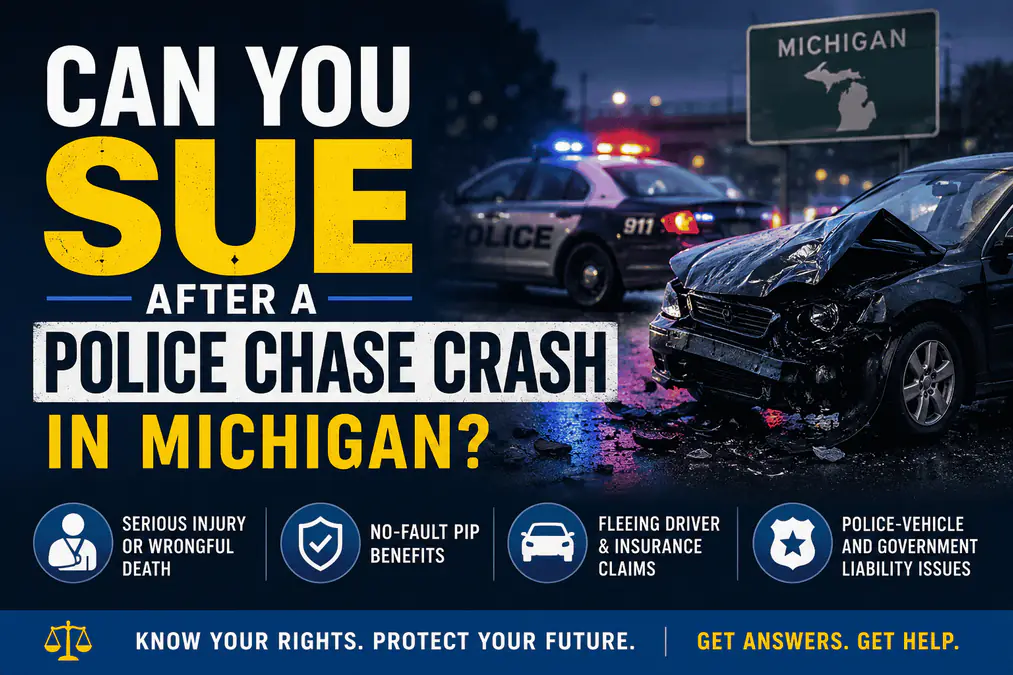
Yes. Depending on the specific facts and circumstances of the case, you may be able to sue after a police chase crash in Michigan. However, your options depend on which vehicle hit you, what the fleeing driver did, whether a police cruiser or government vehicle was involved and what insurance coverage applies.
A police chase crash is often more complicated than a typical collision between two citizens. Cases like these often involve questions of governmental immunity, police pursuit decisions and multiple layers of potential insurance coverage. Liability may depend on evidence such as the fleeing driver’s conduct, police vehicle movements, dispatch records, dashcam or bodycam video, pursuit policies, police policies and procedures, crash reconstruction and available insurance.
Because that evidence can disappear quickly, it is important to preserve it as soon as possible. Even while fault is being investigated, people injured in a Michigan police chase crash may be eligible for no-fault Personal Injury Protection (PIP) benefits, depending on the facts of the case.
Why Police Pursuit Crashes Are Different From Ordinary Car Accidents
Most car accident claims focus on the drivers involved in the collision. A police pursuit crash can be more complicated because the claim may involve a fleeing suspect, another driver, passengers, pedestrians, police officers or government agents.
The fleeing driver may be liable if they caused the crash. Fleeing from police is a crime under Michigan law, separate from civil injury claims. Michigan’s fleeing-and-eluding statute, MCL 257.602a, addresses criminal penalties and treats collisions, serious injuries and deaths during a police stop or pursuit as important aggravating facts.
A police officer or governmental agency may be involved in the claim, but the fact that police were pursuing someone does not automatically make them liable. Police liability is usually more limited, especially if the fleeing driver caused the crash and no government vehicle made contact with the injured person or directly caused the injury.
Michigan governmental immunity can bar claims where the only evidence is the decision to pursue, pursuit policy or dispatch decisions. Unless a specific exception applies, such as a claim involving the negligent operation of a government-owned motor vehicle.
What If the Fleeing Driver Hit You?
If the fleeing driver hit you or your vehicle, the case may include a third-party injury claim against that driver. This is a civil claim for noneconomic damages and is separate from any criminal charge against the fleeing driver.
For pain and suffering or other noneconomic damages after a crash, MCL 500.3135 generally requires death, serious impairment of body function or permanent serious disfigurement. The same statute may also matter for certain excess economic losses beyond no-fault benefits.
A police report, citation or early fault statement does not automatically determine the outcome of a civil case. Determining liability often requires review of the crash report, witness statements, dispatch, radio, traffic, video, vehicle damage, scene evidence, medical records and the full timeline of the pursuit.
If the fleeing driver left the scene, had no insurance, had too little insurance or cannot be identified, it may affect an injured driver’s available insurance coverage. That is where uninsured motorist and underinsured motorist coverage may become important.
What If a Police Cruiser Hit You?
Collisions involving a police car or other government vehicle can become more complicated due to Michigan's governmental motor-vehicle exception, MCL 691.1405. This exception may allow a claim against a governmental agency when bodily injury or property damage results from the negligent operation of a government-owned motor vehicle by a government employee.
Police and other authorized emergency vehicles may have limited exceptions from obeying certain traffic rules during an emergency response or pursuit. Those rules may give an officer limited traffic privileges, but they do not automatically determine who is civilly responsible for a crash.
That does not mean a police department or city is automatically responsible. Under Michigan law, MCL 691.1407, officers and governmental agencies may have immunity depending on the facts of the case. A Michigan Legal Center attorney can help you review the proper defendant, vehicle ownership, employee status, negligent operation, causation, immunity defenses and notice requirements.
Can Michigan No-Fault Benefits Apply After a Police Chase Crash?
Yes. Michigan is a no-fault state, meaning that Personal Injury Protection (PIP) insurance may apply after a police chase crash. These benefits can help cover economic losses from a crash. This would apply to certain medical expenses, wage loss, replacement services and attendant care.
PIP benefits are not the same thing as a lawsuit against the fleeing driver or a separate claim involving a police vehicle.
Determining which insurer is responsible for PIP benefits can depend on whether the injured person was a driver, passenger, pedestrian, bicyclist, motorcyclist or another person injured in the crash. It can also depend on household policies, vehicle status, residency, exclusions and priority rules under MCL 500.3114 and MCL 500.3115. For more on how Michigan decides which insurer pays first, read our guide to who pays medical bills after a Michigan car accident.
You do not need to determine PIP priority on your own. Gather the insurance papers you have and contact Michigan Legal Center so our attorneys can identify the possible insurers, issue notices to preserve and respond if an insurer denies or delays benefits.
When Uninsured or Underinsured Motorist Coverage May Matter
Uninsured motorist coverage and underinsured motorist coverage are optional insurance policies that drivers can choose to sign up for when buying car insurance; they are separate from other types of benefits. If the fleeing driver has no usable liability insurance, not enough liability insurance or cannot be identified, this type of coverage may be an important method of recovering economic damages not covered by the fleeing driver’s liability coverage.
Notice rules, proof requirements, exclusions, offsets, consent to settle provisions, arbitration clauses and suit deadlines can affect the claim. These claims often depend on the exact language of the insurance policy.
Do not sign a release with the fleeing driver or any insurer before Michigan Legal Center reviews available underinsured/uninsured coverage, possible excess economic loss and policy deadlines. For more background, read our guide to Michigan UM/UIM coverage.
What If a Police Chase Crash Killed Someone?
Fatal police chase crashes may involve several different types of legal claims, insurance issues and deadlines and should be reviewed by a Michigan Legal Center attorney as soon as possible. The estate or surviving family members may consider a wrongful death claim, no-fault survivor benefits, funeral or medical expenses, probate, government notice issues, insurance coverage and evidence preservation.
Michigan's wrongful death statute, MCL 600.2922, generally requires the action to be brought by the personal representative of the estate.
Do not assume the criminal investigation, prosecution or public attention around a pursuit crash proves or preserves a civil claim. Civil deadlines, probate steps, procedures, insurance notices, government notices and uninsured or underinsured motorist policy deadlines can still move on their own timelines.
For more on fatal crash claims timing, read Michigan Legal Center's guide to Michigan wrongful death deadlines.
Why Government Vehicle and Police Pursuit Claims Need Fast Review
Police pursuit crash claims can involve short deadlines and different notice rules, so they should be reviewed as soon as possible. The general injury and death limitations statute, MCL 600.5805, is an important resource in determining timing issues but is not the only relevant information.
PIP claims, uninsured/underinsured motorist claims, state-defendant notices and court of claims notices have different timing rules and must be reviewed separately under MCL 500.3145 and MCL 600.6431.
The safer step is early legal review. Michigan Legal Center can evaluate the claim type, possible defendants, insurance policies, government notice issues and evidence-preservation needs together.
What Evidence Should Be Preserved After a Police Chase Crash?
Important evidence can disappear quickly after a police pursuit crash. Some evidence may be in your possession, but other evidence may be controlled by police agencies, dispatch centers, businesses, insurers, towing companies, repair shops or nearby property owners.
Save what you already have or can legally access, including:
- Police report number or crash exchange information.
- Photos and videos from the scene.
- Dashcam, phone, helmet-camera or bike-camera footage.
- Witness names and contact information.
- Medical records, discharge papers, bills and work restrictions.
- Insurance cards, declarations pages, claim numbers and adjuster letters.
- Vehicle repair estimates and towing records.
- Screenshots of messages or posts related to the crash.
Michigan Legal Center may need to preserve or request evidence including pursuit policy materials, dispatch or computer-aided dispatch logs, 911 audio, dashcam video, bodycam video, patrol vehicle data, crash reconstruction files, traffic-camera footage, nearby business video and vehicle inspection or repair records.
A records request is not the same as a preservation request. The sooner attorneys can identify who may hold the evidence, the better the chance that critical video, logs and vehicle data will not be overwritten, repaired away or lost.
Talk To Michigan Legal Center After a Police Chase Crash
If you were hurt in a police chase crash in Michigan, Michigan Legal Center can review what happened, identify possible insurance coverage, preserve evidence, evaluate third party liability, review government-vehicle issues and map the deadlines that may apply.
Michigan Legal Center is the Law Offices of Christopher J. Trainor & Associates. Our attorneys handle car accident, no-fault, wrongful death, police misconduct and related civil injury matters across Michigan.
Michigan Legal Center has office locations in White Lake, Southfield, Grand Rapids, Ann Arbor, Flint, Lansing, Kalamazoo, Bay City, Gaylord and Marquette, and the firm reviews accident claims statewide. Police chase crashes can happen across Metro Detroit, West Michigan, Mid-Michigan, Northern Michigan and the Upper Peninsula.
After ensuring scene safety and getting medical care, gather the documents you can and contact Michigan Legal Center before giving recorded statements, signing releases or assuming the first version of the police report ends the case.