
Michigan UM/UIM Coverage After a Car Accident: What It Pays
What Is Michigan UM/UIM Coverage?
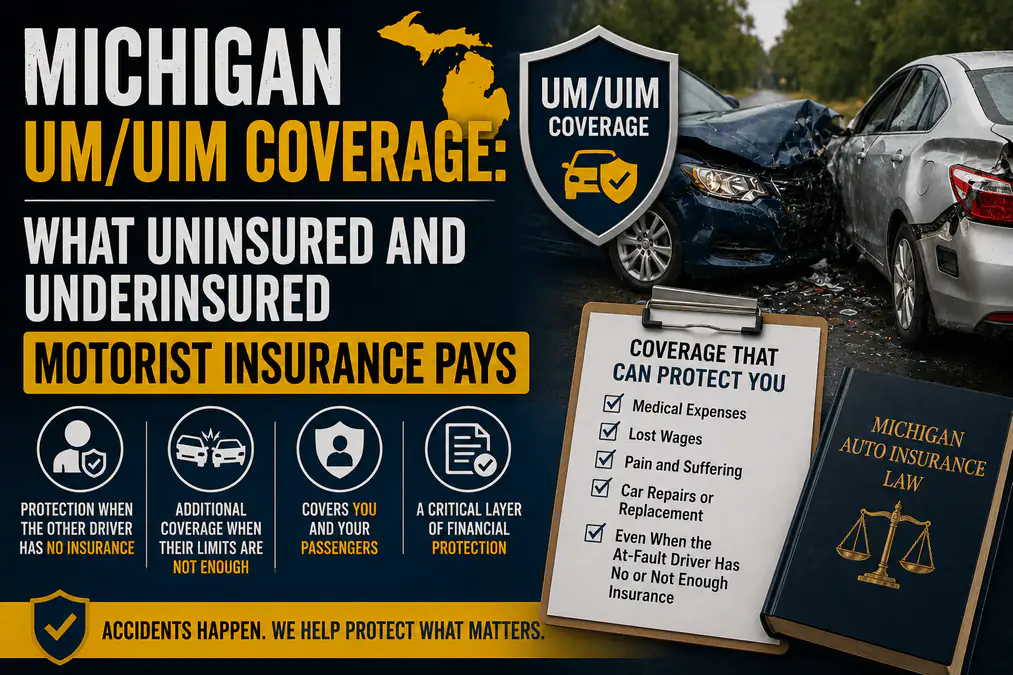
In Michigan, uninsured motorist coverage, often called UM coverage, is optional extra auto insurance coverage that you buy and pay a premium for. It may pay when the at-fault driver has no usable liability insurance. Underinsured motorist coverage, often called UIM coverage, is also optional extra coverage. It may pay when the at-fault driver's available liability policy limits are too low to cover the full value of the injury claim.
UM/UIM coverage does not replace Michigan No-Fault PIP benefits. PIP covers first-party benefits such as medical expenses, wage loss, replacement services, and attendant care, subject to the policy and the No-Fault Act. UM/UIM coverage addresses the separate third-party claim for pain and suffering, excess economic loss, permanent impairment, disfigurement, or death.
The most important rule is this: UM/UIM coverage is controlled by the insurance policy. Michigan law does not make UM/UIM coverage mandatory in every auto policy. If the coverage exists, the policy language controls notice, consent-to-settle requirements, arbitration, offsets, anti-stacking language, and deadlines. Our attorneys review the policy before the claim is presented, because a missed policy step can damage or destroy the UM/UIM claim.
What UM and UIM Mean in Michigan
UM and UIM coverage protect against two different insurance problems.
| Coverage | When it may apply | What it may pay |
|---|---|---|
| Uninsured motorist coverage | The at-fault driver has no liability insurance, the policy lapsed, coverage is denied, or a hit-and-run fits the policy definition of an uninsured vehicle. | Damages the at-fault driver's liability insurance would have owed, up to the UM policy limits. |
| Underinsured motorist coverage | The other driver has insurance, but their coverage is too small for the claim. | Your own UIM coverage may help pay what is left, up to your policy limits. |
The exact result depends on the policy terms. Some policies define an uninsured or underinsured vehicle narrowly. Some require physical contact for hit-and-run claims. Some require written consent before a settlement with the at-fault driver's insurer. Some require arbitration. Some contain anti-stacking language, meaning they may prevent you from combining limits from multiple vehicles or policies.
Our attorneys look at the actual policy, not just the declarations page, before telling a client what coverage is available.
What Michigan No-Fault PIP Covers and What It Does Not
Michigan's No-Fault Act requires security for personal protection insurance benefits, property protection insurance, and residual liability insurance under MCL 500.3101. PIP benefits are first-party benefits. That means they are generally paid through the applicable No-Fault insurer regardless of who caused the crash.
Under MCL 500.3107, PIP may cover:
- Allowable medical expenses, subject to the selected PIP medical coverage level and No-Fault limits.
- Work loss for the statutory period and subject to the statutory monthly maximum.
- Replacement services, usually up to $20 per day.
- Attendant care when help with daily activities is reasonably necessary.
PIP does not pay for pain and suffering. It does not pay for the loss of normal life caused by serious injuries. It does not make the at-fault driver accountable for the human cost of the crash.
That is where the third-party tort claim matters. If the at-fault driver has no insurance or too little insurance, UM/UIM may become the coverage source for that tort claim.
UM Coverage: When the At-Fault Driver Has No Usable Insurance
UM coverage may apply when the responsible driver does not have liability insurance available for the crash. That can happen when:
- The driver had no auto policy.
- The policy lapsed or was cancelled before the crash.
- The insurer denies coverage.
- The crash was a hit-and-run and the policy definition is satisfied.
In a UM claim, the injured person is usually making the claim against their own insurer. That does not make the insurer an advocate. Once a UM claim is made, the insurance company has a financial interest in limiting what it pays.
Our attorneys handle the policy review, notice, evidence preservation, liability proof, injury documentation, and insurer communications. If the policy requires arbitration, we prepare the claim for arbitration instead of treating it like an ordinary adjuster negotiation.
UIM Coverage: When the At-Fault Driver Has Too Little Insurance
UIM coverage may apply when the at-fault driver has liability insurance, but that driver's policy limits are not enough to cover your injuries and losses.
The following are common scenarios involving UIM:
| Scenario | Possible UIM issue |
|---|---|
| Your injuries are worth $200,000, but the at-fault driver has only $50,000 in liability coverage. | UIM may cover part of the remaining loss, depending on the UIM policy limits and policy language. |
| Your injuries are worth $200,000, and the at-fault driver has enough liability coverage to pay the claim. | UIM may not apply because the at-fault driver's coverage is enough for the proven damages. |
| The injured person accepts the at-fault driver's limits without notifying the UIM insurer. | The UIM claim may be jeopardized if the policy required consent before settlement. |
This is why our attorneys review UIM coverage before any release is signed. A settlement with the at-fault driver can create a serious recovery problem, including for the UIM claim, if it violates the UIM policy's consent, notice, exhaustion, or subrogation language.
The Serious Impairment Threshold Still Matters
UM/UIM coverage may pay the third-party tort claim. However, in Michigan auto cases, those claims are limited by MCL 500.3135.
For pain and suffering damages, the injured person generally must show death, permanent serious disfigurement, or a serious impairment of body function. The statute defines serious impairment as an objectively manifested impairment of an important body function that affects the person's general ability to lead their normal life.
That threshold applies whether the claim is made against the at-fault driver's insurer or through UM/UIM coverage. A claimant must meet the statutory threshold before recovering pain and suffering damages. If the injuries do not meet the threshold, PIP benefits may still exist, but the pain and suffering claim may not.
Our attorneys build the threshold proof through medical records, imaging, specialist opinions, disability presentation, work restrictions, treatment history, functional limitations, witness statements, and before-and-after evidence. The legal question is not just what diagnosis appears in the chart. It is whether the statutory threshold is met.
What UM/UIM May Pay
If the policy applies and the injury threshold is met, UM/UIM coverage may pay damages such as:
- Pain and suffering.
- Loss of normal life.
- Permanent impairment or disability.
- Permanent serious disfigurement.
- Excess wage loss or earning-capacity loss beyond what PIP pays.
- Other excess economic damages not covered by PIP.
- Wrongful death damages when the crash caused death and the estate has a covered claim.
UM/UIM does not pay everything. It generally does not duplicate PIP benefits. It does not pay vehicle damage. It does not pay above the purchased policy limits and it may not apply if the policy definition, notice requirement, consent requirement, arbitration requirement, exclusion, or anti-stacking provision defeats coverage.
How Subrogation Can Affect a UIM Claim
Subrogation means the insurance company may have a right to seek repayment from the at-fault driver or another responsible party after it pays a claim.
In a UIM case, subrogation matters because settling with the at-fault driver can affect the UIM insurer's rights. Some policies require written notice or consent before the injured person accepts the at-fault driver's policy limits and signs a release.
Our attorneys review the UIM policy before any settlement is accepted so the client's claim is not damaged by a missed notice, consent, or subrogation requirement.
How Anti-Stacking Can Limit UM/UIM Coverage
Stacking means combining UM/UIM limits from more than one vehicle or policy.
Anti-stacking language is policy language that may prevent the injured person from combining those limits. For example, even if a household has more than one insured vehicle, the policy may limit the claim to one UM/UIM coverage limit.
Our attorneys review all potentially available policies and vehicles before assuming the available UM/UIM limits. Anti-stacking language can make a major difference in the possible available coverage.
Deadlines and Policy Requirements
UM/UIM cases usually involve more than one deadline.
The underlying injury claim is commonly analyzed under Michigan's general three-year injury deadline in MCL 600.5805. PIP benefit disputes have separate timing rules under MCL 500.3145. UM/UIM policies may also impose contractual deadlines for notice, consent to settle, arbitration demand, suit, or proof of claim.
The three-year injury statute is not enough by itself. Our attorneys track the tort deadline, the PIP deadline, and the UM/UIM policy deadlines at the same time. That is the only safe way to evaluate the claim and make sure that nothing is missed.
What Our Attorneys Do After an Uninsured or Underinsured Crash
When Michigan Legal Center handles a UM/UIM case, we do not tell the client to deal with the insurance process alone. We handle the coverage analysis and claim strategy.
Our attorneys can:
- Obtain and review the full auto policy, not just the declarations page.
- Identify UM, UIM, PIP, med-pay, umbrella, household, and commercial coverage.
- Determine which insurer is responsible for PIP benefits under the No-Fault priority rules in MCL 500.3114.
- Preserve evidence of fault, insurance status, injury severity, and damages.
- Handle written notice to the UM/UIM insurer.
- Protect UIM rights before any settlement with the at-fault driver's insurer.
- Prepare the injury threshold proof under MCL 500.3135.
- Negotiate, arbitrate, or litigate the UM/UIM claim when the insurer refuses to pay fairly.
The insurer may ask for recorded statements, broad medical authorizations, independent medical examinations, or arbitration. We handle those requests with the same care as a claim against the at-fault driver's insurance company.
Why Your Own Insurer May Still Fight the Claim
Many people assume their own insurer will be easier to deal with than the at-fault driver's insurer. Our experience in dealing with UM/UIM claims often proves otherwise.
Once a UM/UIM claim is made, the insurer may dispute:
- Whether the at-fault driver was actually uninsured or underinsured under the policy.
- Whether the policy's notice, consent, exhaustion, arbitration, or suit requirements were satisfied.
- Whether the injured person met the serious impairment threshold.
- Whether the medical treatment was related to the crash.
- Whether the damages exceed the at-fault driver's liability coverage.
- Whether anti-stacking or offset language limits recovery.
Michigan's unfair insurance practices statute, MCL 500.2026, sets standards for claim handling practices. But a UM/UIM claim is still adversarial. The company that sold the coverage may become the company trying to limit what the coverage pays.
Talk To a Michigan UM/UIM Attorney
Michigan Legal Center handles uninsured and underinsured motorist claims across Michigan, including the Upper Peninsula. With offices that include Metro Detroit and Marquette, we represent clients throughout Michigan, including Detroit, Grand Rapids, Flint, Lansing, Ann Arbor, Kalamazoo, Wayne County, Oakland County, Genesee County, Kent County, Washtenaw County, Metro Detroit, and the UP.
Call (248) 886-8650 for a free consultation. No attorney fee unless we recover money for you. Case costs and fee terms are governed by the written fee agreement.