
Michigan Multi-Vehicle and Chain-Reaction Accident Lawyer
Who Is at Fault in a Michigan Multi-Vehicle or Chain-Reaction Crash?
Michigan does not decide who is legally responsible for a multi-vehicle or chain-reaction crash from vehicle position, a ticket, or the police report alone. The evidence must show what each person did and how those actions contributed to each impact. No-Fault personal protection insurance (PIP) benefits are a separate claim.
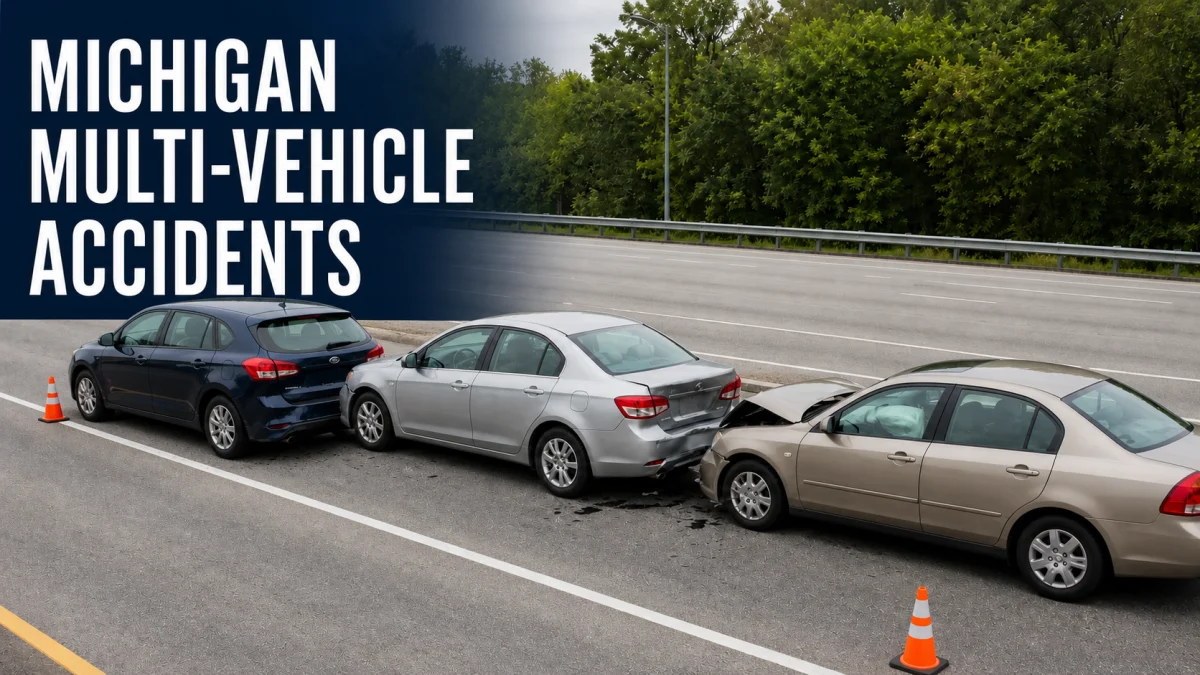
People often use "multi-vehicle" or "chain-reaction" to describe a crash involving three or more vehicles or a series of impacts. Michigan law does not use that description alone to decide who is responsible.
The investigation starts by identifying every vehicle and impact in the order they occurred. One driver may start the sequence. Several people may contribute. Someone may also be involved without doing anything careless that helped cause the crash. For example, one vehicle may be pushed into another. That contact alone does not prove fault.
Why Might the Police Report Show Only Part of the Crash?
A police report may show only part of a crash with several impacts. Michigan reporting instructions limit what appears in the Crash Type field and each vehicle's event sequence.
What Does the Crash Type Field Show?
The Crash Type field labels how vehicles first contacted one another. Under the Michigan State Police 2024 statewide reporting framework, only the first crash type is recorded for a multiple-impact crash. Vehicle damage alone does not determine that crash type.
What Does "Unit" Mean in a Crash Report?
The Michigan State Police UD-10 instruction manual calls each reported vehicle or other participant a unit. Each unit has its own event sequence. Up to four events can be recorded for each unit. If more than four occurred, the officer records the four considered most important, in the order they happened.
These are reporting instructions, not rules for assigning fault. The crash-type field can correctly identify the first crash type without showing every later impact. Later impacts may appear in the diagram, written description, unit entries, or other evidence.
If a report appears incomplete or incorrect, other evidence may help address the dispute. The guide to a wrong police report after a Michigan crash explains possible next steps.
What Evidence Can Show How Each Impact Happened?
The most useful evidence builds one timeline for all vehicles.
Scene and impact evidence: Photos and video can show vehicle positions, road marks, debris, traffic signals, visibility, and damage. This evidence can help show where and how the impacts occurred.
Vehicle and electronic evidence: Repair, tow, total-loss, and salvage records can document what happened to each vehicle. Inspections, dashcam footage, and data from a vehicle's event recorder may help test the reported sequence when available.
Witness and public records: Witness statements, nearby surveillance video, 911 calls, and dispatch records may describe the sequence. The complete UD-10, including its diagram and written description, may show where the accounts agree or conflict.
Which Records Show Injuries and Insurance Coverage?
Medical records and work restrictions serve a different purpose. They can help show the injuries caused by the crash and how those injuries affected the person's life and work. Insurance policies and insurer letters help identify available coverage. These records matter, but they do not establish the impact sequence by themselves.
Why Should Evidence Be Saved Quickly?
Important evidence can disappear quickly. Video can be overwritten, and vehicles can be repaired or destroyed. Electronic data and social media posts can be lost or deleted. Witnesses can also forget details.
Save the photos, videos, messages, witness names, insurance papers, repair documents, and other records already available to you.
Michigan Legal Center can identify other people or businesses that may hold evidence. The firm can send formal requests to keep evidence from being deleted or destroyed. It can also obtain records and arrange an appropriate vehicle or technical review. Its attorneys can then compare the evidence from each source.
Can More Than One Driver or Company Be Responsible?
Yes. More than one person can share responsibility, but the number of vehicles does not determine how many people are legally liable.
How Is Fault Divided?
MCL 600.2957 requires fault to be considered person by person. This can include someone who is not named in the lawsuit. Under MCL 600.6304, the decision considers what each person did. It also considers how closely those actions are tied to the claimed injuries and losses.
Under MCL 600.2956 and MCL 600.6304, each responsible person generally owes only that person's share of the loss. Lawyers call this several liability. In most cases, one person does not have to pay another person's share.
Can an Employer Be Responsible?
An employer may still be legally responsible for an employee's actions in some cases. Lawyers call this vicarious liability. The investigation may need to examine who owned the vehicle, why the trip was made, and who controlled the driver's work.
What If the Injured Person Shares Fault?
An injured person's own fault can also affect the amount of compensation. Under MCL 600.2959, compensation from the fault-based claim is generally reduced by that person's percentage of fault. The person cannot recover pain-and-suffering damages if that percentage is greater than the combined fault of everyone else. The Michigan comparative-fault guide explains this rule in more detail.
Does the Rear-End Rule Decide the Whole Crash?
Michigan has a narrow rule for certain rear-end impacts. MCL 257.402 applies when one vehicle strikes another from behind on a Michigan highway. The front vehicle must be traveling in the same direction or lawfully stopped. When evidence supports those facts, the law treats the impact as initial evidence of negligence. Lawyers call this prima facie evidence. It is a starting point, not automatic liability for every impact in a chain reaction. The Michigan rear-end accident guide explains ordinary two-vehicle rear-end crashes in more detail.
Which Insurance Claims May Apply After a Multi-Vehicle Crash?
A multi-vehicle crash can involve different types of insurance claims. Each type must be reviewed separately. More vehicles do not automatically mean that more coverage is available.
Does No-Fault PIP Depend on Who Caused the Crash?
Under MCL 500.3105, PIP benefits for a covered accidental injury do not depend on who caused the crash.
The correct insurer can depend on priority rules, which decide which insurer should handle the PIP claim. Policy choices, exclusions, other coverage, and the facts may also affect the available benefits. The DIFS Auto Insurance FAQ describes medical benefits, wage loss, and replacement services for household tasks. The guide to PIP medical bills and insurer priority explains these insurer-priority questions separately from crash fault.
What Is a Third-Party Bodily Injury Claim?
A third-party bodily injury claim seeks compensation from a person or business that caused the crash. To recover for pain and suffering, MCL 500.3135 requires death, permanent serious disfigurement, or a serious impairment of body function. This is the legal threshold for pain-and-suffering damages. Meeting it does not prove who caused the crash, what injuries the crash caused, or how much compensation is available.
How Is Vehicle Damage Handled?
Vehicle-damage questions are separate from PIP and bodily injury claims. Which insurer must pay can depend on the insurance policies and the facts of the crash.
Could UM or UIM Coverage Apply?
Uninsured motorist (UM) coverage may apply when a responsible driver has no liability insurance that covers the crash. Underinsured motorist (UIM) coverage may apply when that driver's insurance is too low to cover the proven losses.
These coverages must be purchased, and the full policy controls. The policy may require notice or the insurer's consent before a claim is settled. Other terms may require the use of other coverage first or reduce what the policy pays. The policy may also give the insurer repayment rights or limit whether coverage amounts can be combined. Michigan Legal Center's UM/UIM coverage guide explains these policy rules in more detail.
The Michigan car accident claim guide explains the broader relationship between No-Fault PIP benefits and third-party liability claims.
What Should Be Reviewed Before You Sign a Release?
An attorney should review every potentially responsible person, business, and insurance policy before any one claim is settled.
What Does a Release Do?
A release is a document that gives up a claim. Under MCL 600.2925d, a good-faith release of one person does not automatically release others who may be responsible for the same injury. The document can say otherwise, so its exact wording matters.
The law also protects the released person from certain repayment claims by another responsible person. Lawyers call these contribution claims. This is another reason to identify every potentially responsible person before signing a release.
What Should Be Checked Before Signing?
A release may also affect a liability claim or rights under an insurance policy. Before signing, Michigan Legal Center can review:
- People and claims: Exactly which people, businesses, claims, and injuries the release covers.
- Liability coverage: Whether all potentially responsible people, businesses, and liability policies have been identified.
- UM/UIM requirements: Whether a UM or UIM policy requires notice, consent, or the use of other coverage first.
- Losses and repayment: Whether medical bills, lost income, repayment claims, and future medical needs have been evaluated.
- Other claims: Whether settling one claim could harm another claim or source of coverage.
The Michigan Car Accident Settlement Center provides additional offer and release guidance.
How Can Michigan Legal Center Investigate a Multi-Vehicle Crash?
Michigan Legal Center can organize the crash one vehicle, one impact, one source of evidence, and one insurance policy at a time.
Our attorneys can:
- Build the timeline: Use the report and other evidence to map the crash vehicle by vehicle.
- Preserve evidence: Send formal requests and obtain available video, records, vehicle evidence, and electronic data.
- Identify responsible parties: Review the roles of the drivers, owners, employers, and businesses involved.
- Separate the claims: Distinguish PIP benefits, bodily injury claims, property damage, and possible UM or UIM coverage.
- Review insurance and releases: Examine policies, coverage limits, notices, insurer letters, offers, and proposed releases.
- Document injuries and losses: Evaluate whether the crash caused the injuries, which losses can be proven, and which deadlines apply.
Michigan Legal Center is the Law Offices of Christopher J. Trainor & Associates. If you were injured in a crash involving three or more vehicles, contact Michigan Legal Center to request a case review.