
Who Is at Fault in a Michigan Merging Accident?
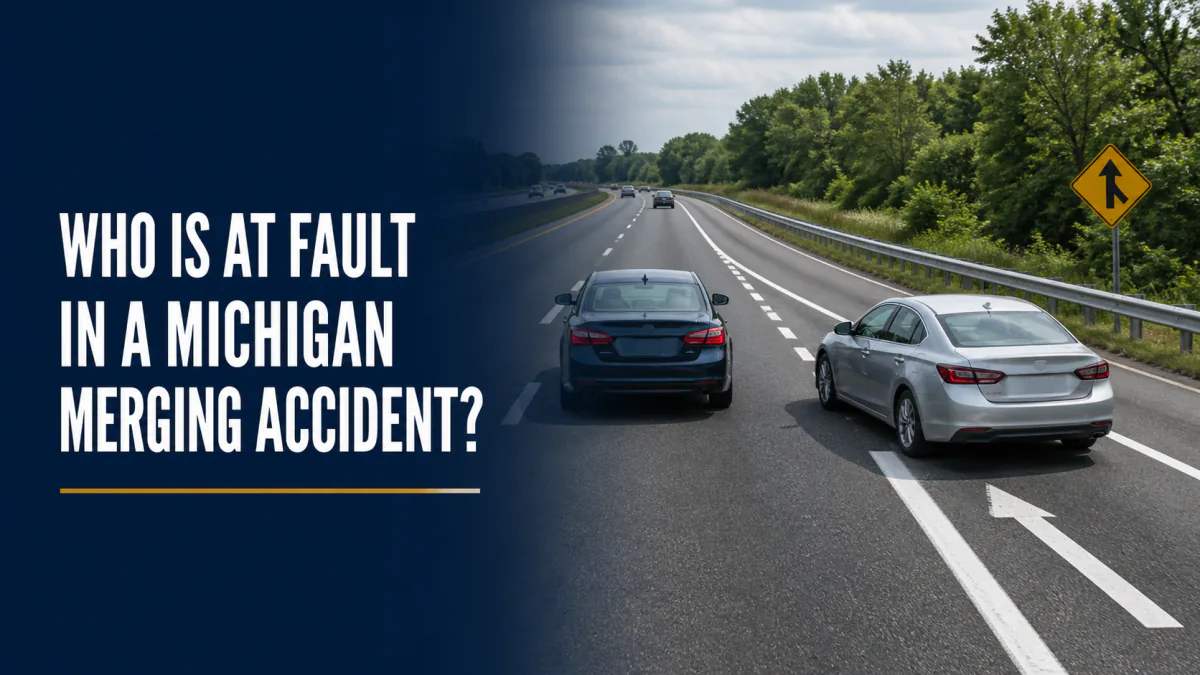
At a properly marked Michigan merge, the entering driver must yield to through traffic that is close enough to pose an immediate hazard and adjust speed so the merge can be made safely. That makes the entering driver's conduct the starting point, but it does not make that driver automatically at fault for every crash. See MCL 257.649(9).
How Does a True Merge Differ From an Ordinary Lane Change?
Civil fault depends on the roadway design, what each driver did, and whether that conduct contributed to the collision. The applicable rule changes with the roadway design and the vehicles' movements. Michigan's specific merge rule applies when an intersecting highway or street was designed and built as a merging roadway and the intersection is clearly marked with appropriate merge signs. If the crash instead involved a move from one continuing marked lane to another, Michigan's marked-lane and signaling rules may apply.
The driver already in the lane, called a through driver, still has to take reasonable care and pay attention to merging traffic. Under MCL 257.649(7), a driver traveling at an unlawful speed forfeits any right-of-way the section otherwise provides. Other unsafe conduct may support a share of fault if it contributed to the crash, but it does not automatically forfeit right-of-way.
Merging accidents are different from disputed lane changes. On a roadway divided into marked lanes, MCL 257.642(1)(a) requires a driver to stay within one lane. The driver may not move from it until first determining the move can be made safely. MCL 257.648(1) separately requires a safety check and signal before turning from a direct line, which includes changing lanes on a highway. A signal gives notice; it does not by itself create right-of-way or decide civil fault.
What Evidence Can Show How the Merge Happened?
If drivers give conflicting stories or blame each other, evidence may be necessary to establish fault. This could include:
- roadway design, such as signs and painted lines
- traffic or dash camera video showing each vehicle before impact
- vehicle damage, debris, and contact points showing direction and angle of travel
- witness names and contact information from people who saw the approach or collision
- the police report, 911 information, and each driver's early description of the crash
After a crash, prioritize immediate safety and needed medical attention, and report the crash as Michigan law requires. Preserve evidence you can lawfully access, including photos and videos of the scene, messages, reports, and witness information.
You may need a lawyer's help to ensure that evidence held by other parties is properly preserved. The Michigan Legal Center's explanation of traffic camera footage after a Michigan car accident explains the issue in more detail.
Can Both Drivers Share Fault?
Yes. Michigan's comparative-fault rules can assign different percentages of fault when the evidence shows that more than one driver's conduct contributed to the crash. A merging driver may have entered without enough space. A through driver may have been speeding unlawfully or making a separate unsafe movement.
Under MCL 600.2959, personal-injury damages are generally reduced by the injured person's percentage of comparative fault. Collision coverage and other property-damage questions may follow different policy and statutory rules.
For motor-vehicle claims covered by MCL 500.3135(2)(b), a person who is more than 50 percent at fault cannot recover noneconomic damages.
For a broader explanation of percentage allocation and different claim paths, see The Michigan Legal Center's Michigan comparative-fault guide.
A ticket, a required crash report, or an insurer's fault allocation may affect claim handling, but none of them by itself decides civil fault. A report can still help identify witnesses and early statements even though MCL 257.624 generally bars the required report itself from use in court. MCL 257.731 likewise makes evidence of a traffic conviction or civil-infraction determination inadmissible in a civil action.
Does Fault Affect PIP Benefits?
No. Qualifying PIP benefits are due without regard to fault under MCL 500.3105(2), although fault still matters for other claims. Subject to the policy and Michigan's No-Fault Act, PIP may include allowable expenses for reasonably necessary care, recovery, or rehabilitation. It may also include work loss and replacement services under MCL 500.3107. Eligibility, priority, selected coverage, exclusions, proof, and limits remain separate questions.
A third-party bodily injury claim is separate from PIP and requires proof that another person's negligence caused or contributed to the crash and resulting injury. Noneconomic damages, such as pain and suffering, generally require death, serious impairment of body function, or permanent serious disfigurement. Comparative fault can reduce or bar that recovery under the rules described above.
A more detailed explanation can be found in The Michigan Legal Center's guide to Michigan car accident medical bills and PIP priority.
Why Do You Need a Lawyer for a Disputed Merging Crash?
After a disputed merging crash, keep original photos, video, messages, reports, and insurance communications. Avoid signing a release until its effect on the available claims is understood.
The Michigan Legal Center can evaluate whether the roadway meets the marked-merge requirements, preserve outside evidence, and compare the drivers' accounts with the vehicle contact points. The firm can also handle insurer communications and review releases. The Michigan Legal Center's Michigan car-accident practice explains the broader legal help available after an injury crash. If you were injured in a disputed Michigan merging accident, contact The Michigan Legal Center for a case review before signing a release or relying on an early fault decision.