
Bicycle and E-Bike Accident Claims in Michigan
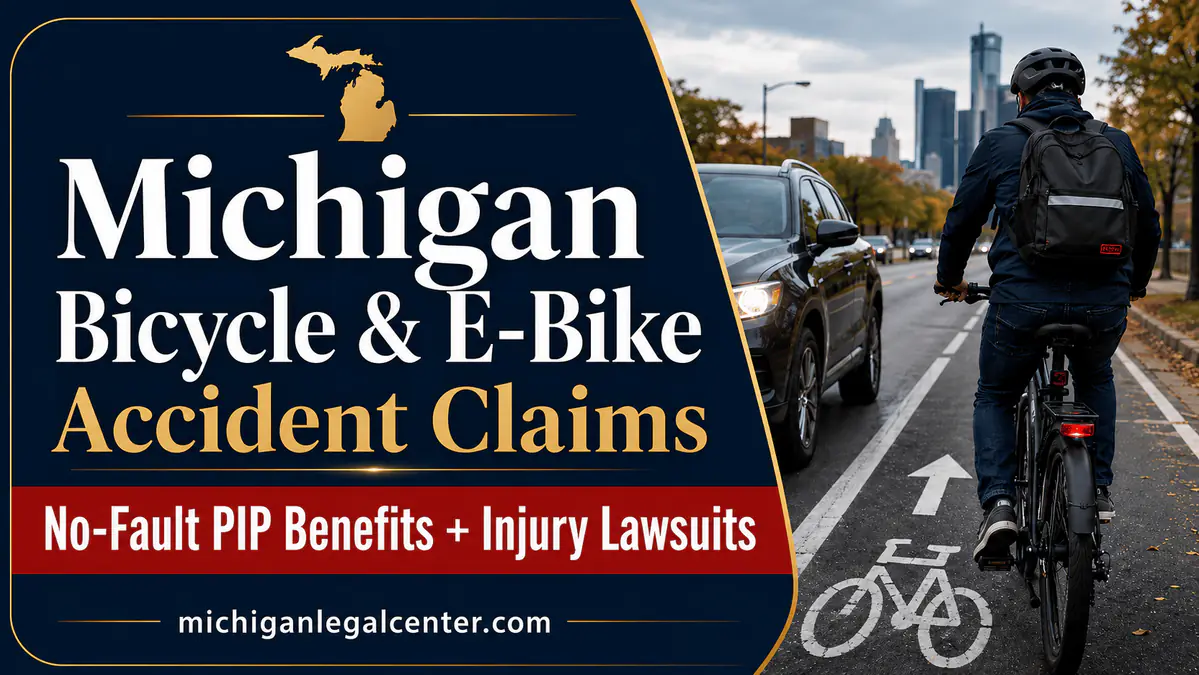
What happens if a bicyclist or e-bike rider is hit by a car in Michigan?
Bicyclists and e-bike riders in Michigan may be eligible for No-Fault personal protection insurance benefits if they were involved in a motor vehicle crash while riding a bike or e-bike. These cases may also involve separate injury claims against negligent drivers and evidence that should be preserved quickly.
Crashes involving No-Fault personal protection insurance benefits, often called PIP benefits, usually focus on possible benefit coverage and determining the responsible insurer. Which insurer is responsible can depend on the injured person's own policy, household coverage, priority rules, exclusions, residency, and whether the Michigan Assigned Claims Plan applies.
Driver-negligence claims focus on who caused the crash and what injury claim is allowed under Michigan law based on the facts.
Evidence preservation can also be important. Video, app data, documents, vehicles, bikes, and witness information can be overwritten, deleted, repaired, or lost before the claim is ready.
Are bicycle and e-bike accident claims different from regular car accident claims?
Yes. A bicyclist or e-bike rider is usually not an occupant of a motor vehicle. That can change the insurance analysis.
Michigan No-Fault laws apply when the injury arises from a motor vehicle accident.
For a rider who was not occupying a motor vehicle, the PIP source may require review of MCL 500.3115 and MCL 500.3114. In some cases, if no applicable insurer exists or insurers dispute responsibility, the Michigan Assigned Claims Plan may need to be reviewed.
Those insurance issues are separate from a claim against the driver who caused the collision.
Does Michigan No-Fault cover bicycle or e-bike riders?
Michigan No-Fault benefits apply to bike riders after a motor vehicle crash, but not every bicycle or e-bike incident involves a motor vehicle.
Under MCL 500.3105, PIP benefits are tied to accidental bodily injury arising out of the ownership, operation, maintenance, or use of a motor vehicle as a motor vehicle, subject to Michigan's No-Fault law.
PIP benefits may include allowable medical expenses, work loss, and replacement services, depending on the facts, policy, and statutory limits. Those benefit categories are addressed in MCL 500.3107.
An injured rider should not assume that the driver's insurance is the only possible source of benefits. Determining whose insurance may be responsible can depend on household auto coverage, available policies, assigned-claims issues, exclusions, residency, and the facts of the crash.
For a deeper explanation of medical-bill priority, read Who Pays Medical Bills After a Michigan Car Accident? PIP Priority.
What counts as an e-bike versus a bike in Michigan?
Michigan law defines an electric bicycle in MCL 257.13e. In general, the device must have a seat or saddle, fully operable pedals, an electric motor not greater than 750 watts, and a class 1, class 2, or class 3 classification.
Classification depends on the type of motor assistance, whether the bike is throttle-assisted or pedal-assisted, and the bike's top assisted speed.
Under MCL 257.662a, Michigan has specific rules for e-bikes that address labels, modification issues, class 3 requirements, and use on parts of a highway open to bicycles, including bike lanes and shoulders, subject to statutory limits.
Classification can affect claims if the device was modified, the label does not match the bike, the motor exceeds statutory limits, or the parties dispute whether the device was really an electric bicycle.
In most injury claims, the practical step is to save the e-bike, photos, class label, purchase records, repair history, and any modification information.
Can the injured rider sue the driver?
Potentially, if the driver was negligent and the facts support a claim. A bicyclist or e-bike rider may have a claim against a driver who failed to yield, turned unsafely, opened a door into the rider's path, passed too closely, drove while distracted, or otherwise contributed to the crash.
For pain and suffering after a motor vehicle crash, Michigan's third-party injury rules may apply. Under MCL 500.3135, noneconomic-loss claims are generally limited to cases involving death, serious impairment of body function, or permanent serious disfigurement.
Economic-loss claims may also be a factor, but they involve separate rules and should be reviewed with the full insurance and injury record.
Other factors that can affect the claim include medical records, imaging, work limits, daily-life limits, scarring, mobility problems, and crash evidence.
What are common causes of bicycle and e-bike crashes involving motor vehicles?
Common causes include:
- Drivers failing to yield.
- Doors opening in a rider's path.
- Unsafe turns.
- Distracted driving.
- Speeding.
- Passing too closely.
- Failing to check bike lanes or shoulders.
- Drunk or impaired driving.
- Delivery or rideshare driver crashes.
- Poor visibility or lighting disputes.
These factors alone cannot assign blame before the evidence is reviewed. They can be a starting point for analyzing or investigating the collision.
What evidence matters after a bicycle or e-bike crash?
Investigators and lawyers may collect or request many different types of evidence after a crash.
Important evidence may include:
- Police report.
- Photos of the bicycle or e-bike.
- Photos of the vehicle damage.
- Photos of injuries.
- Helmet and clothing.
- Location of the bike lane, shoulder, intersection, or crosswalk.
- Driver and insurance information.
- Witness names and contact information.
- Nearby surveillance video.
- Dashcam or rideshare/delivery app records.
- 911 calls.
- Medical records.
- Repair or replacement estimates.
- E-bike make, model, class label, and modification history if relevant.
Save any possible evidence already in your possession. Michigan Legal Center can help identify what else should be preserved or requested.
Why does fast investigation matter after a bicycle or e-bike crash?
Evidence in these cases can change, disappear, or come to light quickly. That makes fast investigation important.
Video can be overwritten. Vehicles and bikes can be repaired. Skid marks, debris, glass, and roadway markings can disappear. Witnesses become harder to find. Rideshare, delivery, GPS, dispatch, and app records may be harder to obtain later.
To help preserve evidence, an injured person should get medical care, save the bike and damaged gear, keep photos and documents, and avoid handling the investigation alone.
A lawyer can send preservation requests, identify insurance paths, and separate benefit claims from the driver-negligence claim.
What should you not do after a bicycle or e-bike crash?
Avoid:
- Giving any statements without legal advice.
- Throwing away the bike, helmet, clothing, or damaged equipment.
- Repairing the e-bike before photos and evidence review.
- Posting about the crash online or on social media.
- Signing releases.
- Assuming the driver's insurer is the only possible source of benefits.
These actions can complicate an injured person's PIP claim, driver-negligence claim, or both.
How can a Michigan bicycle accident attorney help?
A Michigan Legal Center attorney can do the claim work while the injured rider focuses on medical care.
Michigan Legal Center can:
- Identify the correct No-Fault/PIP insurer.
- Investigate the at-fault driver.
- Preserve video, app data, and witness evidence.
- Review e-bike classification if it matters.
- Separate benefit claims from third-party injury claims.
- Handle insurer communication.
- Determine whether the facts support a claim.
For related claim information, see our Car Accident and Personal Injury pages.
Talk to Michigan Legal Center after a bicycle or e-bike crash
If you were injured while riding a bicycle or e-bike in Michigan, contact Michigan Legal Center / Christopher Trainor & Associates for a free consultation.
Our attorneys can review the crash facts, medical records, insurance issues, e-bike classification questions, and evidence-preservation needs before an insurer locks in a position or asks for a release.
Contact Michigan Legal Center to talk with our team.