
Hit by a "Self-Driving" Car in Michigan? Who May Be Responsible
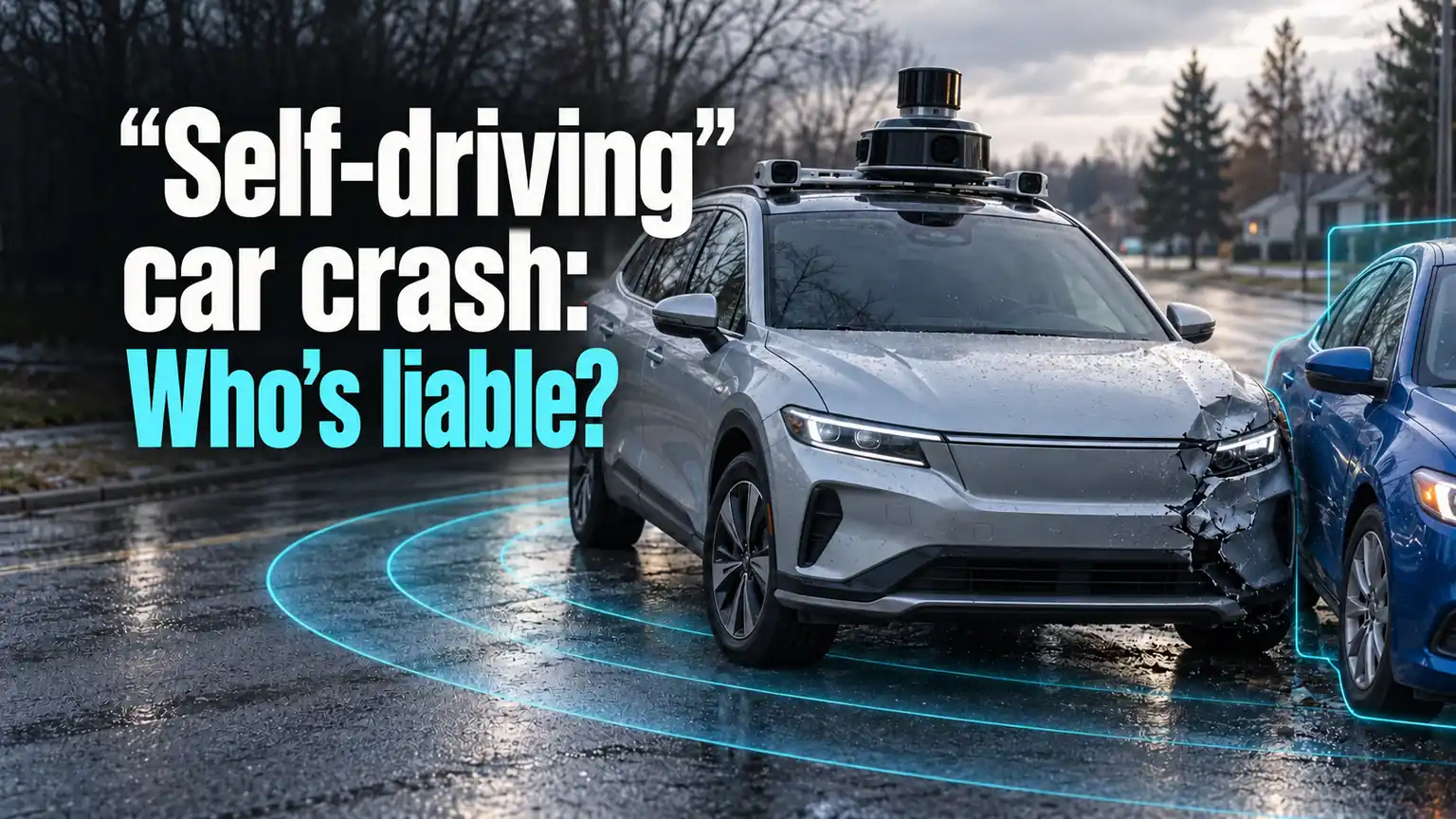
Many features people call “self-driving” are actually driver assistance. With Level 0 through 2 systems, the driver still must watch the road and be ready to act. After a Michigan crash, the investigation should examine the driver’s actions and whether the technology contributed to what happened.
Is a driver-assist car the same as a self-driving car?
No. There are a variety of features that are similar to self-driving cars yet are legally distinct in Michigan. This includes ordinary active safety and operator-assistance features unless the technology can operate the vehicle without human control or monitoring. MCL 257.2b lists examples such as emergency braking, adaptive cruise control, lane-keeping assistance and lane-departure warning.
According to the National Highway Traffic Safety Administration (NHTSA), the driver is still responsible for driving and monitoring the vehicle regardless of advanced driver assistance systems at levels 0 through 2.
- Level 0 provides warnings or momentary intervention.
- Level 1 assists either with steering or with acceleration and braking.
- Level 2 assists with steering, acceleration and braking together.
None of these levels makes the vehicle autonomous. The NHTSA recognizes six levels of automation. At level 3, the car can drive itself in limited conditions, but a human must still be able to take over. At level 5, the highest level, the system can drive in any situation without a human driver.
Just because a feature is installed in a car does not mean it was being used at the time of a crash or that it contributed to the crash. Those questions depend on the exact vehicle, feature, software, warnings, driver inputs and crash evidence.
Which people or companies might be investigated?
For a Level 0 through 2 system, the human driver’s conduct is usually the starting point of the investigation. The investigation may ask whether the driver watched the road, used the feature within its limits, responded to warnings and braked or steered when needed.
The vehicle owner, under MCL 257.401, is generally liable for an injury caused by negligent operation when the vehicle is driven with the owner's consent or knowledge, subject to the statute’s exceptions. However, the driver and owner may be different people and that could have an impact on liability.
Michigan has a specific exception for qualifying peer-to-peer car sharing. During the legally defined car-sharing period, the owner generally cannot be held liable simply because they own the vehicle. That protection does not automatically rule out a claim based on the owner’s own negligence.
A work trip may make employment and vehicle-use records relevant. Evidence of a sensor/software defect may support a claim against a manufacturer or supplier. Evidence of negligent repair or calibration may support a separate negligence claim against a dealer or repair facility. The applicable theory depends on who supplied, serviced or altered the system and what caused the crash.
How do Michigan PIP and a liability claim differ?
A Michigan car-accident claim can involve two types of claims depending on the facts of the case.
Michigan's personal injury protection (PIP) statute, MCL 500.3105, makes benefits for economic losses available without regard to fault for injury from auto accidents. Subject to coverage, proof, policy and statutory limits, PIP may include allowable medical expenses, work loss and replacement services.
Third-party claims are fault-based and may seek compensation for pain and suffering as well as certain economic losses. Liability, causation, insurance and damages are governed by separate rules. Under MCL 500.3135, noneconomic damages are available only if the injured person suffered death, serious impairment of body function or permanent serious disfigurement. A third-party claim may also seek certain medical expenses, work loss and survivor’s loss beyond applicable PIP limits. Special rules apply to medical expenses when a qualifying PIP medical opt-out or exclusion applies. An unpaid bill does not automatically become part of the claim against the other driver.
The PIP insurer may require a separate priority analysis. The Michigan Legal Center's explanation of which insurer may owe PIP benefits provides more detail.
Which vehicle and system evidence should be preserved?
Once you are safe and have received needed medical care, preserve evidence you can lawfully access. A lawyer can help seek preservation of the following vehicle and system records:
- Vehicle and system identity. Preserve the vehicle identification number (VIN), plate, make, model, model year, trim, owner, exact feature name and equipment list.
- Engagement and warnings. Preserve instrument-cluster status, takeover requests, attention alerts, fault codes, audio warnings and the driver's statements about what happened.
- Event data recorder (EDR) and vehicle modules. NHTSA explains that an event data recorder may capture technical information for seconds before, during and after a crash. It is not an audio or video recorder. Available data varies.
- Video and connected records. Preserve local dashcam storage, removable media, connected-service records, nearby security video and the injured person's phone or dashcam.
- Configuration. Preserve the hardware, software version, feature settings, subscription status, user profiles, recent updates and diagnostic records.
- Repair and calibration history. Preserve camera, radar, windshield, alignment, tire, body and other pre-crash or post-crash service records.
- Traditional crash evidence. Preserve police and 911 material, scene photographs, vehicle damage, body-camera or dash-camera video, traffic-signal data, witness accounts and legally obtainable phone records.
Evidence availability and access depend on the vehicle, settings, services, triggering event, storage location, owner consent and post-crash handling. An injured person should not enter the other vehicle, use someone else's account or attempt a technical download. A targeted preservation request and qualified download can protect both the information and the record of how it was collected.
The Michigan Legal Center's Michigan post-crash guide covers the immediate steps after an accident in more detail.
What evidence may exist for EyeSight, Tesla, Super Cruise and BlueCruise?
Some evidence may be available for one system but not others:
- Subaru EyeSight: Subaru's vehicle privacy notice says EyeSight records exterior images when automatic emergency braking or sudden braking is triggered and stores images from the six most recent events. It describes locally stored EDR information separately. Verify the EyeSight version, triggering event, stored data and camera, windshield, sensor or alignment service.
- Tesla Autopilot or Full Self-Driving (FSD) (Supervised): Tesla states that FSD (Supervised) requires active driver supervision and does not make the vehicle autonomous. Check the feature and software version, engagement, warnings, driver inputs, hardware, settings, updates and any locally stored Dashcam or Sentry footage.
- General Motors (GM) Super Cruise: GM describes Super Cruise as hands-free driver assistance that still requires attention and readiness to take control. GM's privacy statement says GM does not collect interior camera images or video from the Super Cruise Driver Attention System but may collect derived data indicating that the vehicle detected a distracted or drowsy driver. The statement says GM may collect exterior camera data with consent or when the vehicle detects a safety event and does not access the EDR without consent. Verify whether Super Cruise was active, the road and conditions, attention or takeover prompts, connected-service settings and the data described in the privacy statement.
- Ford BlueCruise: Ford describes BlueCruise as Level 2 driver assistance. Verify the installed version, compatible driving area, engagement, driver-monitoring warnings, diagnostics, updates, service, calibration and connected information that may exist under Ford's privacy notice.
A request for only the car's "black box" may miss relevant information stored in other vehicle modules, removable media, connected services, repair records, phones or third-party cameras.
What if the vehicle was genuinely automated?
A vehicle capable of operating without human control or monitoring is governed by different rules under MCL 257.2b. When an automated driving system capable of operating without a human is engaged, MCL 257.665 treats the system as the driver or operator for compliance with traffic and motor vehicle laws. That rule does not by itself decide civil liability after a crash.
Michigan also has a special rule for qualifying automated fleets known as SAVE projects. The participating manufacturer must assume liability for an incident when the automated driving system was in control and at fault, subject to Michigan’s No-Fault law. This special rule does not automatically apply to a privately owned car using Level 2 driver assistance.
Level 4 and Level 5 vehicles that are more autonomous are not available for consumer purchase. Level 4 is limited to particular service areas or conditions, while Level 5 vehicles could theoretically operate under all conditions and on all roadways.
Michigan does, however, have limited automated vehicle testing programs and operations. In August 2024, Detroit announced the launch of its Connect autonomous-shuttle pilot, with a safety operator remaining behind the wheel throughout the pilot. Automated driving systems are also being developed elsewhere throughout the state.
A crash investigation may need to determine whether the vehicle was privately owned, being tested, carrying passengers or operating in a manufacturer-controlled fleet. It may then need to identify the system developer, fleet operator, insurer, operating limits, remote-assistance role and control records.
How can The Michigan Legal Center investigate the crash?
The Michigan Legal Center can identify the system, prepare targeted preservation requests, coordinate qualified technical review and compare electronic records with the scene, damage, witnesses, medical records and driver account. The Michigan Legal Center can also keep the PIP and third-party claims separate while evaluating which people, companies and insurers require investigation.
If you were injured by a vehicle that may have been using driver assistance, contact The Michigan Legal Center for a confidential consultation. Bring any photos, video, crash paperwork, vehicle description and statements about the system. Do not delay care or try to retrieve another person's vehicle data yourself.