$5M
For a family after a fatal semi-truck crash
We represented the estate of a husband and father killed in a semi-truck crash. Nearly two years of investigation and litigation led to a $5 million judgment.

Gaylord office · Serving northern Michigan
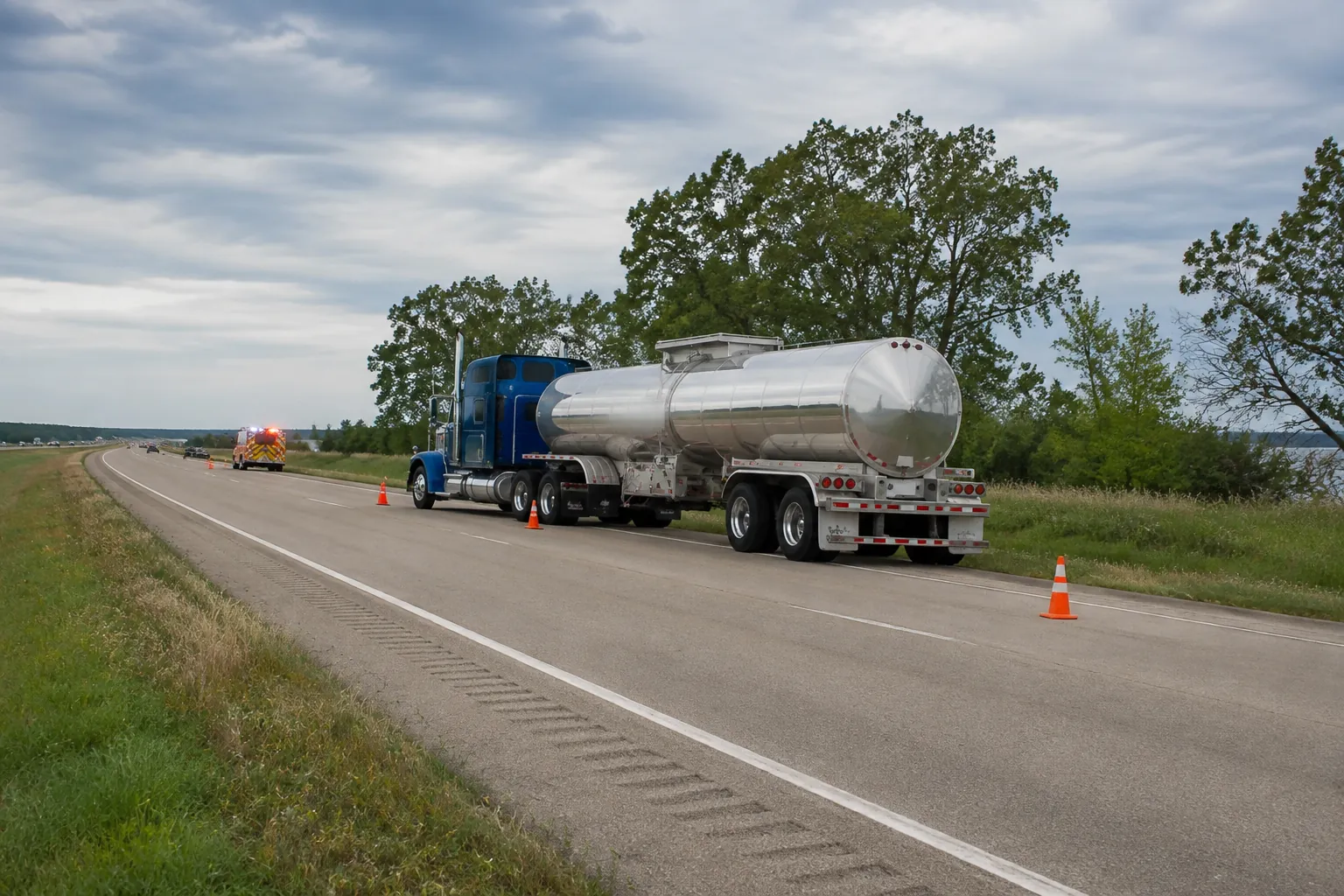
Hurt in a tanker or hazardous-material truck incident? Get help organizing medical, cargo, company, and response records. Start with a free review of what happened in Gaylord.
Start with what you know: when and where it happened, how you were affected, and any reports or messages you have. You do not need a complete file before contacting us. We can explain what else may matter, which records to look for, and whether we can help.
Call if a tanker or hazardous-material truck crash caused medical care, serious injury, death, a fire, suspected release, evacuation, decontamination, or an exposure concern. Michigan Legal Center can separate the local response, cargo and tank, carrier, cleanup, medical, No-Fault personal protection insurance (PIP), and liability records without assuming that every possible actor or regulation applies. For the statewide legal and technical framework, see our Michigan tanker and hazmat truck accident page and commercial-truck evidence preservation guide.
Shipping papers, emergency-response information, tank inspection and testing, loading, training, ELD, ECM, telematics, dispatch, monitoring, cleanup, and medical exposure evidence may be held in separate systems and can change or disappear.
Read the legal detailsIt costs nothing to learn where you stand. Call (248) 886-8650 or start a free case review.
The cases. The work.
The difference it made.
$5M
We represented the estate of a husband and father killed in a semi-truck crash. Nearly two years of investigation and litigation led to a $5 million judgment.
$1.1M
A collision with a semi-truck left our client with neck, back and head injuries.
$600K
A truck hit the side of our client’s car. The injuries included a cervical herniated disc and lumbar spine damage requiring surgery.
Crash investigators, fire or hazmat responders, emergency planners, environmental agencies, the carrier and cargo chain, cleanup companies, insurers, employers, and medical providers may each hold a different part of the record.
The useful record may include shipping papers, the proper shipping name and identification number, quantity and packaging, placard or marking photographs, emergency-response information, safety data, driver or carrier communications, and responder identification. The material and governing rule must be verified rather than inferred from the vehicle's shape or a generic hazard label.
Preserve the cargo tank and valves when available, specification and test records, repair and inspection history, loading and unloading documents, seals, weights, driver training and endorsement material, ELD, ECM, telematics, dashcam, dispatch, route, maintenance, post-crash testing, ownership, contracts, and insurance. Different entities may control different parts.
We account for tourist witnesses, seasonal businesses, weather, road conditions, trail records, vehicle data, and regional medical transfers that may not appear in a short crash report. Fire, police, 911, dispatch, incident command, air or water monitoring, decontamination, evacuation, environmental, cleanup, tow, and road records may be separate. Treatment through Munson Healthcare Otsego Memorial Hospital, Munson Healthcare Grayling Hospital, McLaren Northern Michigan, and regional providers and later providers must connect substance, pathway, timing, symptoms, diagnosis, alternative causes, function, and prognosis without treating proximity as medical causation.
Otsego County Emergency Management/911 publishes the county LEPC schedule and emergency-alert information. Gaylord’s 2025 master plan states that the Otsego County Fire Authority serves the city and surrounding jurisdictions, while Gaylord Police, the sheriff, and MSP can assist one another. These service descriptions do not identify the responders in a particular crash.
Gaylord and Otsego County. A Gaylord-area incident may divide fire-authority, city police, sheriff, MSP, county emergency-management or LEPC, EMS, road, towing, environmental, private cleanup, carrier, and hospital records. Rural location, winter access, and transfer distance can affect documentation and preservation, but they cannot be used to presume delay, fault, or exposure.
The Otsego County LEPC supports planning and emergency communication. The county also publishes a hazardous-material response cost-recovery ordinance link. Planning, alerts, or cost recovery do not prove that a transported substance was released, that cleanup charges establish negligence, or that any person received a harmful dose.
A tanker body, placard, odor, evacuation, road closure, cleanup, or database entry does not by itself prove cargo identity, a release, a claimant’s pathway or dose, medical causation, a regulatory violation, or civil liability.
| Possible holder | Possible material | How to request or preserve it | What to confirm |
|---|---|---|---|
| Otsego County Fire Authority, EMS, and dispatch | Fire or hazmat response, rescue, command, equipment, monitoring, decontamination, EMS, dispatch, and response chronology | Identify the incident number, responding department, and office that controls the record | Fire-authority service coverage does not prove a particular apparatus, capability, or mutual-aid response. |
| Gaylord Police, Otsego County Sheriff, MSP, county emergency management, or road agency | City, county, freeway, traffic, planning, alert, road, closure, tow, or coordination records | Route the request by exact location, responding unit, and record type | Mutual assistance and LEPC planning do not merge these records or establish fault. |
| Carrier, shipper, tank, maintenance, transfer, tow, and cleanup firms | Shipment, tank tests, training, ELD/ECM, route, dispatch, chain of custody, product recovery, disposal, contracts and insurance | Immediate preservation addressed to each identified private holder | Distance, storage, or a cost-recovery charge does not establish breach or causation. |
| EGLE, medical providers, employer, laboratory, or experts | Conditional environmental response, sampling, medical chronology, work benefits, weather, industrial hygiene, and causation evidence | Separate state, clinical, employment, laboratory, and expert channels | An alert, odor, evacuation, or winter condition does not prove individual exposure or toxic injury. |
The exact scene helps identify where to look for reports, video, witnesses, and other records.
I-75, M-32, Old 27, local roads, snow, distance, and jurisdictional boundaries make responder identity and early preservation especially important. Those conditions help identify evidence sources; they do not establish a spill, delayed response, route violation, or winter negligence.
Confirm whether the Otsego County Fire Authority responded, which station or personnel arrived, who commanded, and whether another department or specialized resource was requested. The city master plan confirms general service coverage, not the equipment, timing, or work performed at one scene.
A crash inside city limits, on I-75, on a county road, or near a boundary can involve different law-enforcement and road agencies. Obtain the report number, exact lane, dispatch source, tow destination, and road closure authority before requesting cameras, measurements, witness, or reconstruction evidence.
Snow, plowing, towing distance, product transfer, later road work, and vehicle storage can alter scene and equipment evidence. Photographs, coordinates, weather, responder observations, tank condition, tow and transfer chain, and instrument records should be tied to actual times rather than a generalized winter narrative.
No-Fault PIP, motor-vehicle liability, cargo or tank theories, work benefits, environmental evidence, product issues, and exposure causation are separate paths. None is automatic from a tanker, placard, response, cleanup, or federal report.
PIP priority and benefits are separate from a third-party claim against a responsible driver, owner, carrier, or other supported actor. The correct insurer, serious-impairment rule where applicable, comparative fault, causation, damages, and policy terms require independent review.
A shipper, loader, tank owner, maintenance company, manufacturer, or another operational actor may be investigated only when role-specific records support a duty, breach, and causal connection. A name on a shipping paper or contract does not make every participant liable.
A worker may have compensation benefits and, when the facts and law support it, a separate third-party claim. Environmental or government response can add evidence, notice, immunity, forum, reimbursement, or cleanup issues, but an agency's presence is not a civil-liability finding.
Answer five short questions about the vehicle and material, response, timing, injuries or symptoms, possible claims, insurance, and evidence risk. There is no sign-up and no dollar estimate. Your answers are included only if you submit the free case review below. The result is general information, not legal advice.
Question 1 of 5
Federal requirements depend on the actual material, quantity, packaging, tank, transportation role, and operation. A regulatory issue, incident report, agency response, or cleanup record is evidence to analyze—not automatic proof of liability, exposure, or medical causation.
Immediate notice, written incident reporting, shipping, communication, placarding, emergency-information, and training requirements depend on the substance, quantity, packaging, transportation role, and event. A possible regulatory issue is evidence to investigate, not automatic civil liability.
When applicable, federal rules address cargo-tank inspection and testing and a motor carrier’s accident register. Those minimum records do not replace tank condition, loading, repair, electronic, dispatch, cleanup, or other evidence needed to prove the actual claim.
PIP priority and timing, vehicle-owner issues, the motor-vehicle threshold, comparative fault, general or government timing, and a possible third-party work claim must be reviewed alongside substance, pathway, medical causation, and damages evidence.
Confirm the exact location, vehicle and tank identifiers, carrier and USDOT markings, driver, shipper, loader, consignee, trip purpose, cargo description, placards or markings, first responders, tow destination, cleanup entities, and every insurer before assigning legal roles.
Direct crash, fire, hazmat, environmental, medical, carrier, shipper, tank, maintenance, cleanup, employer, and insurance requests to the entities that may control each item. A public-record request, preservation demand, PHMSA report, insurance notice, and lawsuit serve different purposes.
I-75, M-32, Dickerson Road, Old 27, Otsego County roads, trail crossings, and seasonal tourism routes can all matter. Compare scene and vehicle evidence with cargo identity, tank condition, monitoring, weather, drainage, responder actions, claimant location, symptoms, treatment, and alternative causes. Do not assume that a crash produced a release or that a release reached a claimant.
Review PIP, motor-vehicle liability, commercial and excess policies, UM/UIM, work benefits, third-party claims supported by the facts, product, environmental, or government issues, liens, medical causation, economic loss, daily function, and claim-specific timing before resolution. Otsego County 46th Circuit Court, 87-A District Court, the Eastern District of Michigan, and nearby northern Michigan courts may be involved. The actual parties and claims—not the responder or spill location alone—determine forum and venue.
In their own words. Read what clients and families say about working with our team.
I had a rear end collision with a driver in a Ford F-150 pick up truck and I had multiple surgeries and quite a few medical bills that Ryan Ford worked with multiple providers to ensure the medical bills were paid for.
I loved everything about my experience!!! From start to finish I was always in communication with staff & any concerns or questions I had were handled adequately! Thank you so much for everything. Car accidents are scary but you all made this process so easy & fought hard for me to get paid
Christopher Trainor & Associates represented my mother in an extremely tragic car accident. The insurance company was resistant on paying out her law suit, and the team won our case! Thank you so much for your representation!!
Send the basics. We will check the facts, coverage, deadlines, evidence, and whether hiring us makes sense. No obligation.
Serving Gaylord, Grayling, Petoskey, Charlevoix, Cheboygan, Indian River, Boyne City, Mancelona, and Johannesburg.
Call before visiting so the team can confirm the right meeting location and time.
Every case at Christopher Trainor & Associates is a team effort. Our attorneys collaborate on strategy, discovery, and litigation so you get the full strength of the firm behind you—not just a single lawyer. We have built our practice on this collaborative model since 1989.
Meet Our Attorneys