
Battle Creek Teen Detainment Sent to Community Oversight Board
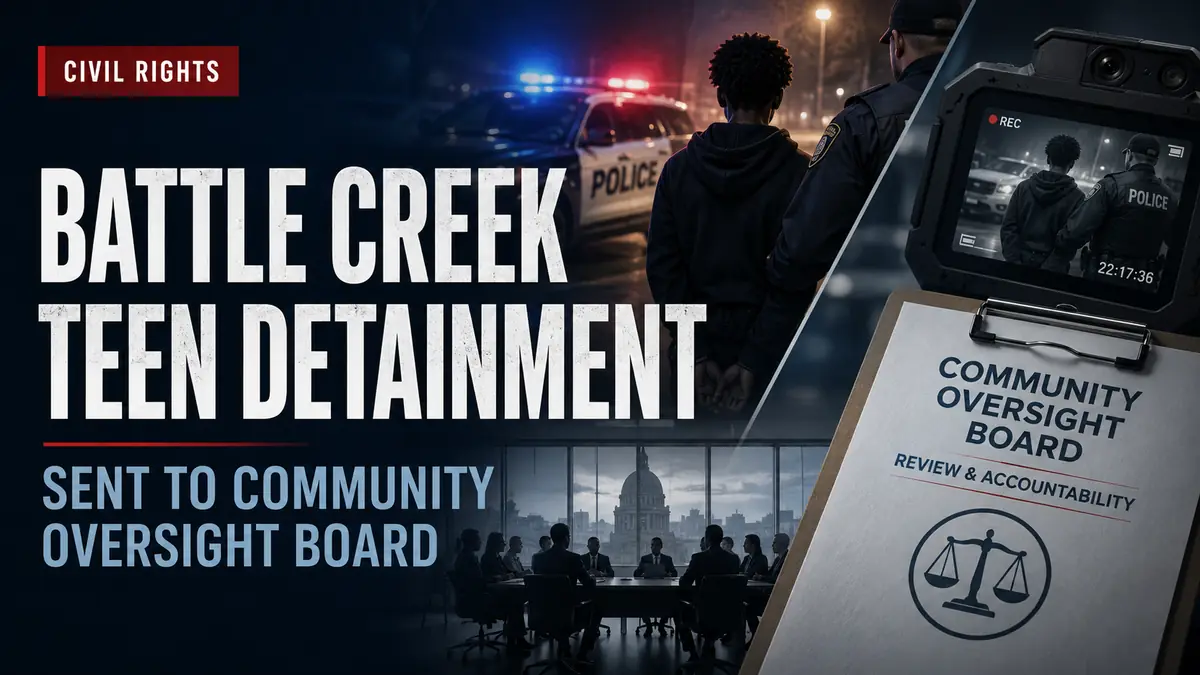
Battle Creek community speaking out over viral police body camera footage of a 16-year-old being detained while walking home.
Jeremiah Spearman was detained June 14 while walking in the Washington Heights neighborhood near Greenwood Avenue and Hubbard Street, according to a Battle Creek Police Department report.
Police saw the teen walking home wearing a full face covering. According the officer, he saw Spearman looking at the patrol vehicle, changing direction while walking and keeping his hand near his waistband. Based on those observations, the officer claimed he had reasonable suspicion.
He approached Spearman, asked him to stop and said that he wasn’t in trouble. When Spearman didn’t stop he detained him to search for a weapon. The officer grabbed his arm to frisk him. During this, Spearman told the officers he had a pocket knife, which was removed during the stop.
No other weapons were found.
In the body camera footage of the incident, the officer can be heard telling Spearman, “I don’t want people to walk around looking like they just committed a crime.”
Spearman told News Channel 3 he did not comply with the officer’s commands because of a previous encounter he says he had with Battle Creek police, where he claims he was also body slammed by officers.
After Spearman’s family members arrived at the scene to see what was happening, the officer determined there was no ongoing risk and released him. No charges were filed and no arrests have been made.
Spearman, his mother, Martricia Spearman, and several community members have spoken out publicly about racial profiling, police communication and trust in Washington Heights. Battle Creek police have said the officer acted within department policy.
“Our officers have a responsibility to address situations that may impact the safety and security of our neighborhoods,” said Police Chief Shannon Bagley. “Based on what the officer observed at the time, the decision to stop and briefly detain the individual was appropriate. The officer’s approach was calm and focused on resolving the situation safely.”
The Battle Creek Police Department has since released a redacted incident report and body camera footage of the incident.
City Manager Amanda Zimmerlin has referred the matter to the Community Oversight Board. The board serves in an advisory role to the city manager and reviews certain police-related complaints, appeals and incidents. The next listed Community Oversight Board meeting is July 8 at 5 p.m.
“We know our community expects us to respect individual rights while also keeping neighborhoods safe,” Bagley said. “Those decisions can be challenging in real time. We take these concerns seriously and encourage neighbors to work with us, share their concerns and try to understand the need to respond when something raises a safety concern.”
The local NAACP chapter was expected to meet with Mayor Mark Behnke on Tuesday, June 23, to discuss community concerns. Spearman's mother said she is considering legal action.
Legal Issues After a Police Detention
A police detention is any interaction with an officer when the officer prevents a person from leaving. Police generally have the authority to detain people if they have reasonable suspicion of criminal activity. A hunch is not enough.
To perform a frisk or pat-down, an officer generally needs reasonable suspicion that a suspect is armed and presently dangerous. The frisk must be limited to checking for weapons.
A police encounter can involve Fourth Amendment issues if an officer uses authority or physical contact to restrain someone's movement, put them in handcuffs or perform a pat-down. If the detainment was lawful depends on whether they had specific facts at that time supporting reasonable suspicion for the stop and a safety basis for a limited pat-down.
If legal action or a formal complaint follows, key evidence may include body camera footage, Spearman's cellphone video and any dashcam or pre-contact patrol video.
A civil-rights review may involve 42 U.S.C. Section 1983, officer conduct, city policy, training, supervision and the Community Oversight Board process. A disputed police stop does not automatically become a viable civil-rights claim.
For more background, see our guides on Michigan police ID demands and Michigan excessive-force claims, plus our police misconduct and civil rights practice pages.
Get Help From Michigan Legal Center
Michigan Legal Center is the Law Offices of Christopher J. Trainor & Associates. Our attorneys review Michigan police misconduct and civil-rights cases involving detentions, searches, arrests, excessive force, and government misconduct.
If you or a family member were detained, searched, handcuffed, injured, or targeted during a police encounter in Michigan, call Michigan Legal Center at (248) 886-8650 or contact us for a free consultation.
There is no attorney fee unless money is recovered for you. Case costs and fee terms are governed by the written fee agreement.