
When Do You Have To Show ID to Police in Michigan?
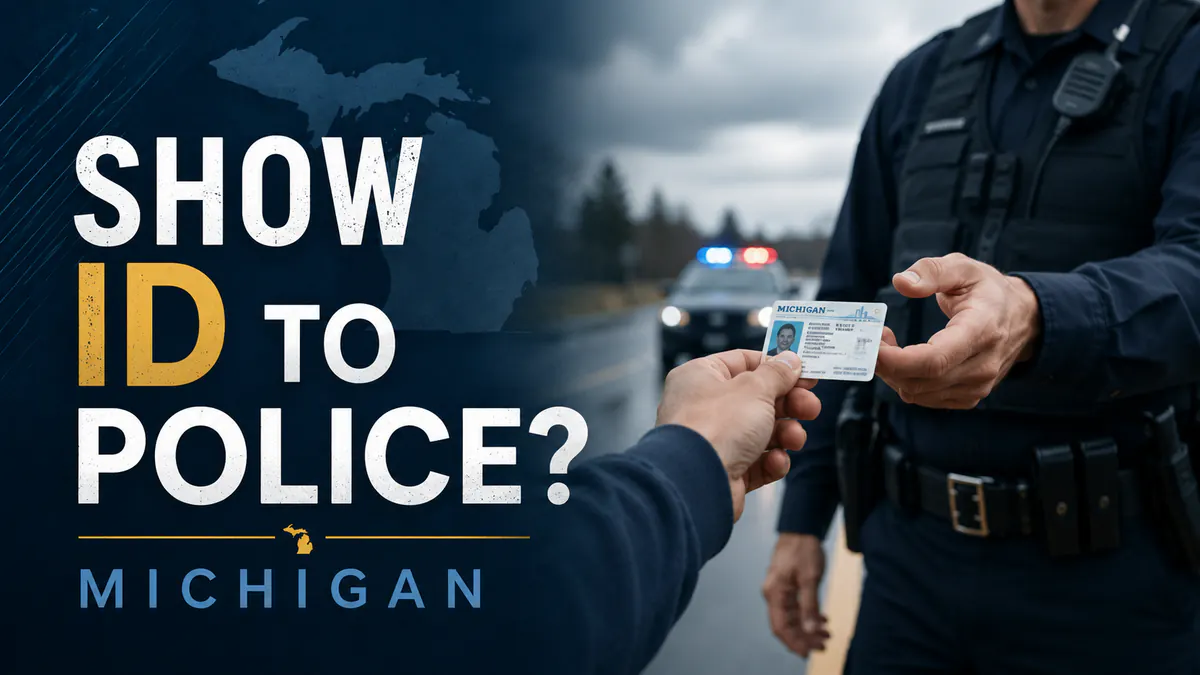
Do I Have to Show ID to Police in Michigan?
In Michigan, you do not have to show ID every time police ask, but you may have to identify yourself or provide documents if you are driving, lawfully detained, cited, arrested, or ordered to comply with a lawful command. Refusing, lying, or giving false documents can create arrest or obstruction risks.
Why it matters: If an ID demand turns into detention, a search, force, or arrest, the exact facts and records matter.
Police can ask for ID in many situations. The harder question is whether the request is legally enforceable. The answer depends on what you were doing, whether you were free to leave, what police claimed gave them a legal basis, and whether you were the driver, a passenger, or a pedestrian.
Is Michigan a Stop and ID State?
No, not in the broad way people usually mean that phrase. Michigan does not have a general stop-and-ID rule that makes every person show ID just because police ask.
But ID can still matter. Drivers have specific document duties. A lawful detention, citation, arrest, warrant issue, or lawful command can change the risk. Hiibel v. Sixth Judicial District Court upheld a Nevada stop-and-identify statute during a valid Terry stop; it did not involve a Michigan statute.
Separate duties can also apply in specific situations. For example, a person licensed to carry a concealed pistol who is stopped while carrying must immediately disclose the pistol and show the license and state-issued ID on request under MCL 28.425f.
When Drivers Must Provide ID and Documents During a Michigan Traffic Stop
If you are driving in Michigan and are lawfully stopped, you should provide your driver's license, registration, and proof of insurance when requested.
Michigan law requires a driver to display a license on police demand. Registration and insurance have separate production rules. See MCL 257.311, MCL 257.223, and MCL 257.328.
If you show registration or insurance on your phone, open only the document needed. Michigan law says that showing an electronic copy of your registration or insurance is not presumed to be consent to a search of your device. See MCL 257.223 and MCL 257.328.
Do Passengers Have to Show ID During a Traffic Stop?
Not simply because they are passengers. Driver document duties do not automatically apply to everyone in the car.
Passenger ID questions are fact-specific. Police may have another claimed basis to ask for ID, such as a separate investigation, citations, warrant issues, arrests, or safety concerns. A passenger can calmly ask, "Am I required to provide ID, or am I free to leave?" If the officer gives an order, avoid physical resistance and save the details for review.
Under Brendlin v. California, passengers are seized during a traffic stop. Arizona v. Johnson also treats a traffic stop as a seizure of everyone in the vehicle, but those cases do not create a general passenger duty to produce driver documents.
Do Pedestrians Have to Show ID if Police Ask?
Usually, a pedestrian does not have to show ID just because an officer asks a question. Police can approach and ask, but a detention has to be legally justified.
Terry v. Ohio allows a brief investigatory stop when police have reasonable suspicion. Brown v. Texas rejected an ID-based detention where officers lacked reasonable suspicion. The practical question is whether police had a specific legal basis, not whether the encounter felt uncomfortable.
What if Police Say I Am Being Detained or Under Arrest?
If police say you are detained or under arrest, do not physically resist. Ask calmly, "Am I free to leave?" If the answer is no, remember what the officer said and what reason was given.
After an arrest, identification can affect release or appearance-ticket issues in some situations. But the bigger civil-rights question is whether police had a lawful basis for the stop, detention, search, or arrest.
Can Refusing, Lying, or Giving False Documents Create Legal Risk?
Yes. Refusing an unlawful request is different from refusing a lawful command. Michigan obstruction law includes knowing failure to comply with a lawful command. See MCL 750.81d.
Lying or giving false documents can create separate risk. If you do not want to answer questions, a safer response is calm and simple: "I do not want to answer questions." Do not guess, argue, or give false information.
When Can an ID Demand Become a Civil-Rights Issue?
An ID demand may need civil-rights review when it leads to an unlawful detention, search, arrest, use of force, racial profiling, or retaliation for calmly asserting rights.
Save any evidence, photos, videos, documents, messages, witness names, ticket or arrest paperwork, and officer information you already have. Police video, dispatch audio, reports, and witness memories can become harder to obtain over time.
Talk to Michigan Legal Center About an Unlawful Detention or Arrest
Michigan Legal Center handles civil rights claims and police misconduct matters across Michigan. Michigan Legal Center has office locations in White Lake, Southfield, Grand Rapids, Ann Arbor, Flint, Lansing, Kalamazoo, Bay City, Gaylord, and Marquette, and the firm reviews claims statewide, including Metro Detroit, West Michigan, Mid-Michigan, Northern Michigan, and the Upper Peninsula.
If an ID demand led to detention, search, arrest, force, discrimination, or retaliation, contact Michigan Legal Center so our attorneys can review the records, preserve evidence, and evaluate the legal basis for what happened.