
Can Police Search Your Car or Home Without a Warrant in Michigan?
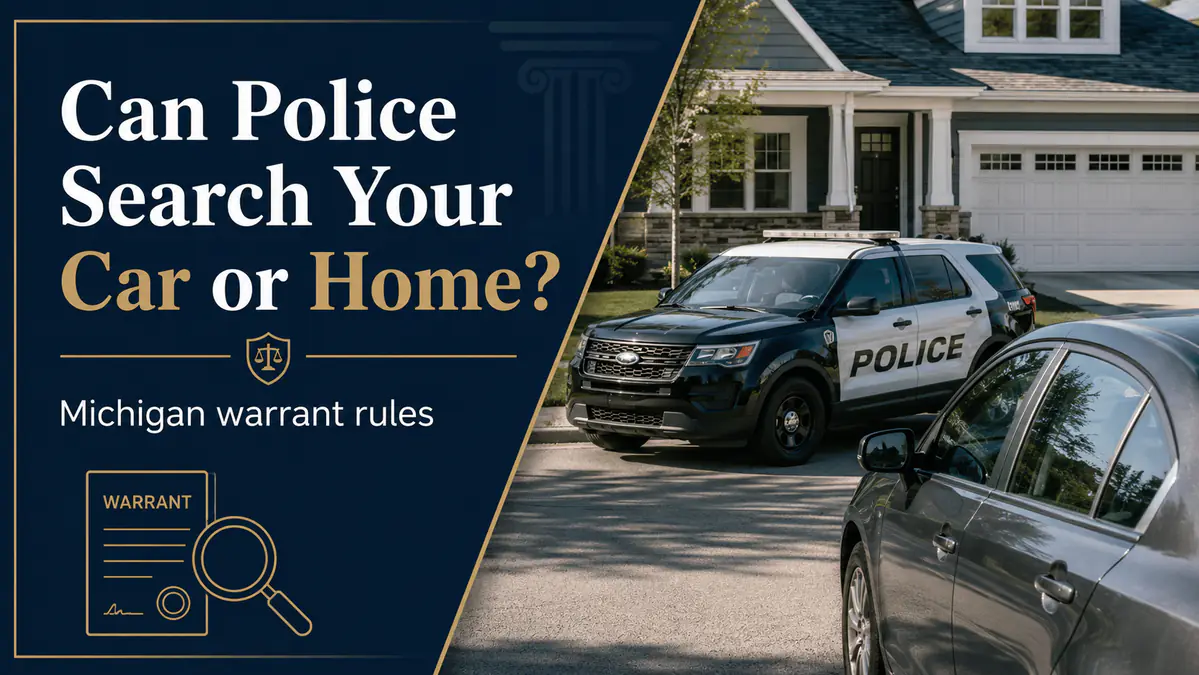
Police generally need a warrant to search a home, but cars are treated differently. During a traffic stop, police may search a vehicle without a warrant if a recognized legal exception applies.
If an officer asks to search your car, you can plainly and clearly state, "I do not consent to a search," but do not physically resist or otherwise obstruct the officer.
Why it matters: A clear and unequivocal refusal and an accurate record of what happened can help an attorney determine whether police had legal authority for the search.
Any time a police officer intrudes on a person’s reasonable expectation of privacy, it is considered a search. This may apply to an officer looking through the contents of a vehicle, containers, location or personal property.
Digital devices are treated differently from many physical containers. Police generally need a warrant to search the contents of a cell phone, even after an arrest.
A seizure is defined as an officer interfering with property or restraining a person's ability to freely move about.
Whether or not a search or seizure is legal depends on more than whether police had a warrant. It is what they searched, where they searched, whether anyone consented, what facts police claimed gave them legal authority for the search and what exception they relied on.
When Can Police Search a Car Without a Warrant?
A traffic stop does not automatically give police the right to search a car. During a stop, officers may ask the driver to show a license, registration and proof of insurance. That request for documents does not allow for a full vehicle search.
They can, however, stand outside the vehicle and look for anything in plain view. However, plain view requires the officer to lawfully be able to see the item and it’s incriminating nature to be immediately apparent.
Police may conduct a warrantless vehicle search if they have consent or probable cause to believe the vehicle contains evidence, contraband or something connected to a crime. This is often called the automobile exception or vehicle exception.
A warrant may also be unnecessary if the search took place during a lawful arrest. Arrest related car searches are limited however and do not automatically let police search the whole car.
In the past, an odor of marijuana was considered enough probable cause to search a car. In 2025, the Michigan Supreme Court held that marijuana odor alone no longer establishes probable cause to search a vehicle.
However, police can use the smell of marijuana as one factor in a totality of the circumstances evaluation.
If an officer attempts to search a car after the driver has refused consent, the driver should not physically block or resist the search in any way. Fighting against an illegal search comes later with the help of a lawyer, not at the scene of the search.
If possible, record the interaction with a cell phone, but do not interfere.
Can Police Search Your Home Without a Warrant?
Homes, apartments, rented rooms and other private living spaces usually receive stronger Fourth Amendment protection than vehicles. A search warrant generally means a judge or magistrate has approved a search of a specific place and/or specific items based on the probable cause that has been presented.
Even without a warrant, there are situations where police may still enter or search a home if there was:
- consent from someone with authority over the space
- an emergency, such as a reasonable belief that someone needs immediate help
- exigent circumstances, such as a serious risk that evidence will be destroyed or someone will be harmed
- evidence in plain view after police are already lawfully inside
Whether or not police have been given legal consent or access can become more complicated when involving other people who live in or are staying in or own the home. Private bedrooms, closed bags, locked containers, phones or other private areas may or may not be subject to search depending on the specific language in the search warrant and the specific facts of the case.
These types of cases are very fact intensive and specific.
Police may rely on consent from someone they reasonably believe has authority over property, even if that belief later turns out to be wrong.
A search warrant is not the same as an arrest warrant. Generally, a search warrant should identify the place to be searched, and the specific items police are looking for, while an arrest warrant generally authorizes police to arrest a specific person. Because of the possible complications and exceptions and the fact intensive nature of these cases, the facts of the case should be carefully reviewed before assuming that a search was lawful or unlawful.
What Should You Say If Police Ask to Search?
Use clear, calm words:
"I do not consent to a search."
If able, record the rest of the interaction on your cell phone.
Do not explain, debate, threaten or physically block officers. If you are not sure whether you are allowed to leave, ask:
"Am I free to leave?"
If police give you an order, don't argue, stay calm and remember any details you can. Refusing consent does not stop every search, but it can matter later because it shows you did not voluntarily give permission.
If police ask to search your phone or electronic information, say that you do not consent and want to speak to a lawyer. Digital searches can raise separate warrant and privacy issues.
What Is the Difference Between Reasonable Suspicion and Probable Cause?
Police can stop someone briefly or conduct a limited investigation if they have reasonable suspicion that the person has committed, is committing or is about to commit a crime. Reasonable suspicion requires a lower standard of proof than probable cause.
Probable cause requires a higher standard. It may support searches, arrests or a request for a search warrant. Probable cause generally means there are enough facts to reasonably believe evidence, contraband or something connected to a crime will be found in the place searched.
The difference matters because police may have enough information for a brief stop but not for a search. This could be the distinction between a cop being allowed to stop someone and ask a few questions, versus being able to search their car, room, bag or home.
There is no single, simple rule that covers every circumstance. The facts, location, timing and officer's stated reason all matter.
What If Police Found Evidence During an Illegal Search?
The exclusionary rule can suppress evidence found as a result of an illegal search or seizure. The fruit of the poisonous tree doctrine may exclude later evidence discovered because of an illegal search. This means that evidence found during or because of an illegal search, or because of that search could be kept out of a criminal case.
That does not mean evidence is automatically suppressed. Courts may look at the search, the claimed exception, the connection between the search and the evidence and other legal doctrines.
For example, evidence may still be admitted if it came from an independent source, would have been discovered lawfully anyway or the connection to the illegal search became too remote.
A civil-rights claim is a separate issue. Establishing that a search was unlawful in a criminal case does not automatically create a civil lawsuit. A civil claim may depend on who conducted the search, what rights were violated, whether the violation caused harm, available defenses and whether the claim is limited by a conviction or plea.
What Evidence Should You Save After a Police Search?
Save any evidence you have or can legally obtain as soon as it is safe to do so. Do not trespass, interfere with officers or access someone else’s private account or device without permission. Focus on saving:
- body camera, dash camera, doorbell, security or phone video
- names and contact information for witnesses
- the search warrant, affidavit for a search warrant, inventory sheet, ticket, citation, police report or incident number
- photos of damaged doors, locks, furniture, containers, vehicles, phones or personal property
- photos showing where items were before and after the search
- texts, calls, location data, receipts or messages showing the timeline
- medical records if force was used
- notes on what officers said, who consented or refused and where officers searched
Police videos can disappear or become harder to obtain over time. So a written preservation request may be necessary to keep the evidence from being deleted or recorded over. This type of request is different from a public records request, which may also be necessary to obtain the same evidence.
When Should You Call a Michigan Civil Rights Attorney?
Immediately. A civil rights attorney at Michigan Legal Center may be able to help you if the search involved:
- a vehicle search after you refused consent
- a home, apartment, bedroom or private room search without a warrant
- a search after a questionable traffic stop
- a false arrest or wrongful detention
- excessive force during the search
- racial profiling or retaliation for asserting rights
- missing, delayed or conflicting police reports or video
- property damage during the search
Michigan Legal Center handles civil rights and police misconduct matters across Michigan. For related issues, see our articles on false arrest and wrongful detention and police brutality and excessive force.
If a police search of your car, home, apartment, room, bag, phone or property may have violated your rights, contact Michigan Legal Center for a case review.