
Can Police Arrest or Retaliate Against You for Recording Them in Michigan?
Can I record police officers in Michigan?
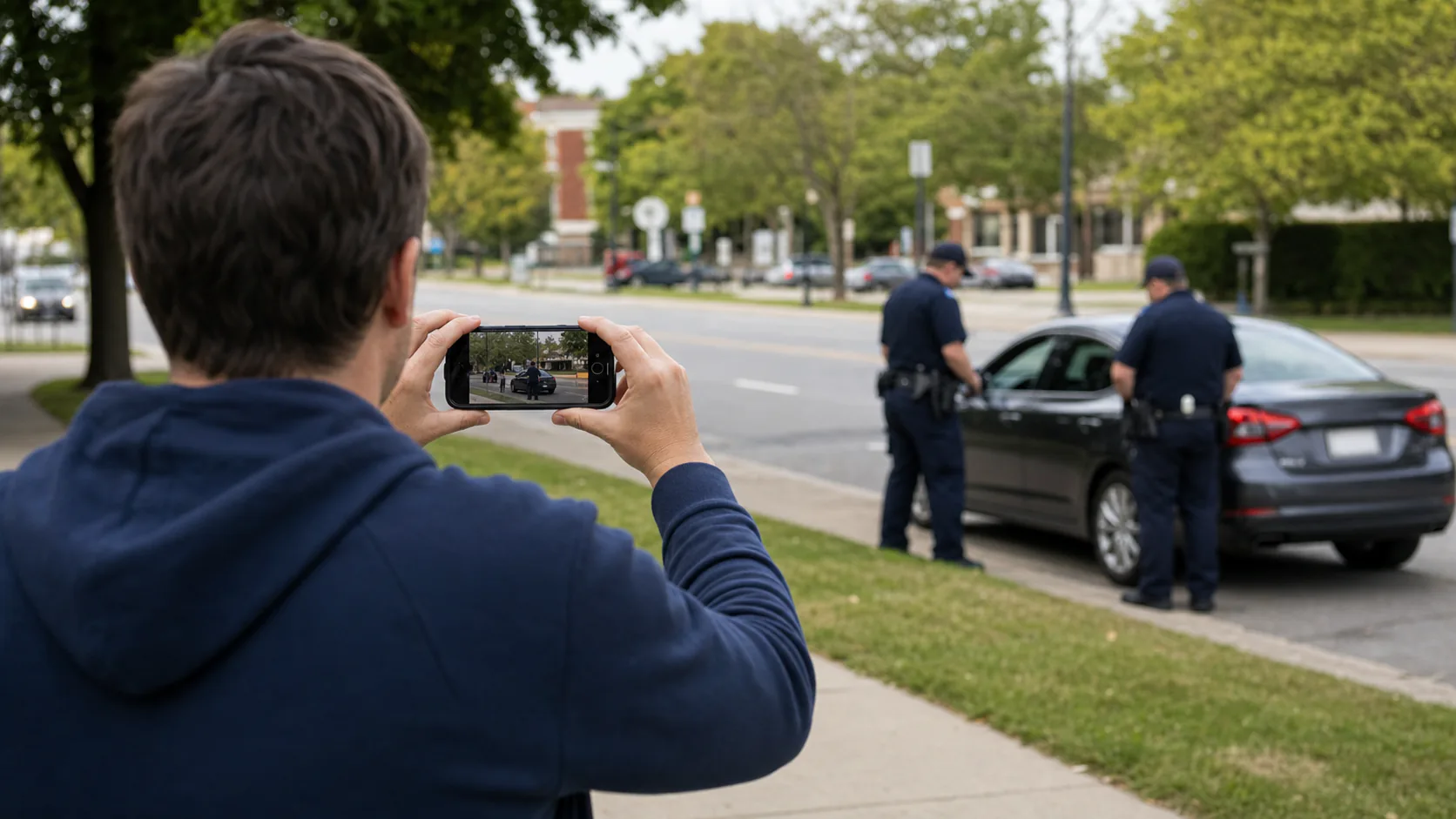
Yes. In most situations you are allowed to record police officers performing their duties in public, as long as you are not trespassing. You still have to be careful not to interfere with police work, violate a lawful safety restriction or enter an area that is closed to the public.
Recording private conversations or recording in private places is a separate legal issue in Michigan law and has different standards.
When can police tell you to move while you are recording?
Police may tell you to move while you are recording if the order is a reasonable safety or scene-management restriction. It cannot be based on the content of your recording, must be narrowly tailored to a significant government interest and should leave a meaningful way to continue recording.
In People v. Van Net, the Michigan Court of Appeals held that videotaping a traffic stop was protected by the First Amendment. It upheld the defendant’s obstruction conviction because he repeatedly ignored directions to stay back, continued approaching the stop and shined his phone’s flash directly into a trooper’s eyes. The officers still allowed him to film from a safe position.
The right to record does not allow you to cross a police line, enter a closed crime scene, block an officer or physically interfere with police work. Under Michigan’s resisting-or-obstructing statute, obstruction can include knowingly failing to follow a lawful command. Michigan courts distinguish a physical refusal to comply from verbal disagreement alone.
Not every direction to move or stop recording is automatically lawful. The distance involved, traffic and scene conditions, the stated safety reason and whether another location still allows recording can all matter.
Can police arrest you for recording or criticizing them?
No. But they may arrest you when they have probable cause to believe you committed a separate offense, such as violating a lawful safety order or interfering with an investigation. They may not use an arrest to punish protected recording or criticism.
Probable cause means the specific facts and circumstances known at the time would lead a reasonable officer to believe an offense occurred. Under Nieves v. Bartlett, probable cause generally defeats a First Amendment retaliatory arrest claim. There are exceptions to this, such as other people who committed the same unlawful conduct not being arrested while the person who was filming was.
In Grady v. Cratsenburg, the Sixth Circuit concluded that probable cause supported the arrests after they entered the perimeter of an active shooting investigation and repeatedly refused commands to step back. Other neighbors also filmed the officers, but they remained outside the perimeter and had not received or disobeyed the same commands.
A threat, temporary detention, citation, arrest, phone seizure, digital search, use of force and prosecution are different actions with different legal standards. A later dismissal or acquittal can be important evidence to preserve, but it does not by itself prove that the original arrest lacked probable cause.
A person acting under color of state law who violates a federal right may face a claim under 42 U.S.C. § 1983. Whether a claim is viable depends on the facts, circumstances, causation, injury, defendants and defenses. An officer’s alleged violation also does not automatically make a city or county liable.
Michigan Legal Center’s false arrest and wrongful detention information addresses the separate arrest and detention questions. Our civil rights practice information page explains how constitutional claims, defendants, evidence and defenses can differ.
Can police take or search the phone that recorded them?
No, not automatically. Police may have a lawful reason to take or secure a phone, including during an arrest or while seeking a warrant. But a lawful seizure does not itself authorize a search of its digital contents.
In Riley v. California, the United States Supreme Court held that police generally need a warrant before searching the digital information on a phone seized during an arrest, subject to recognized exceptions.
If police take your phone, preserve information about where and why they took it, whether they gave you a property receipt, how long they kept it and whether they searched or unlocked it. Preserve any warrant, inventory record, extraction report or account alert connected to the device.
Michigan Legal Center’s phone search information explains the broader rules for searches, consent and warrants.
What evidence should you preserve after an arrest or threat?
Preserve the original recording and related records. Context, timing, distance, exact words and file metadata can be as important as the video itself.
Save what you already have and any other records lawfully available to you, including:
- the original recording in its original format and a separate cloud or device copy
- file metadata, upload history, account alerts and messages about the recording
- a written timeline covering the lead-up, location, distance, directions and what happened next
- videos and photographs that show witnesses, plus witness names and contact information, because witnesses may be difficult to locate later and evidence can disappear
- police reports, citations, charging records, dismissal records and court papers
- phone property receipts, warrant papers and search records
- photographs of injuries, medical records and lost-work records if the encounter caused harm
Keep the original file unchanged. Editing, trimming, overwriting or deleting it can remove context or metadata needed for review.
Send a written preservation request as soon as possible to the agency and other involved public entities because video can be overwritten or otherwise become unavailable. A Freedom of Information Act request can seek copies of records, but it is not the same as asking an agency to preserve evidence.
Do deadlines matter after police retaliation or an arrest?
Yes. A criminal case and a civil claim can have separate deadlines. State law claims may also have different timelines.
A federal civil rights claim under Section 1983 in Michigan generally uses the state’s three-year personal-injury limitations period under MCL 600.5805. Federal law determines when the clock begins for a particular claim.
Michigan’s limitations statute separately lists two-year periods for some state law claims, including false imprisonment, malicious prosecution, assault and battery. Do not assume a pending criminal charge, a dismissal or a public records request pauses a civil deadline.
Contact Michigan Legal Center if you need a civil rights attorney to review the police order, the basis for an arrest, available video and records, possible deadlines and the proper defendants.