
Passenger Injury Claims After a Michigan Car Accident
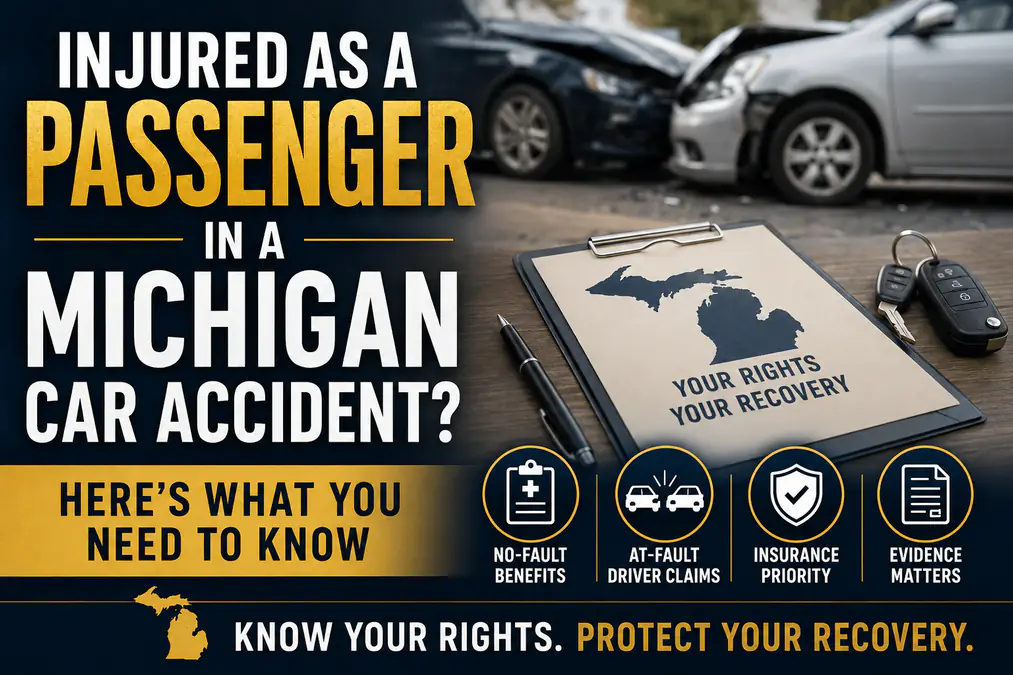
What Happens if I was Injured as a Passenger in a Michigan Car Accident?
If you were injured as a passenger in a Michigan car accident, you may have two potential claims: a Michigan no-fault/PIP claim for medical bills and certain benefits, and a separate injury claim against an at-fault driver; if fault, injury severity, insurance coverage, and Michigan law support it.
Why it matters: Passengers usually do not cause the crash, but insurance priority, fault evidence, medical records, and timing rules can still become complicated and require immediate assesment by one of our accident attorneys.
What are the Two Types of Michigan Passenger Injury Claims?
A passenger injury accident in Michigan can involve two types of potential claims.
The first type of claim is the no-fault/PIP claim. That claim may address medical bills and certain benefits through an insurer responsible under Michigan's priority rules.
The second type of claim is the third-party injury claim. That claim asks whether a driver, company, or other party caused the crash and whether the passenger can pursue damages beyond no-fault benefits.
Do Passengers Have Their Own Injury Claims?
Yes. A passenger included in an accident is not wihtout options just because they were not driving.
The passenger will need to identify the correct no-fault insurer. The passenger may also need to evaluate whether the driver of the vehicle they were in, another driver or more than one driver caused the crash.
Those questions should be kept separate. PIP priority is not the same as fault. A fault dispute between drivers does not automatically answer who should handle the passenger's medical bills.
Who Pays a Passenger's Medical Bills After a Michigan Crash?
The answer can depend on Michigan's no-fault priority rules, the aplicable insurance policies, the vehicles involved, household coverage, exclusions and other factors.
For many motor vehicle occupants, MCL 500.3114 is the starting point for PIP priority. It includes rules for occupants, vehicles used in the business of transporting passengers, employer-owned or employer-registered vehicles, and assigned-claims issues.
That does not mean the passenger should determine priority by themselves. The practical question of who pays medical bills for an injured passenger, based on the policies involved and the facts and circumstances that actually exist.
Our attorneys can review the passenger's household auto coverage, the involved vehicle's coverage, any rideshare or commercial coverage, health insurance coordination issues, and insurer letters before a wrong claim position creates delay. Even if neither party has insurance, benefits may still be received through the Michigan Automobile Insurance Placement Facility.
For a broader discussion, read Michigan Legal Center's guide to who pays medical bills after a Michigan car accident.
Can a Passenger Sue the Driver Who Caused the Crash?
Sometimes. A passenger may have a third-party injury claim against an at-fault driver if Michigan's injury threshold and other legal requirements are met.
The at-fault driver could be:
- the driver of the vehicle the passenger was in
- another driver
- more than one driver
- a company, vehicle owner or other responsible party depending on the facts
For pain and suffering or other noneconomic loss after a motor vehicle crash, MCL 500.3135 generally requires death, serious impairment of body function, or permanent serious disfigurement.
That threshold is fact-specific. Medical records, imaging, work restrictions, treatment history, scarring, daily-life changes, and crash evidence may all matter.
What If the Driver Was a Friend or Family Member?
This is common. Often times, a passenger may worry that a claim against a friend, parent, spouse, sibling, coworker or other person they know is a personal attack.
In the majority of cases, the claim is focused on insurance coverage and legal responsibility. That does not mean coverage is guaranteed, nor does it not mean that every claim is simple or quick to resolve.
What Evidence Should an Injured Passenger Obtain?
Save everything you have or can obtain. Do not worry about sorting out legal priority before you preserve basic records such as:
- crash report or incident number
- driver and insurance information
- photos of vehicles and scene
- photos of injuries
- names and contact information of witnesses
- medical records and discharge papers
- ambulance or emergency room records
- text messages about the ride or crash
- rideshare trip receipt or app screenshots, if applicable
- work schedule or missed-work records
- insurance letters
- any recorded-statement requests from insurers
- medical prescriptions
- mileage and medical appointment logs
What Can Hurt a Passenger Injury Claim?
Avoid these common pitfalls:
- assuming the driver's insurer is the only possible source of benefits
- giving a written or recorded statement without legal advice
- signing a release too early
- minimizing symptoms to medical care providers
- avoiding medical treatment
- posting information about the accident online
- failing to give accurate and truthful medical histories
The goal is not to make the passenger handle the claim alone. The goal is to make sure the right people/insurance comanies give you what you deserve.
Why Does Fast Attorney Review Matter?
Passenger claims can involve multiple insurers, fault disputes between drivers, PIP priority questions, treatment records, and deadlines.
PIP timing is especially sensitive. MCL 500.3145 addresses such things as written notice, lawsuit timing, one-year-back, tolling, and notice-content rules for personal protection insurance benefits. The takeaway is simple: deadlines can depend on the claim and facts, so timing should be reviewed immediately after an accident.
If the injured passenger should get medical care, immediately save the records they have, and let counsel sort out the rest.
How Can a Michigan Car Accident Attorney Help?
A Michigan car accident attorney can:
- Identify the correct no-fault/PIP insurer.
- Separate the no-fault claim from any third-party injury claim.
- Review whether the injury meets Michigan's threshold requirements.
- Determine which driver or company may be responsible.
- Preserve crash and insurance evidence.
- Handle insurer communication.
- Evaluate pain and suffering, excess economic loss and related damages.
- Get vital accident information preserved or inspected by experts in necessary.
Michigan Legal Center's personal injury attorneys can review the crash facts, policies, medical records, insurance letters, and evidence before a passenger signs a release or gives a detailed statement.
What Should I Do Next After a Passenger Injury Claim?
If you were hurt as a passenger, get medical care if needed, keep the records you have, and obtain legal help immediately.
Michigan Legal Center, The Law Offices of ChristopherJ. Trainor & Associates offers free consultations for injured passengers across Michigan. Contact Michigan Legal Center to discuss your passenger injury claim after a Michigan car accident.
What If the Passenger Was in an Uber, Lyft, Taxi or Work Vehicle?
Rideshare, taxi, commercial and work-vehicle crashes can make the case potentially more complex. If the crash involved Uber, Lyft or another rideshare, read Michigan Legal Center's article on Michigan Uber and Lyft accident claims.