
Michigan Uber and Lyft Accident Claims: Who Pays After a Crash?
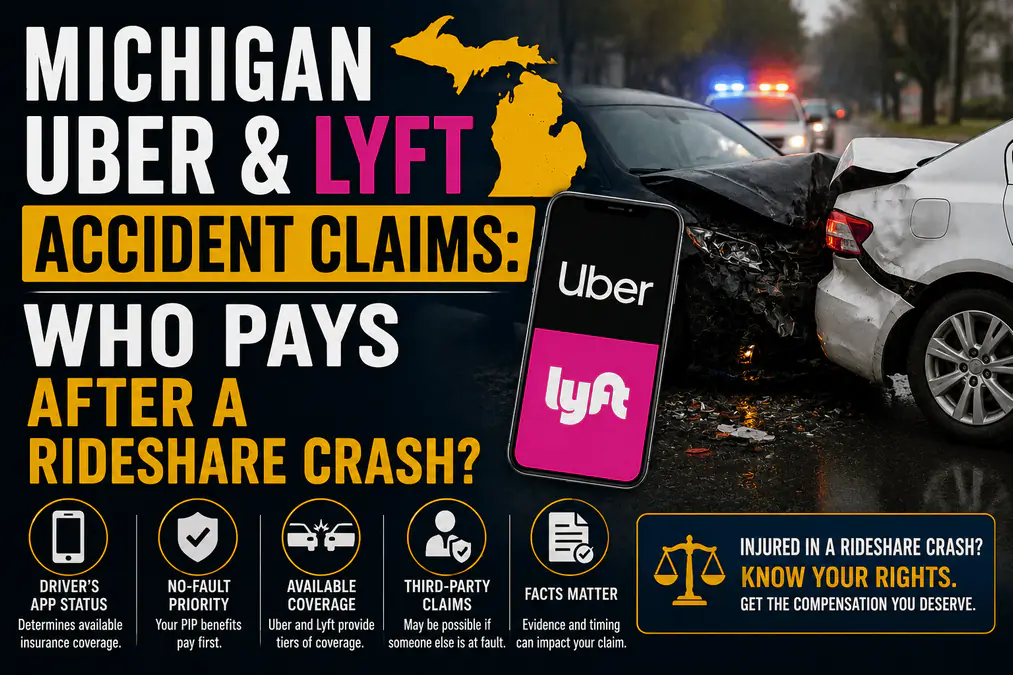
Who Pays After a Michigan Uber or Lyft Accident?
Short answer: In Michigan, Uber and Lyft accident claims are different from ordinary car accident claims because the driver's app status can change which insurance coverage applies.
The main question is usually this: was the driver logged out of the app, logged into the app and waiting for a ride request, or already engaged in a prearranged ride?
Michigan's Limousine, Taxicab, and Transportation Network Company Act sets insurance requirements for transportation network company drivers. Under MCL 257.2123, the required coverage changes depending on whether the driver is available for ride requests or engaged in a prearranged ride.
Michigan Legal Center reviews the app status, insurance policies, No-Fault priority, medical evidence, and liability before a claim is presented. In rideshare cases, a missed coverage issue can change the available recovery.
What Is a Michigan Rideshare Accident Claim?
A Michigan rideshare accident claim is a motor vehicle injury claim involving a transportation network company driver, such as an Uber or Lyft driver. These claims often involve multiple possible insurance sources, including:
- The rideshare driver's personal auto insurance
- Uber or Lyft insurance
- The injured person's own No-Fault policy
- A spouse's or resident relative's No-Fault policy
- The rideshare vehicle's insurer
- Other available liability, uninsured motorist, underinsured motorist, umbrella, or commercial coverage
Because several insurers may be involved, the app-status investigation often becomes one of the most important parts of the case.
The Three Rideshare Coverage Periods
Michigan rideshare claims usually start with the driver's app status at the time of the crash.
| Period | Driver's app status | Available coverage |
|---|---|---|
| App off | The driver was not logged into the rideshare app. | MCL 257.2123 may not apply. |
| Logged on, but not engaged in a prearranged ride | The driver was logged into the rideshare app and available for ride requests, but had not accepted a ride. | Michigan law requires residual third-party liability of at least $50,000/$100,000, according to MCL 257.2123(2)(a). |
| Prearranged ride | The driver accepted a ride request, was on the way to pick up the rider, was transporting the rider, or had not yet completed drop-off. | Michigan law requires at least $1,000,000 in combined liability coverage, according to MCL 257.2123(3)(a). |
These periods are not just labels. They can decide which insurer pays, what limits apply, and which liability coverage may apply.
What Counts as a Prearranged Ride?
Michigan law defines a prearranged ride in MCL 257.2102(o). In general, the prearranged ride begins when a transportation network company driver accepts a ride request from a requesting rider through the transportation network company, continues while the driver transports the rider, and ends when the last requesting rider departs from the vehicle.
That definition matters because a crash during a prearranged ride has different minimum insurance requirements than a crash when the driver is merely logged into the app and waiting for a request.
App records, trip receipts, GPS data, pickup status, drop-off status, and driver communications can all matter. A police report may not be enough to prove the correct coverage period.
App Off: Personal Auto Coverage Usually Controls
If the driver was not logged into the Uber or Lyft app, Uber or Lyft coverage generally does not apply.
That does not make the case simple. The driver's personal auto insurer may dispute fault, damages, policy exclusions, or whether the driver was using the vehicle for a commercial purpose. The injured person's own No-Fault coverage may also need to be identified.
Our attorneys determine whether the app was truly off, preserve phone and app evidence, and review every potentially available policy before accepting an insurer's coverage position.
Logged On, No Ride Accepted
This period creates many coverage disputes. The driver is logged into the rideshare app and available for requests, but has not accepted a prearranged ride.
Under MCL 257.2123(2), required coverage during this period includes at least:
| Coverage | Minimum amount |
|---|---|
| Bodily injury or death | $50,000 per person / $100,000 per accident |
| Property damage | $25,000 |
| No-Fault PIP and property protection | Required under Michigan No-Fault law |
The required coverage may be maintained by the driver, the transportation network company, or both.
For serious injuries, the minimum limits may be far below the value of the claim. That is why the app status and all available policies need to be investigated quickly.
Prearranged Ride: Accepted Ride Through Drop-Off
Once the driver is engaged in a prearranged ride, the required liability coverage increases.
Under MCL 257.2123(3), this period requires residual third-party automobile liability insurance with a minimum combined single limit of $1,000,000 for bodily injury or property damage. Required No-Fault PIP and property protection coverage also apply.
Do not assume the insurer will voluntarily classify the crash as an active-ride case. The ride acceptance timestamp, trip status, GPS records, trip receipt, internal rideshare data, and driver communications may become the most important evidence in the case.
Michigan No-Fault PIP Benefits Still Matter
Rideshare liability coverage is only one part of the claim. Michigan No-Fault PIP benefits may cover allowable medical expenses, work loss, replacement services, and related benefits, subject to the policy and the No-Fault Act.
Under MCL 500.3107(a), (b), and (c), PIP benefits may include allowable expenses for reasonably necessary care, recovery, or rehabilitation; work loss; and replacement services, subject to statutory limits and policy elections.
No-Fault priority can be complicated in a rideshare crash.
Under MCL 500.3114(2)(g), a rideshare passenger must first look to their own No-Fault policy, a spouse's policy, or a resident relative's policy. If that coverage is not available, the insurer of the transportation network company vehicle may become responsible under the statutory priority rules.
If you were in another vehicle hit by a rideshare driver, your own No-Fault policy usually takes priority for your PIP benefits first. If you were the rideshare driver, coverage depends on whether you were logged on, whether a prearranged ride was active, and how the personal and rideshare policies interact.
Our attorneys identify the proper PIP insurer, send notices, track deadlines, and pursue the liability claim separately.
Serious Injury Claims Against the At-Fault Driver
PIP benefits are separate from a pain and suffering claim. To recover noneconomic damages after a Michigan motor vehicle crash, the injured person generally must meet the threshold in MCL 500.3135:
- Death
- Serious impairment of body function
- Permanent serious disfigurement
For serious impairment, the statute focuses on an objectively manifested impairment of an important body function that affects the person's general ability to lead their normal life.
McCormick v Carrier, 487 Mich 180; 795 NW2d 517 (2010), explains that the analysis is fact-specific and looks at how the person's normal life was affected before and after the crash.
The threshold applies even when a commercial rideshare policy is involved. A large policy limit does not eliminate the need to prove the statutory injury threshold.
Our attorneys build the threshold proof through medical records, imaging, specialist opinions, work restrictions, treatment history, functional limitations, witness statements, and before-and-after evidence. The legal question is not just what diagnosis appears in the chart. It is whether the statutory threshold is met.
Why App Records Matter
The most important evidence is often not visible at the scene. Uber and Lyft maintain digital records showing when a driver logged in, accepted a ride, arrived at a destination, began the trip, and completed the trip.
Those records can determine whether the liability limits apply. A driver statement or police report may not be enough.
Michigan law also requires transportation network company drivers to disclose certain insurance information and whether they were logged on or engaged in a prearranged ride when directly involved parties, insurers, or law enforcement request it, pursuant to MCL 257.2123(8).
Our attorneys send preservation demands, request trip data, subpoena records when litigation requires it, and compare the app log against police, GPS, phone, vehicle, and witness evidence.
What to Preserve After a Rideshare Crash
If you were a rideshare passenger, preserve:
- Trip receipts
- App history
- Driver and vehicle information
- Screenshots of the trip
- Messages with the driver or rideshare platform
- Photos of injuries, vehicle damage, and the scene
- Medical records, bills, discharge papers, and follow-up instructions
If you were another driver, pedestrian, or cyclist, preserve:
- Photos and videos
- Witness names and phone numbers
- The police report number
- Vehicle and license plate information
- Anything showing the driver was working for Uber or Lyft
- Your own insurance information and medical treatment records
Then let counsel handle the coverage investigation. Rideshare insurers and personal auto insurers may each try to shift responsibility to someone else.
Deadlines in Michigan Rideshare Accident Claims
There may be several deadlines.
The underlying bodily injury claim is commonly analyzed under Michigan's general three-year injury deadline in MCL 600.5805(2). A claim for No-Fault PIP benefits has separate timing rules under MCL 500.3145, including notices, filing deadlines, tolling, and the one-year-back rule.
The general three-year injury deadline is not enough by itself. App data, video, vehicle evidence, and witness information can disappear much earlier. Our attorneys track the bodily injury deadline, PIP deadlines, and policy deadlines at the same time.
Can You Sue Uber or Lyft Directly?
Often, the first practical claim is against available insurance coverage, not a direct negligence claim against the rideshare company.
A direct claim against Uber, Lyft, or another transportation network company may require additional facts showing the company itself did something legally actionable, such as negligent screening, negligent retention, negligent safety practices, or another independent act or omission. That issue depends on the evidence.
Our attorneys evaluate the driver history, app records, platform records, policy language, and company conduct before deciding whether a direct claim against the transportation network company is supported.
What Our Attorneys Do After a Rideshare Crash
Your first job is to get medical care and preserve basic information. Your attorney's job is to handle the coverage maze.
Michigan Legal Center can:
- Determine the active rideshare period
- Send preservation demands for app, GPS, trip, and communications data
- Identify available personal, rideshare, PIP, property protection, UM/UIM, umbrella, commercial, and liability insurers
- Send required No-Fault notices and track MCL 500.3145
- Determine whether MCL 500.3114 or MCL 500.3115 points to the injured person's policy, a household policy, the rideshare vehicle's insurer, the Michigan Assigned Claims Plan, or another source
- Build the medical evidence needed for the MCL 500.3135 threshold
- Push back when insurers misclassify the coverage period or delay payment
- Evaluate settlement offers
- Litigate the claim when an insurer refuses to pay fairly
The goal is not for you to become an expert in rideshare insurance. The goal is to get counsel involved early enough so that the right data is preserved and the right insurer is held responsible.
Talk to a Michigan Rideshare Accident Attorney
Michigan Legal Center handles Uber, Lyft, rideshare, car accident, and personal injury cases throughout Michigan. With offices in Metro Detroit and Marquette, we represent clients in Detroit, Grand Rapids, Flint, Lansing, Ann Arbor, Kalamazoo, Wayne County, Oakland County, Macomb County, Genesee County, Kent County, Washtenaw County, Metro Detroit, and across the Upper Peninsula.
Call (248) 886-8650 for a free consultation. No attorney fee unless we recover money for you. Case costs and fee terms are governed by the written fee agreement.