
Can You Sue After a Hunting Accident During Michigan Deer Season?
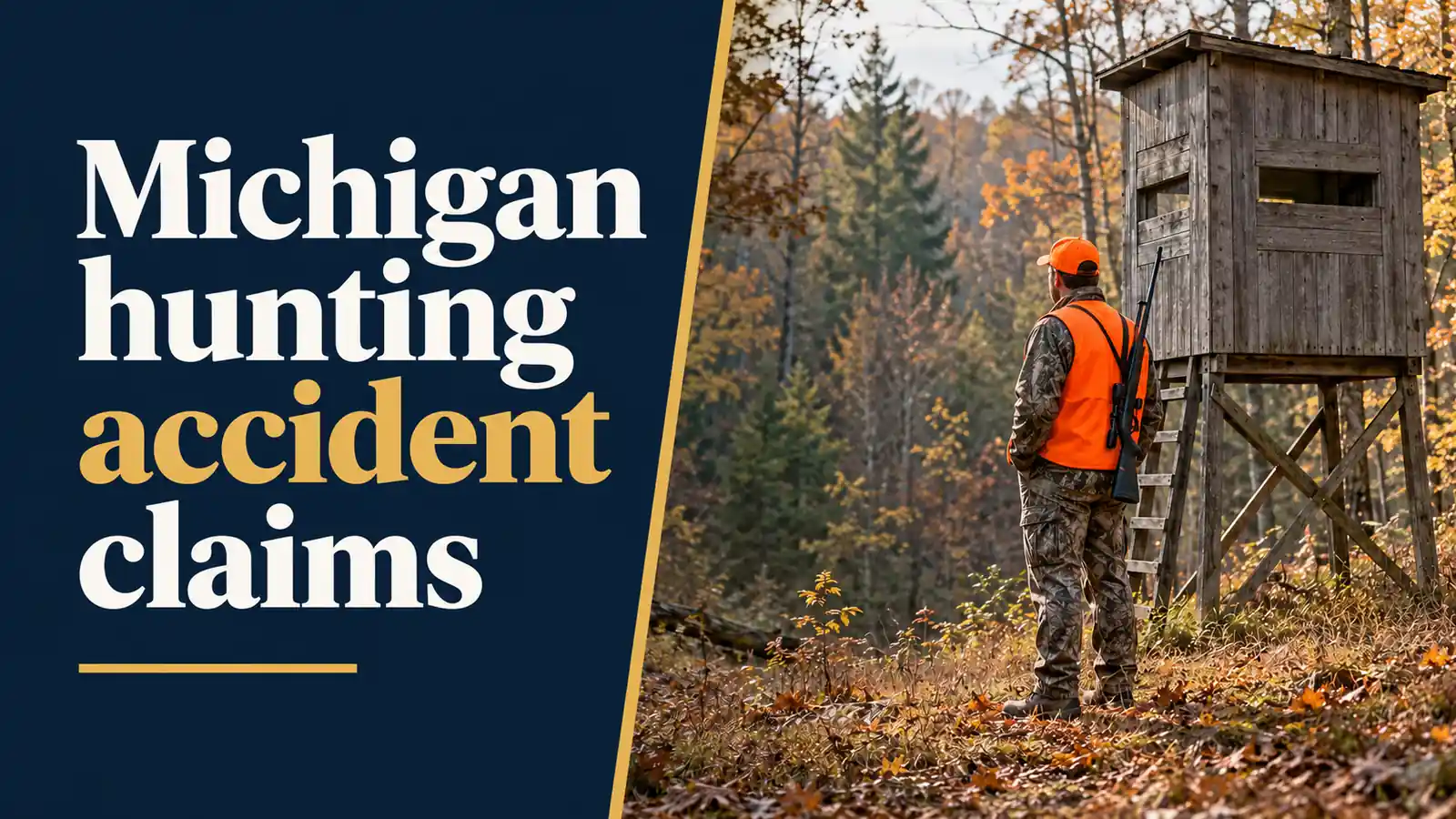
Yes, if you were shot by a hunter, they could be held liable for your injury. There is an inherent risk that hunters share when they are firing guns together, so creating a successful claim means proving the injury was caused by reckless misconduct.
Can you sue if the shooting was accidental?
Yes, as long as the evidence can prove that their actions led to your injury and they acted recklessly. An ordinary-negligence claim asks whether the shooter failed to use the care a reasonably careful person would have used in the same circumstances. Under Michigan Model Civil Jury Instructions 10.02 and 15.01, an injury alone does not establish that failure.
A successful lawsuit could allow you to recover expenses for medical care, lost earnings and pain and suffering damages.
Does being a fellow hunter change the situation?
Yes. When two people hunt together, they accept a level of inherent injury risk, so a claim requires a higher standard than ordinary negligence. Otherwise, ordinary negligence applies.
Reckless misconduct is more than being careless, it’s knowing that someone could be hurt by your actions and not caring if they are or trying to avoid it.
Under Bertin v. Mann, that inherent risk is one a reasonable participant would foresee in the actual circumstances. General awareness that hunting can be dangerous is not enough. The question is whether the injury was foreseeable. For a hunting injury, that can depend on where the hunters stood, the sequence of shots, their experience, their past practices and the hunt’s rules.
In Payne v. Payne, which involved a European-style pheasant hunt, a hunter lowered his shotgun after firing at a bird. The gun discharged and struck the hand of the hunter beside him. The court sent the case back to determine whether an injury occurring that way was an inherent risk of the hunt.
The higher standard does not automatically apply to an injured bystander who was not taking part in the hunt.
Is the landowner automatically responsible?
No. If you were hunting an owner, tenant or lessee without paying for access, a claim against that person may be barred under Michigan’s recreational-use law. This is unless their gross negligence or willful and wanton misconduct caused your injury. These standards require more serious fault than ordinary carelessness.
For paid hunting on a qualifying agricultural farm, MCL 324.73301 requires an injury caused by an unreasonably dangerous condition, the property holder’s knowledge or reason to know of the danger, a failure to use reasonable care to make it safe or warn you and your lack of knowledge or reason to know of the danger.
Does breaking a hunting rule prove liability?
No. Depending on the violation, it could impact liability, but it doesn’t automatically establish fault. Its significance depends on the rule, whom it protects, the harm it addresses and whether it contributed to the injury.
Under Michigan Model Civil Jury Instructions 12.01–12.05, a relevant statutory or agency regulation violation can support a negligence claim, subject to any legally recognized excuse. But they don’t replace causal proof or the reckless misconduct standard.
For example, Michigan’s 150-yard firearm-hunting rule requires written permission from the property’s owner, renter or occupant before hunting with a firearm within that distance of an occupied building, dwelling, house, residence, barn or other building used for a farm operation. It is not a 150-yard rule around every person or property line.
Safety advice is different from a statute or regulation. Firearm-safety guidance from the Michigan Department of Natural Resources (DNR) advises hunters to keep the muzzle pointed in a safe direction, know the target and what lies beyond it and put a finger on the trigger only when ready to shoot.
Can a lack of hunter orange be used against you?
No. Under MCL 324.40116(3), failing to comply with the hunter-orange section can’t be used as evidence that you contributed your own injury.
The protection doesn’t cover every other action during a hunt or establish the shooter’s liability. The exceptions to the clothing requirement in MCL 324.40116(1)–(3) include taking deer with a bow or crossbow during archery deer season.
What evidence can connect the shot to your injuries?
Preserve records that show how the shooting happened and what injuries it caused. Do not handle, test or alter firearms or ammunition, disturb physical evidence or enter a restricted scene.
If they can be taken safely without disturbing the scene, preserve photos of the hunters’ positions, blinds, shooting lanes and sight lines. These can help resolve where the gun was pointed and what the shooter could see. Record the time and conditions rather than trying to recreate the shot.
Keep the original files from trail cameras and other video and available time settings, not just screenshots or edited clips. They may show movement, positions or the sequence around the discharge.
Identify people who saw the shot or heard instructions immediately before it. Their accounts may resolve disputed positions or timing.
Save maps, assigned shooting positions, safety instructions and relevant messages. They can help establish the agreed practices and what participants knew before the shooting.
Keep report numbers and the investigating officers’ contact information. Seek reports and other records through the proper channels so the civil review can account for the official investigation.
Preserve treatment records, bills, work restrictions, wage records and notes about continuing limitations. These help connect the discharge to the diagnosed injury and show its effects.
A rule violation unconnected to the injury is not enough. Under Michigan Model Civil Jury Instruction 15.01, the conduct in a negligence claim must actually have caused the injury.
What if the shooting was fatal?
Under MCL 600.2922(1), a fatal hunting shooting can support a wrongful-death action if the deceased person would have had an actionable claim had they survived. The death does not itself establish fault or remove the civil standard and defenses that apply to the underlying conduct.
Under MCL 600.2922(6), recoverable losses could be qualifying medical, funeral and burial expenses, lost financial support and loss of society and companionship.
Along with the shooting evidence, preserve available death and autopsy records, medical records, investigation information and documents showing financial support and the family’s losses. These records can help establish the cause of death and the consequences for the family.
Civil deadlines during a DNR or criminal investigation
Have the civil claim reviewed while the investigation proceeds. As explained in Payne v. Payne, Michigan’s careless firearm criminal statute doesn’t create a civil damages claim. Criminal and civil negligence or recklessness are separate inquiries, so a charge doesn’t settle civil responsibility.
Many negligence injury or death claims have a general three-year filing period under MCL 600.5805(1)–(2), but the actual deadline depends on the underlying claim, when it arose under Michigan law, the defendant, any exceptions and applicable notice requirements. Have those issues reviewed promptly rather than calculating a deadline from the general rule alone.
Do not assume a DNR investigation, criminal case or estate appointment automatically stops the civil clock. Evidence also needs attention while events are fresh and original files are still available. For families after a fatal shooting, the Michigan wrongful-death deadlines guide explains why the underlying claim and estate authority need separate review.
Michigan Legal Center can help protect your claim from lost evidence or missed deadlines by reviewing the shooting records, applicable civil standard and steps needed to preserve evidence. After a fatal shooting, the review should also address authority to act for the estate.