
Family disputes Detroit police shooting of teen near Ford Fireworks
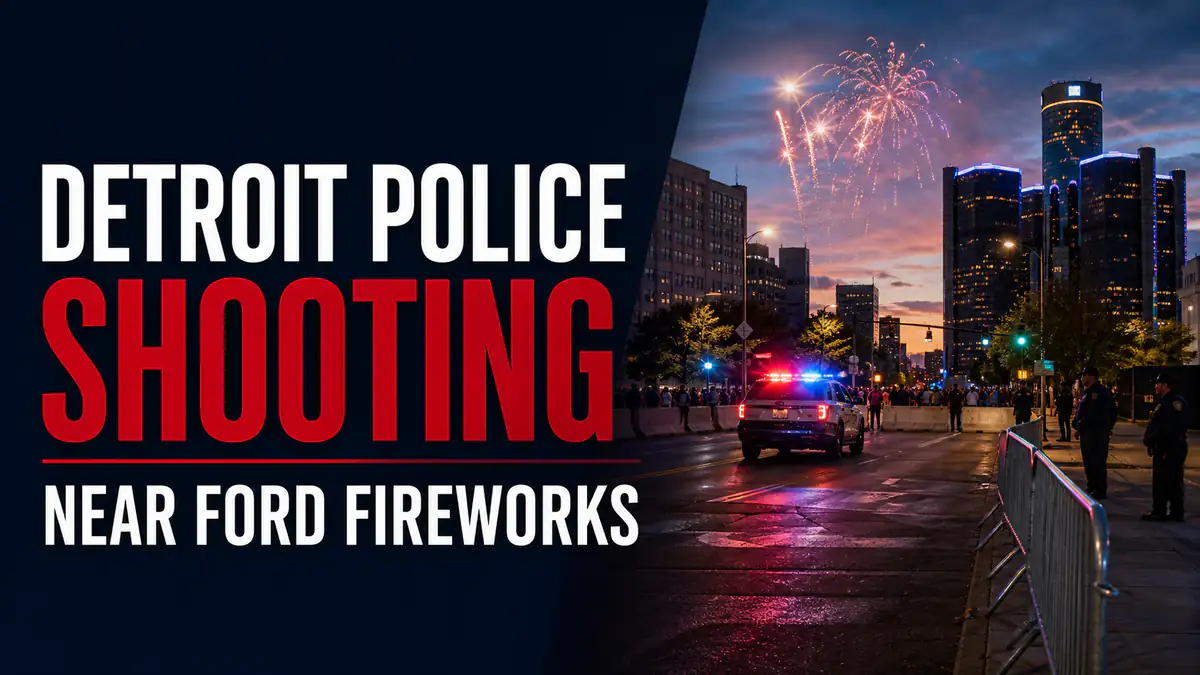
Alonzo Lee-Perkins, 18, was shot by a Detroit police officer near the Ford Fireworks crowd in downtown Detroit, and his family is now challenging the police account of why the officer fired.
The shooting happened June 22 near Farmer and Bates streets, around 6:25 to 6:30 p.m., as police worked the large fireworks crowd near Cadillac Square and Campus Martius.
Detroit police have said officers were dealing with suspected gun possession when a 19-year-old was arrested and Lee-Perkins ran from the group. Police said an officer fired during the foot chase because he feared for his safety and public safety, and police reported that a weapon was recovered.
Lee-Perkins' grandmother, Renee Wilson, told the Detroit Free Press that her grandson did not take out a gun and was shot from behind. She said he was wounded in the back, buttocks, and back of the shoulder, and that he remained handcuffed to a hospital bed while recovering.
Lee-Perkins has since been charged with carrying a concealed weapon, resisting a police officer, and felony firearm, according to the Wayne County Prosecutor's Office. He was arraigned June 30 on a $10,000 personal bond and is expected back in court July 8. The charges are allegations, not convictions.
The shooting came during a heavy enforcement operation around the fireworks. Detroit police said officers detained about 180 juveniles for curfew violations and made additional arrests, including arrests for carrying concealed weapons.
The family is demanding body-camera footage and the name of the officer who shot Lee-Perkins. As of publication, the footage and the officer's name had not been made public, no investigative findings had been announced, and no court had ruled on the criminal charges.
Legal Issues After a Detroit Police Shooting
Police shootings during stops, detentions, arrests, and foot chases can raise Fourth Amendment and 42 U.S.C. Section 1983 questions. The issue is not decided by one fact alone, such as whether a gun was later recovered or whether someone ran. A civil-rights review looks at what officers knew at the moment force was used, the suspected offense, any immediate threat, resistance or flight, warnings, timing, and the amount of force used.
That is why the missing evidence matters here. Body-camera footage, dash-camera footage, dispatch audio, CAD records, use-of-force reports, officer statements, medical records, witness video, and recovered-weapon evidence could all affect how the police account and family account are evaluated.
A criminal case does not automatically end the civil-rights question, but it can affect civil-rights strategy, and an experienced attorney can evaluate the options. For a broader explanation of how these cases are reviewed, see our guide to Michigan excessive-force claims and our police misconduct and civil rights practice pages.
Police video can also be time-sensitive. A FOIA request may help obtain records, but FOIA is not the same as a written demand to preserve evidence. Anyone involved in a disputed police shooting should act quickly so body-camera video, dispatch records, and other evidence are not lost, overwritten, withheld, or reviewed too late.
Get Help From Michigan Legal Center
Michigan Legal Center is the Law Offices of Christopher J. Trainor & Associates. Our attorneys review Michigan police misconduct, excessive force, and civil-rights cases involving police shootings, stops, detentions, arrests, and government misconduct.
If you or a family member was injured during a police encounter in Michigan, call Michigan Legal Center at (248) 886-8650 or contact us for a free consultation.
There is no attorney fee unless money is recovered for you. Case costs and fee terms are governed by the written fee agreement.