
Michigan Mini-Tort Claims After a Car Accident: What to Know
Quick Answer: What Is a Michigan Mini-Tort Claim?
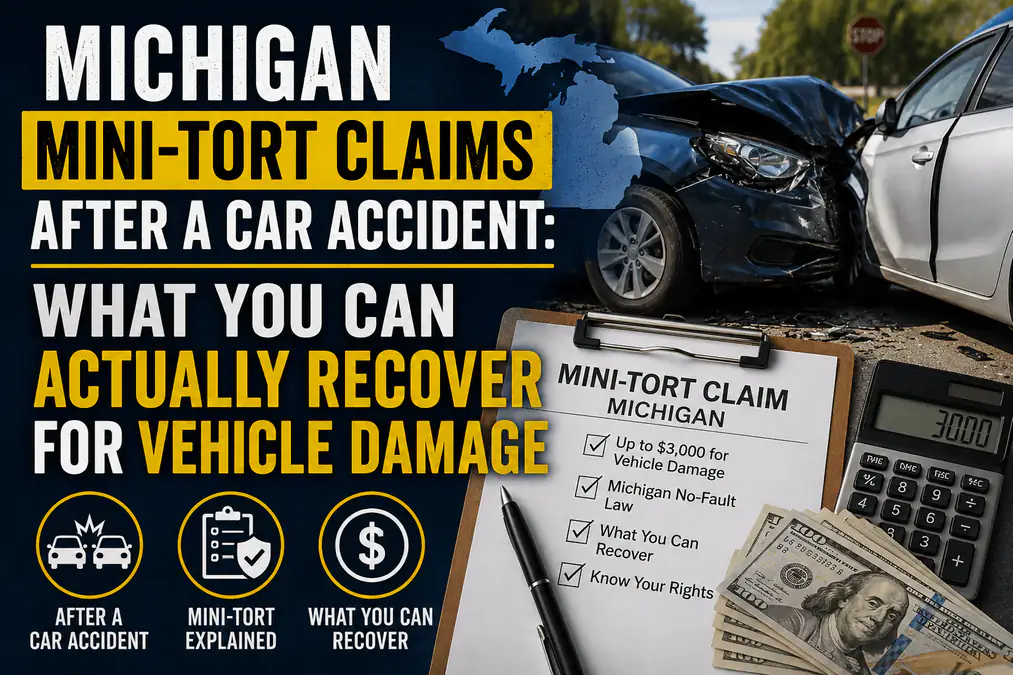
Michigan's mini-tort law, also called limited property damage liability, allows recovery for limited vehicle damage after a crash. Under MCL 500.3135(3)(e), a driver may potentially recover up to $3,000 for damage to a motor vehicle after an accident occurring after July 1, 2020, to the extent the damage is not covered by insurance.
Mini-tort covers vehicle damage only. It does not cover personal injury, rental expenses, lost use, or personal property inside the vehicle.
Mini-tort is also subject to fault rules. Your recovery is reduced by your percentage of fault, and no damages may be awarded if you were more than 50% at fault. If the damaged vehicle was being operated when the damage occurred, recovery may also be barred if the security required by MCL 500.3101 was not in effect.
For many drivers with collision coverage, the mini-tort claim covers the deductible or other uncovered vehicle-damage amount. For drivers without collision coverage, mini-tort may be the only direct vehicle-damage claim against the at-fault driver, but recovery is still capped at $3,000.
The rules sound simple until the insurers start arguing about fault, coverage, subrogation, deductibles, repair values, or whether the same crash also created a larger injury claim. It is imperative to contact our attorneys early so that we can sort through those issues, deal with the insurance companies, and identify the recovery paths that matter.
The Legal Basis for Michigan Mini-Tort Claims
Michigan's no-fault system tries to limit lawsuits arising from motor vehicle accidents. However, Mini-tort is one of the statutory exceptions.
MCL 500.3135(3)(e) allows limited property damage liability, commonly called a mini-tort claim, for:
- Up to $3,000 for motor vehicle accidents occurring after July 1, 2020.
- Only for damage to a motor vehicle.
- Only to the extent the damage is not covered by insurance.
The rest of the claim depends on the facts: fault allocation, available insurance, collision coverage, deductible issues, and whether the same crash also caused injuries.
What Mini-Tort Covers
Mini-tort is narrow. It can help recover the vehicle-damage amount that insurance did not cover.
Common examples include:
- A collision deductible;
- Uncovered repair costs;
- Uncovered total-loss vehicle damage;
- Vehicle damage when the claimant did not carry collision coverage, subject to the $3,000 cap.
Mini-tort is not $3,000 on top of a full collision payment. If your collision insurer paid for the repairs and the only amount left unpaid was a $1,000 deductible, your likely personal mini-tort amount is the deductible, not $3,000.
What Mini-Tort Does Not Cover
Mini-tort does not cover:
- Personal injuries;
- Medical bills;
- Wage loss;
- Pain and suffering;
- Rental car expenses;
- Lost use of the vehicle;
- Personal property inside the vehicle, such as phones, laptops, tools, or car seats;
- Vehicle damage already paid by collision insurance;
- Vehicle damage above the applicable mini-tort cap.
If the crash caused injuries, your injury claim is separate from the mini-tort vehicle-damage claim. Medical benefits, medical mileage, attendant care, wage loss, replacement services, and related no-fault benefits are handled through the no-fault system, including the deadline rules set forth in MCL 500.3145.
Let Our Attorney Sort Out the Collision Coverage and Subrogation Issues
Whether you had collision coverage often determines what your mini-tort claim is potentially worth.
| Situation | What usually happens |
|---|---|
| You have collision coverage | Your own insurer may pay covered vehicle damage, usually subject to the deductible and terms of the policy. Our attorney can determine whether the remaining claim is only your deductible or whether another uncovered vehicle-damage amount exists. |
| You do not have collision coverage | Our attorney can help you evaluate whether a direct mini-tort claim against the at-fault driver is worth pursuing, subject to the cap and collection realities. |
| Your vehicle was uninsured when operated | Under MCL 500.3135(4)(e), mini-tort damages may not be awarded if the damaged vehicle was being operated without the security required by MCL 500.3101. |
| The at-fault driver is uninsured | You may still have a right to sue, but collecting money can be difficult if there is no insurance and no collectible asset source. |
Subrogation is one of the issues our attorneys review early. You should not have to untangle whether your insurer is recovering its payment, whether your deductible is included, or whether you still need to bring a separate claim. Our attorneys can review the policy, insurance correspondence, repair documents, and fault evidence so the right demand is made to the right party.
Fault Rules for Mini-Tort Claims
MCL 500.3135(4)(a) applies comparative fault to mini-tort claims, and MCL 500.3135(4) also includes the small-claims, uninsured-vehicle, and non-res judicata rules that can affect the strategy.
That means:
- Your recovery is reduced by your percentage of fault.
- If you are more than 50% at fault, damages cannot be awarded in your favor.
- A small-claims decision on mini-tort does not decide other liability issues from the same crash.
Example: if your uncovered vehicle damage is $3,000 and you are 20% at fault, your recoverable amount may be reduced to $2,400. If you are more than 50% at fault, you cannot recover mini-tort damages.
Fault disputes matter. Police reports, photos, witness names, repair estimates, dash camera footage, and insurance correspondence can all affect whether the claim gets paid.
What To Do After a Crash Involving Vehicle Damage
Your first goal is to stay safe, get medical care if anyone may be hurt, and preserve the basic information. Your attorney's job is to sort out the insurance, fault, evidence, and filing strategy.
If you can, save:
- The police report;
- Photos of both vehicles and the scene;
- Repair estimates or invoices;
- Proof of your deductible or uncovered vehicle-damage amount;
- The other driver's name, address, insurer, policy information, and vehicle information;
- Any witness names or contact information;
- Any messages or letters from the insurers.
Then talk with a Michigan car accident attorney before assuming the claim is too small, too simple, or not worth pursuing. Mini-tort may be only one part of the case. If the crash caused injuries, the injury claim, no-fault benefits, medical documentation, wage-loss issues, and deadlines may matter much more than the vehicle-damage claim.
Path 1: Insurance Claim Review
The issue is not just submitting papers. Insurers may dispute fault, challenge the repair amount, ask whether collision coverage has already been paid, or ignore the deductible issue. Do not assume the other driver's policy automatically resolves the mini-tort claim. Mini-tort liability is treated separately from residual liability under MCL 500.3135(4)(b), and the available coverage depends on the actual policy and facts.
Our attorneys can review the police report, photos, repair estimate, deductible proof, insurer letters, and coverage position, then decide whether the claim should be handled through the insurer, pursued directly, or folded into a broader car accident case.
Path 2: Small Claims or District Court
Mini-tort actions must be filed in the small claims division of district court or municipal court. Small claims is designed for people without lawyers.
If the claim ends up in small claims, the evidence usually includes:
- The police report;
- Photos;
- Repair bills or estimates;
- Deductible proof;
- Insurance correspondence;
- Witnesses or witness statements;
- Any evidence showing fault.
Before filing, an attorney can help you decide whether court is worth the time, whether fault evidence is strong enough, whether the defendant is collectible, and whether the vehicle-damage issue is distracting from a more important injury claim.
Parking Lot and Private Property Accidents
Mini-tort can apply to parking lot, gas station, driveway, and other private-property crashes. The key questions are still the same:
- Was the damage to a motor vehicle?
- Was the damage not covered by insurance?
- What percentage of fault belongs to each driver?
- Was the damaged vehicle properly insured when operated?
- Is the claim within the applicable cap?
Parking lot crashes often involve disputed fault. Photos, surveillance video, witness statements, vehicle positions, and diagrams can be more important than the fact that the crash happened off a public road.
Total Loss Vehicles
A total loss does not automatically prevent a mini-tort claim. The question is whether there is uncovered vehicle damage after insurance payments are applied.
If your collision insurer paid the actual cash value of the vehicle and the only amount left unpaid was a deductible, your mini-tort claim usually focuses on the deductible. If you did not have collision coverage, the unpaid vehicle loss may support a mini-tort claim up to the cap.
If you dispute your own insurer's total-loss valuation, that dispute is usually handled through your own policy and insurer, not through the mini-tort claim against the other driver. An attorney can help separate the total-loss valuation issue from the mini-tort issue so the wrong claim is not sent to the wrong insurer.
Mini-Tort Deadline
Michigan's general deadline for property-damage claims is often three years under MCL 600.5805. Do not wait until the deadline is close. Repair documentation, photos, witness information, and insurance records are easier to gather early.
If the same accident caused injuries, no-fault PIP deadlines are separate and are shorter. MCL 500.3145 has its own notice and timing rules for PIP benefits. A mini-tort vehicle-damage claim does not protect a PIP claim.
When Mini-Tort May Not Be Worth It
Mini-tort is useful when the amount is documented, fault is clear, and there is a realistic source of payment.
An attorney can help decide whether it is worth pursuing when:
- The uncovered amount is small;
- Fault is heavily disputed;
- The other driver is uninsured and has no collectible assets;
- The repair documentation is weak;
- The time and filing cost outweigh the likely recovery.
If the same crash caused injuries, the injury claim may be far more important than the mini-tort claim. A Michigan car accident attorney can evaluate both tracks and keep the vehicle-damage issue from distracting from the larger recovery.
Talk To a Michigan Car Accident Attorney
Mini-tort can help recover vehicle damage, but it is only one part of a Michigan car accident case. If the crash caused injuries, the no-fault and third-party injury claims may matter much more.
Christopher Trainor & Associates can handle the insurance correspondence, deductible issue, subrogation questions, fault disputes, filing strategy, and injury-claim review so you are not left trying to decode Michigan no-fault rules on your own.
Michigan Legal Center handles car accident cases throughout Michigan, from the Upper Peninsula to the southern border. With offices serving communities across the state, including Marquette, Detroit, Grand Rapids, Flint, and Lansing, our attorneys help crash victims in Metro Detroit, Southeast Michigan, West Michigan, Mid-Michigan, Northern Michigan, and the U.P.
Call (248) 886-8650 for a free consultation. No attorney fee unless we recover money for you. Case costs and fee terms are governed by the written fee agreement.