
Clio Motorcycle Police Pursuit Crash Raises Liability Issues
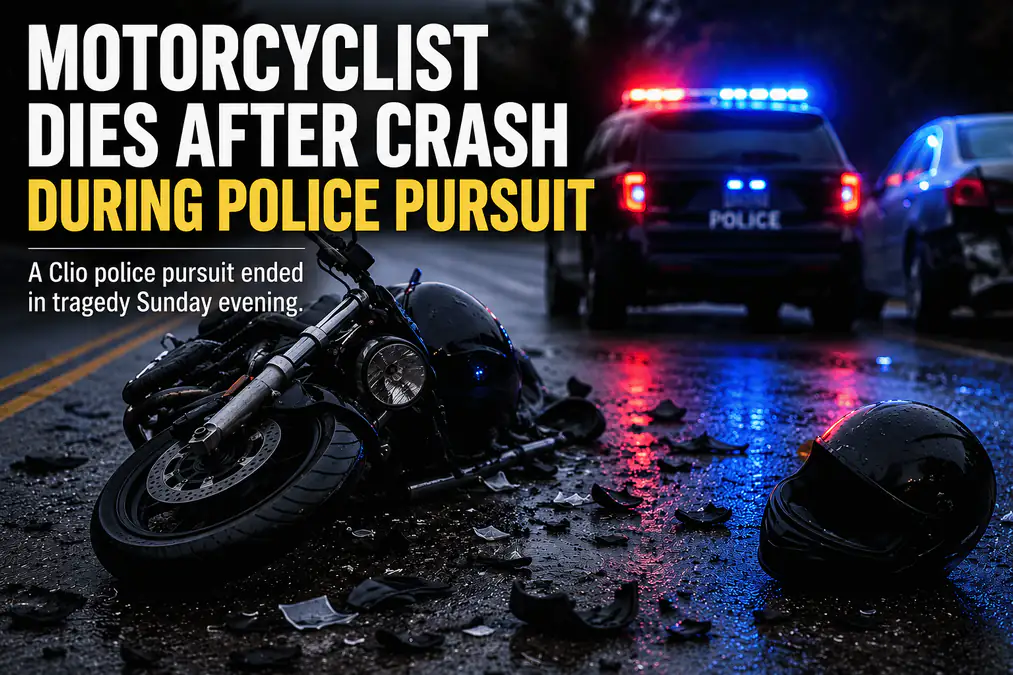
A police pursuit ended in tragedy in Clio on Sunday when a motorcyclist died after crashing into another vehicle attempting to escape officers.
According to Clio Police Department, an officer who was leaving the site of an unrelated call witnessed the motorcyclist speeding down East Vienna Street going west. At 6:15 p.m., the officer activated his lights and sirens and began pursuing the motorcyclist.
The motorcycle was fast enough to escape the line of sight of the officer. Around that time, the motorcycle crashed into the back of a vehicle turning west of Vienna Road.
The officer arrived at the scene of the crash and began performing CPR on the motorcyclist. The Genesee County Sheriff's Office and Clio Area Fire Department arrived moments later to continue lifesaving efforts.
The motorcyclist was pronounced dead at the scene. Police did not report any serious injuries to anyone in the vehicle.
The Genesee County Sheriff's Office will continue investigating the crash.
In Michigan, the act of fleeing and eluding the police is a crime, according to Section 750.479a of the Michigan Penal Code and Section 257.602a of the Michigan Vehicle Code.
Even if there is no civil liability, agencies almost always conduct internal review after serious pursuits.
Investigators typically review:
- whether pursuit policy was followed
- radio communications
- bodycam/dashcam footage
- supervisor authorization
- public risk vs. need to apprehend
Officers can face:
- suspension
- retraining
- discipline
- termination
The Michigan Supreme Court established in Robinson v. City of Detroit that there is a legal difference between when an officer causes a crash and when a fleeing suspect causes a crash.
If a fleeing suspect crashes into another vehicle without first being struck by police, courts often place primary liability on the suspect. If an officer physically collides with the suspect or creates unnecessary danger through reckless driving, they are more likely to be held liable.
Under MCL 691.1407, Michigan's governmental tort liability act provides significant immunity to government agencies and officers for discretionary acts performed during the course of their duties. Police pursuit decisions fall within that protected discretionary zone.
Another Michigan law, MCL 257.603, allows police officers involved in pursuits to exceed normal traffic laws when operating with lights and sirens activated. However, officers are still required to drive with “due regard” for the safety of others and are not protected from reckless disregard for public safety.
This means that individual officers are usually protected from liability when involved in crashes resulting from a chase unless their conduct amounts to gross negligence.
Michigan defines gross negligence as conduct so reckless it demonstrates a substantial lack of concern for whether someone is injured as a result.
Ordinary mistakes are usually not enough. Gross negligence is usually shown by demonstrating that there was:
- violation of pursuit policy
- continuing a dangerous chase for a minor offense
- pursuing in crowded urban areas
- ignoring supervisor orders
- creating an unreasonable danger to the public
Family members of deceased involved in the crash may sometimes bring wrongful death claims against the police officer, the department or the fleeing driver. Governmental immunity often still applies to these cases, so gross negligence or violation of constitutional rights is needed if suing a government entity or employee.
Yes. Motorcycles lack seatbelts and protective cages, are less stable than passenger vehicles and carry a greater risk of rider ejection.
There are several ways a motorcycle can crash without even coming in physical contact with the chasing police vehicle such as:
- rider loses control during evasive maneuver
- target fixation
- high-speed wobble
- panic braking
- road hazard avoidance
For these reasons motorcycle pursuits are often treated as high-risk pursuits and have more restrictions for them than car chases.
When a crash occurs without physical contact between the police and fleeing vehicles, Michigan courts historically tend to place primary responsibility on the fleeing suspect. However, the more aggressive or prolonged the pursuit, the harder that argument becomes for police.
PIT maneuvers are a tactic of ending a car chase with a controlled collision between the police vehicle and fleeing vehicle.
Use of a PIT maneuver on a motorcycle is potentially considered deadly force since it is more likely to throw the rider from the vehicle.
Michigan Legal Center is the Law Offices of Christopher J. Trainor & Associates. Our attorneys help injured people and grieving families across Michigan with No-Fault claims, wrongful death cases, third-party lawsuits, insurance disputes, and serious injury claims.
If you or a loved one was injured in a Michigan car accident, contact Michigan Legal Center at (248) 886-8650 for a free consultation.
There is no attorney fee unless money is recovered for you. Case costs and fee terms are governed by the written fee agreement.
Note
Our firm used outside sources when creating this post. We have not independently verified every fact regarding this accident. If you find information that is incorrect, contact Michigan Legal Center immediately so we can correct the post. This post can be removed upon request.
Disclaimer
This post is for general information only and is not legal or medical advice. If a photograph is used with this post, it was not taken at the actual accident scene unless specifically stated. This post is not a solicitation for business.