
What are your rights during a Michigan traffic stop?
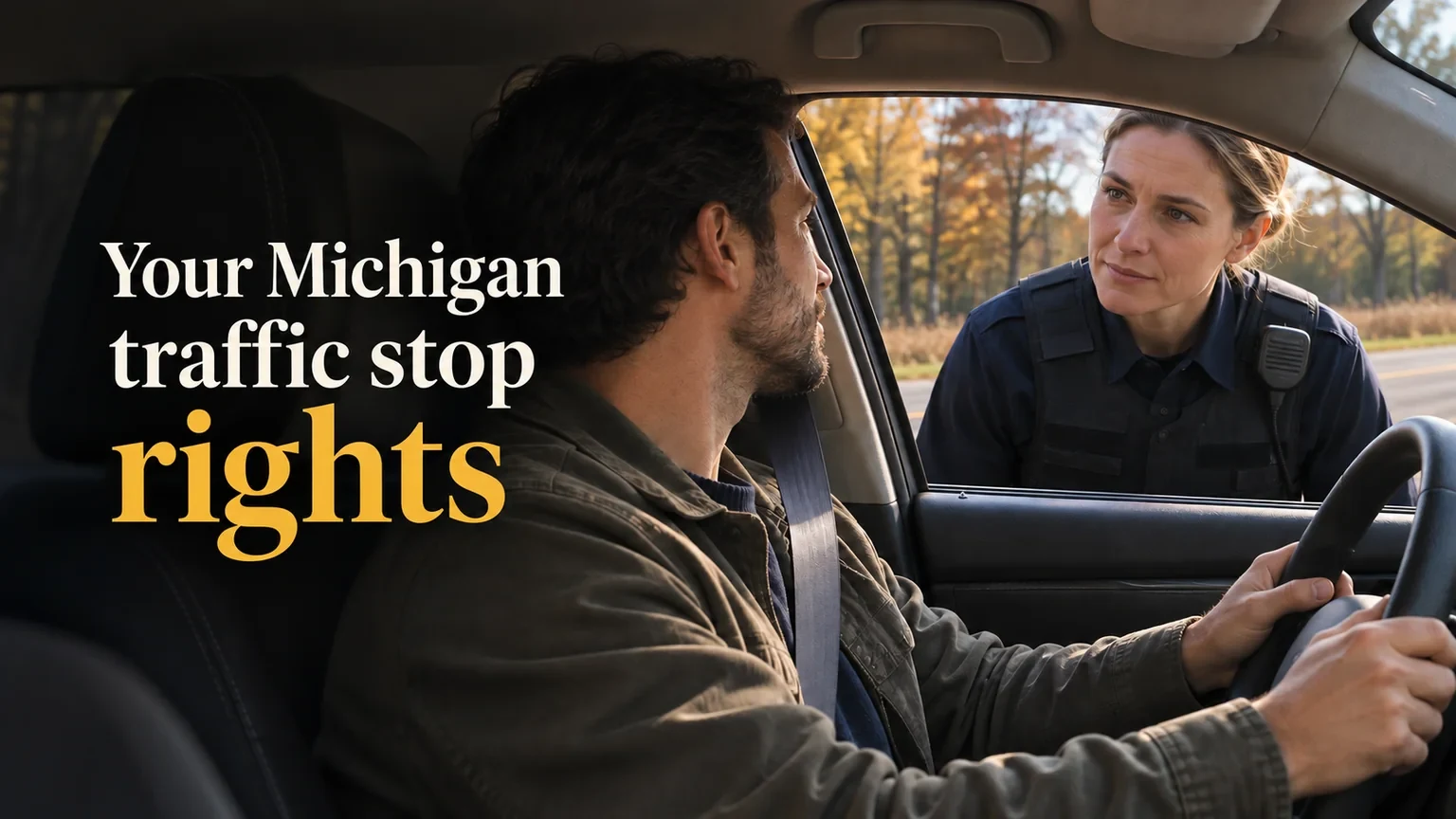
If you get pulled over by the police, even if you didn’t do anything wrong, stop, pull to the side of the road and get ready to show your driver's license, registration and proof of insurance.
Knowing your rights and knowing when to comply with questions can keep you from being taken advantage of. You can decline investigative questions, refuse consent to a vehicle search and ask whether you are free to leave at any point.
What should you do when pulled over in Michigan?
If you are getting pulled over, take the stop seriously even if you believe the officer is wrong.
Michigan drivers are required under law to safely pull over and stop when authorized emergency vehicles are using lights and audible signals, even if a stop seems unwarranted.
- Signal and pull over in a safe, visible place.
- Turn off the engine.
- Keep your hands where the officer can see them.
- Wait before reaching for your license, registration or insurance.
- Tell the officer where the documents are before you reach for them.
- Speak calmly and keep answers short.
- Provide required documents if you are the driver.
- Avoid arguing, insulting the officer or physically resisting.
- If you are arrested, ask to speak with a lawyer.
By following these rules and acting respectfully, even if they believe that an officer is treating them unfairly, a driver can set themselves up for a better legal situation afterward.
What do drivers have to provide during a Michigan traffic stop?
Michigan drivers are legally required to keep their driver’s license or a statutory receipt on them, while the registration can be kept in the car, saved electronically or kept on their person.
The registration or insurance can be kept digitally, but drivers should be careful when they show their phones or tablets to the police. Officers are allowed to handle the device to see the registration or insurance but aren’t allowed to look through it for other material.
Do you have to answer police questions when pulled over?
No. After pulling someone over, an officer might ask where you are coming from or going, if you know why you were stopped or if you have anything in the car. The driver can decline investigative questions.
The driver does have to say they aren’t answering questions and should never lie, make guesses or hand over false documents to the officer. The officer is allowed to continue asking questions even if the driver is not required to answer them.
Do passengers have to show ID during a traffic stop?
No, only drivers are required to hand over documents, although passengers are also considered to be detained during the stop.
The best thing for a passenger to do in many situations is to comply anyways. If an officer has reasonable suspicion that the passenger is related to criminal activity, then refusing could become justification for an arrest.
If a passenger doesn’t want to hand over their ID, they can ask if they are legally required to do so, ask if they are free to leave, tell them their name instead of showing an ID, calmly assert their rights and refuse consent for a search. If the officer conducts an illegal search anyways, that doesn’t mean they can interfere. They should allow the officer to complete the search and get legal representation afterwards.
Can a police officer search your car during a traffic stop?
Yes, if they have consent or another lawful basis, but not just because they want to look. The key distinction in many cases is consent. Calmly saying ‘I do not consent to a search’ is enough to refuse consent but doesn’t mean they will stop searching.
In some circumstances, officers can search a vehicle without permission if they have probable cause, a valid warrant, a lawful arrest-related basis or a safety-related basis supported by the facts.
Probable cause to search means facts supporting a fair probability that evidence of a crime or contraband will be found in the vehicle.
Even if an officer is conducting a search without consent or another lawful basis based on the facts the officers had at the time, drivers and passengers should still not physically interfere with the search in any way. The best thing to do in this scenario is to record what happened afterward and seek legal advice.
How long can police detain you in a traffic stop?
A traffic stop could become unlawful if the driver is held for an unreasonable amount of time without reasonable suspicion.
There isn’t an amount of time that makes a stop too long. The determining factor for how long they can detain you is based on what they are doing and why. The officer could be spending that time checking documents, running ordinary records checks, handling the reason for the stop and writing a warning or citation.
Reasonable suspicion requires specific facts suggesting criminal activity, rather than a hunch.
If the officer says you aren’t free to leave, stay calm, note the time, what the officer said, what questions were asked, whether a dog sniff or search occurred and whether police gave a new reason for keeping you there.
When can a traffic stop become a civil-rights issue?
A civil rights claim could be filed to fight an unlawful stop, but to be successful in court the claimant will need to prove several things. The stop doesn’t become unlawful or warrant a lawsuit just because an officer was rude, gave you a ticket you disagree with or because charges were later dismissed.
These are some of the circumstances that could make a stop unlawful:
- no reasonable suspicion or probable cause for the stop
- a stop prolonged beyond the traffic mission without a new lawful basis
- a car search without consent or another lawful basis
- detention after the reason for the stop was finished
- false arrest after a stop
- excessive force during the stop or arrest
- racial profiling or selective enforcement
- retaliation for calmly asserting rights
Missing, delayed or conflicting police reports and video can matter when reviewing what happened.
You may need a Michigan Legal Center attorney to help you review what police knew, what they claimed justified the stop, how long the detention lasted, what was searched, what force was used and what the records show.
What should you do after a traffic stop that went too far?
Focus on practical steps which help preserve evidence such as:
- Write down the date, time, location, officer names, badge numbers, patrol car numbers and agency names.
- Write down the exact words you remember, including why police said they stopped you.
- Save tickets, citations, towing papers, bond paperwork, release paperwork and court papers.
- Preserve phone video, dashcam video, photos, text messages, location data and call logs.
- Get witness names and contact information.
- Photograph injuries, vehicle damage, search damage or the condition of items moved during a search.
- Request medical care if you were injured or force was used.
- Save receipts, work records and other documents showing where you were and what happened afterward.
- Avoid posting detailed accusations online while a criminal or civil-rights issue may still be reviewed.
- Contact a lawyer if the stop involved a search, prolonged detention, arrest, force, racial profiling or other police misconduct.
Video and other records created and kept by the police can become more difficult to obtain after enough time passes. Body-worn camera footage, dashcam footage, dispatch audio, jail video, reports and internal records need to be preserved, not just collected.
A records request can help obtain documents, and a preservation demand can keep other evidence from being lost or overwritten before it can be used.
Can you sue for an unlawful traffic stop, false arrest or police misconduct?
Yes, if the facts support a claim that the officer violated Fourth Amendment rights or other civil rights. Claims for these violations are often brought under 42 U.S.C. Section 1983. The Fourth Amendment protects against unreasonable searches and seizures, and Section 1983 is the federal statute commonly used to seek relief for constitutional violations by state or local officials.
A civil-rights lawyer will look for evidence that police lacked a lawful basis, extended the stop unlawfully, searched without consent or another legal basis, arrested without probable cause, used objectively unreasonable force or treated the person differently for unlawful reasons.
Michigan Legal Center: the Law Offices of Christopher J. Trainor & Associates handles civil rights and police misconduct matters across Michigan and can help you take steps to preserve evidence before it is lost.
For related issues, see Michigan Legal Center's articles on false arrest and wrongful detention in Michigan and police brutality and excessive force in Michigan.
If a traffic stop led to an unlawful search, prolonged detention, false arrest, excessive force, racial profiling or another serious violation, contact Michigan Legal Center for a case review.