
Vista Maria Lawsuit Alleges Abuse at Dearborn Heights Facility
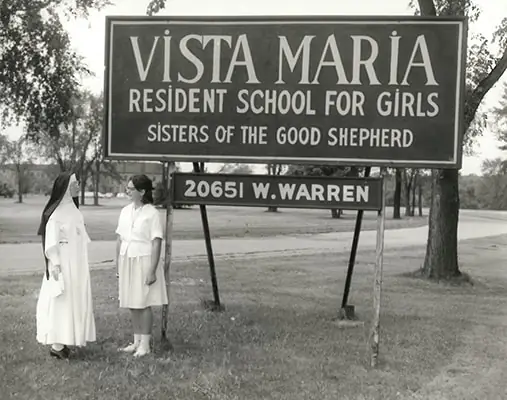
Michigan Legal Center News Desk | April 14, 2026 | Dearborn Heights, Wayne County
Primary source: WDIV ClickOnDetroit / Local 4, reporter Erika Erickson, published April 13, 2026. Additional coverage: The Detroit News, WXYZ Channel 7, Michigan Public Radio.
NOTE: The allegations described in this article are drawn from a civil lawsuit and from prior investigative reporting. They represent the plaintiffs' claims and have not been adjudicated. Vista Maria has stated it will not comment until it has reviewed the complaint.
| QUICK ANSWER: What the Vista Maria Lawsuit Alleges and What It Means | |
|---|---|
| Who filed | Six former residents, including some represented by family members, filed a civil lawsuit on April 13, 2026, against Vista Maria, a nonprofit residential facility for girls in Dearborn Heights, Wayne County, Michigan. |
| What is alleged | The lawsuit alleges psychological abuse, physical abuse, sexual abuse, including assault and non-consensual touching, unsafe living conditions, improper restraints, denial of food and medication, falsified records, negligent hiring, failure to report abuse, and violations of the Elliott-Larsen Civil Rights Act. The allegations span from 1999-2000 through 2025. |
| Who are the plaintiffs | Sophia Knoblauch (placed age 12, 2020-2025), a minor represented by a family member (the 16-year-old who went missing in 2025), Rebecca Andrzejewski (placed age 16, 2020-2022), Alaina Armstrong (placed age 12, 2017-2019), Bella Cantineri (2020-2021), and Ashley Bell (placed age 13, 1999-2000). |
| Legal counsel | The plaintiffs are represented by attorney Moose Scheib of the Moose Law Firm. The suit is described as the first in a series of lawsuits to come against the facility. |
| Background | WDIV Local 4 began investigating Vista Maria in March 2025 after a 16-year-old resident went missing for six weeks. MDHHS suspended placements from April to July 2025. Vista Maria ended its residential program in October 2025 and laid off 130 employees in December 2025. |
| Legal claims asserted | Assault and battery, intentional infliction of emotional distress, violation of the Elliott-Larsen Civil Rights Act, gross negligence, and negligent hiring, retention, and supervision. |
| Vista Maria response | Vista Maria has stated it will not comment until it has reviewed the complaint. The residential program remains closed. |
| If you were at Vista Maria | If you or a family member were a resident at Vista Maria and experienced abuse, you may have legal rights. Michigan law provides multiple avenues for survivors of institutional abuse to seek accountability and compensation. Contact the Michigan Legal Center at (248) 886-8650. |
For years, Vista Maria presented itself to the public and to the Michigan court system as a place of care and healing. For the six former residents who filed a lawsuit on April 13, 2026, it was something entirely different.
The lawsuit, filed in Wayne County by attorney Moose Scheib of the Moose Law Firm, describes a Dearborn Heights nonprofit where girls placed by the state were subjected to sexual assault by male staff, stripped naked under male observation, denied food and medication as punishment, physically restrained with force that slammed their heads into walls, and kept in conditions that one plaintiff described as lacking heat and fire alarms.
The allegations span from 1999 to 2025. The plaintiffs range in age from a minor to a 40-year-old woman. All of them were placed at Vista Maria as children. Many were placed there by the Michigan Department of Health and Human Services or through court orders, placed by a system that was supposed to protect them from abuse.
"There's girls who literally didn't survive that place." -- Sophia Knoblauch, former Vista Maria resident, now 18
Scheib described the lawsuit as the first in a series. He stated that more survivors are expected to be added to the case through a rolling process in the coming months.
What WDIV Local 4's Year-Long Investigation Found
Lawsuits do not emerge from nowhere. WDIV Local 4 began investigating Vista Maria in March 2025 after a 16-year-old resident went missing from the facility on March 14 and was not found for approximately six weeks. When police located her, she was in an apartment belonging to a 62-year-old man. Investigators believed sexual contact had occurred. Kamal Abou Darwiche later pleaded guilty to attempted child sexually abusive material and harboring a juvenile.
This disappearance triggered a broader investigation. Former employees and residents came forward by the dozens. The Dearborn Heights police told Local 4 that they had responded to 368 calls from Vista Maria. State records documented a pattern of complaints spanning years, including improper use of physical restraints, inappropriate physical contact, and failure to report assaults.
Current and former employees described inadequate training, unsafe environments, and concerns ignored by management. One participant described men grooming residents and maintaining relationships with them after they aged out. Another described the living conditions as inhumane. A staff member was reported to have hit a young resident in the face five times without the incident being reported properly. In another case, a girl was hospitalized after a staff member allegedly punched and choked her.
"They're hiring people off the street, or people who used to live at Vista Maria. There are men grooming the girls, and they keep relationships with them even after they age out." -- former Vista Maria employee, per Local 4 reporting
Following Local 4's report, the MDHHS suspended placements at Vista Maria from April 24 to July 24, 2025, directing the facility to work toward remediation. In October 2025, Vista Maria announced it was ending its residential program entirely and transferring the remaining eleven residents to other facilities. In December 2025, the facility laid off nearly 130 workers. Vista Maria said the layoffs were due to "social, systemic, and regulatory factors."
The Six Plaintiffs: What Each Alleges
The lawsuit names six plaintiffs. Their allegations are specific, documented, and in many cases, corroborated by prior Local 4 reporting and staff accounts. The following is drawn directly from the complaint, as reported.
Sophia Knoblauch, now 18
Knoblauch was placed at Vista Maria at the age of 12 and lived there from 2020 to 2025. The lawsuit alleges staff made degrading and abusive comments, including encouraging her to die by suicide. She was denied meals as punishment and subjected to restraints forceful enough to push her head into a wall. In one incident, a staff member allegedly poured a chemical cleaning agent over her head while she was restrained. She was denied access to her prescribed inhaler during asthma attacks and was excessively sedated, sometimes with multiple injections simultaneously.
The lawsuit also alleges she was repeatedly placed in a "behavioral management room" where male staff forcibly removed her clothing and observed her on cameras, and that a male staff member sexually assaulted her while she was under observation.
"I feel like Vista Maria was actually like literally thw rost times of my life. It didn't do anything but traumatize me even more." -- Sophia Knoblauch
The minor who went missing in 2025
This plaintiff, who is still a minor, is represented by a family member in the lawsuit. Her allegations include staff failing to notify proper authorities when she disappeared, a staff member hitting her in the face, denial of private telephone conversations that would have allowed her to report abuse, and the deletion of her computer data without backup during her disappearance, which the lawsuit characterizes as mishandling or concealing evidence and prolonging the search.
Rebecca Andrzejewski, now 21
Andrzejewski was placed at Vista Maria at age 16 and lived at Rose Hall and Freedom Hall from approximately 2020 through 2022. She alleges that she was placed in the behavioral management room twice, where male staff removed her clothing and watched her on cameras. She described a restraint called the "chicken wing," during which a male staff member allegedly rubbed his groin against her.
Alaina Armstrong, now 20
Armstrong was placed at age 12 and lived at the facility from approximately 2017 through 2019. She alleges phone privileges were revoked after staff discovered she was calling relatives to report what was happening to her. She further alleges that during a behavioral management room incident, a male staff member forcibly removed her clothing and rubbed her exposed thighs and pubic region, after which she was left nude overnight in view of cameras.
Bella Cantineri, now 21
Cantineri lived at Vista Maria from July 2020 to May 2021. She alleges she was stomped on her head for several minutes without staff intervention. Under restraints, the lawsuit alleges a male staff member straddled her and spat on her. She also describes a hall without working heat or fire alarms and only a hospital blanket for warmth.
Ashley Bell, now 40
Bell lived at Vista Maria as a 13-year-old, in 1999 and 2000. She alleges discriminatory targeting based on race, denial of food and necessities as punishment, and repeated sexual abuse by a male therapist who rubbed his genitals against her. She also alleges a female staff member provided alcohol and cigarettes to residents at night and encouraged them to perform sex acts on one another while staff watched.
Bell's allegations establish that the conduct described in this lawsuit is not a recent aberration. The pattern described by the plaintiffs spans more than two decades.
What the Lawsuit Claims: Legal Theories and Remedies
The lawsuit asserts multiple legal claims against Vista Maria and its staff. Each reflects a distinct theory of liability recognized by Michigan courts.
Assault and Battery
Physical contact that is harmful, offensive, or non-consensual constitutes battery under Michigan common law. Every incident of forcible restraint, physical striking, and sexual touching alleged in this complaint is potentially a separate battery count. The fact that these acts occurred against children in a residential facility under the guise of institutional care does not reduce liability. It compounds it.
Intentional Infliction of Emotional Distress
Michigan recognizes a tort claim for intentional infliction of emotional distress when the conduct is extreme and outrageous, intentional or reckless, and causes severe emotional harm. Encouraging a child to die by suicide, pouring cleaning chemicals over a restrained resident's head, and leaving a minor nude under camera observation by male staff are acts that define extreme and outrageous conduct. The long-term trauma documented in the lawsuit, including PTSD, depression, anxiety, mistrust, and physical manifestations, establishes harm.
Violation of the Elliot-Larsen Civil Rights Act
Michigan's Elliott-Larsen Civil Rights Act, MCL 37.2101 et seq., prohibits discrimination in access to services based on race, sex, and other protected characteristics. Ashley Bell's allegation of racial targeting and the broader pattern of differential treatment documented in the complaint put this claim squarely within the statute's reach. Elliott-Larsen applies to places of public accommodation, which includes nonprofit service organizations that receive state referrals and public funding.
Gross Negligence
Ordinary negligence is the failure to exercise reasonable care. Gross negligence is a substantially more culpable failure that demonstrates a reckless disregard for the safety of others. The allegations here, across multiple years, multiple staff members, multiple documented complaints that were not acted upon, and a MDHHS suspension that came only after a media investigation, describe an institutional failure of the kind that reaches the gross negligence standard under Michigan law.
Negligent Hiring, Retention, and Supervision
Under Michigan law, an employer can be held liable when they knew or should have known that an employee posed a risk of harm to others and failed to act accordingly. The lawsuit alleges Vista Maria hired people without necessary clearances or training, retained employees despite documented abuse complaints, and failed to supervise staff in direct contact with vulnerable children. The allegation that some hires came from the pool of former residents adds a particular dimension to the failure of supervision.
State Oversight, MDHHS, and the Question of Who Knew What
The allegations in this lawsuit raise serious questions regarding the role of state oversight. Many of the plaintiffs were placed at Vista Maria by MDHHS or through court orders. In a meaningful sense, the state was their guardian. They paid for their placement. It had the authority and obligation to ensure that the placement was safe.
The MDHHS placement suspension from April to July 2025 came only after WDIV Local 4's reporting made the facility's conditions a matter of public record. State records showing a pattern of complaints were available prior to this. The Dearborn Heights police responded to 368 calls from the facility. Current employees raised concerns that were ignored.
Attorney Scheib made it clear in his statement that the examination of accountability will extend beyond the facility itself.
"As this case develops, we will be looking closely at all degrees of accountability. These include not only those directly involved, but also the leadership and governance structures in place at the time." -- Moose Scheib, attorney for the plaintiffs
The broader accountability lens is the correct one. When the state places children in a facility that becomes a site of documented abuse, the failure is not only institutional. It is systemic. The question of who knew, when they knew it, and what they failed to do extends well beyond Vista Maria's walls.
Michigan Law and the Rights of Survivors of Institutional Abuse
Survivors of abuse at residential facilities in Michigan have legal options that are distinct from, and in some ways more powerful than, those available to victims of individual wrongdoers.
Institutional Liability
A nonprofit organization that operates a residential facility for children is not shielded from civil liability by its charitable status. Michigan law allows survivors to sue institutions directly for negligent hiring, negligent supervision, and gross negligence. An organization's insurance, assets, and operational records are all subject to discovery in civil litigation.
The Statute of Limitations for Childhood Abuse
Michigan law provides an extended statute of limitations for survivors of childhood sexual abuse. Under MCL 600.5851b, a person who was sexually abused as a minor has until their 28th birthday or within three years of discovering the connection between the abuse and their injuries, whichever is later, to file a civil claim. This provision was specifically enacted to address the documented reality that survivors often cannot process or pursue their claims until years after abuse occurs.
For non-sexual abuse claims, the general personal injury statute of limitations under MCL 600.5805 applies, with some tolling provisions for minors. Anyone who believes they may have a claim should speak with an attorney as soon as possible to understand exactly what window applies to their specific circumstances.
What Damages Survivors Can Pursue
Civil claims for institutional abuse can seek compensation for the following:
- Past and future physical pain and suffering
- Past and future emotional distress and psychological harm, including PTSD
- The cost of past and future therapy and mental health treatment
- Lost earning capacity where abuse caused lasting impairment
- Humiliation, degradation, and loss of dignity
- Punitive damages in cases involving gross negligence or intentional misconduct
These are not abstract categories. The plaintiffs in this case describe a lifetime of trauma: depression, anxiety, PTSD, mistrust of adults in authority, and the inability to fully function in the years that followed their time at Vista Maria. The law recognizes all of these as compensable harms.
If You Were a Resident at Vista Maria
Attorney Scheib has stated publicly that this lawsuit is the first in a series, and that additional survivors are expected to come forward in the months ahead. This means that the window for former residents to have their stories included in this legal process is open.
If you or someone you know was a resident of Vista Maria and experienced physical, sexual, or psychological abuse, you do not have to navigate this alone. The law provides specific protection for survivors of childhood institutional abuse. An attorney can assess your situation, explain the deadlines that apply to your case, and help you understand whether participating in this litigation or filing a separate claim is the right path.
The Michigan Legal Center, Law Offices of Christopher Trainor and Associates, has spent decades holding institutions, government agencies, and individuals in power accountable when they fail the people in their care. We have taken on cases that others have walked away from. We have won verdicts against police departments, government agencies, and organizations that thought their size or nonprofit status would protect them. It did not.
If you believe you have a claim related to Vista Maria or any other Michigan residential facility where children were harmed, we want to hear from you.
Call (248) 886-8650 to speak with the Michigan Legal Center. Free consultation. Confidential. No fee unless we recover for you. We come to you.