
Detroit and Warren Police Face Warrantless-Entry Lawsuits
Michigan Legal Center News Desk | April 30, 2026 | Detroit (Wayne County) and Warren (Macomb County)
Note: These are civil lawsuits. The allegations have not been proven in court. The Warren Police Department denies the claims. The Detroit Police Department declined to comment. This article covers the legal claims and the constitutional framework they rely on.
| QUICK ANSWER: The Two Lawsuits and What They Allege | |
|---|---|
| Who filed the suits | Detroit civil rights attorney Todd Perkins filed both lawsuits on behalf of the affected families. The cases are filed in federal court and allege violations of constitutional rights under 42 U.S.C. § 1983. |
| Case 1: Detroit (April 2, 2026) | Around 1 a.m. on April 2, 2026, Detroit police officers surrounded a home on Wormer Street. Police said they stopped a young man for a suspected curfew violation; when they determined he had a gun, he fled into the residence. Officers entered. Body camera footage shows an officer striking Carnell Givens multiple times while Givens was already restrained. Givens was charged with felony assault and resisting police. Those charges were dismissed last week. |
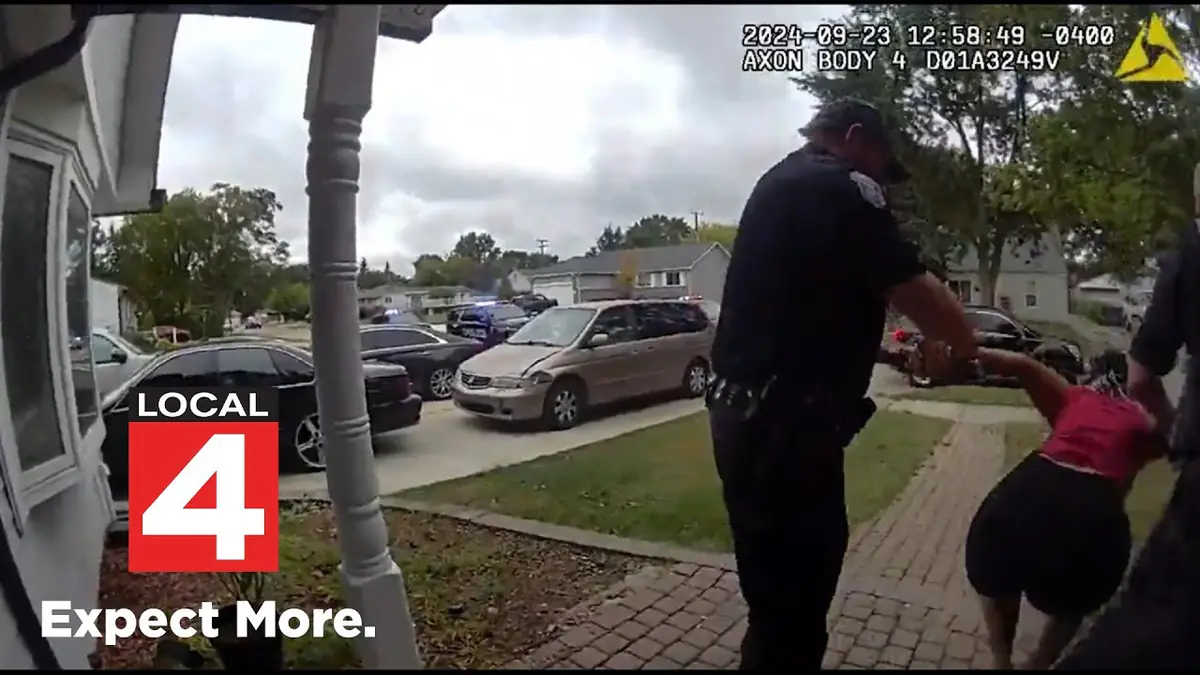
| Case 2: Warren (September 2024) | Warren police were conducting a traffic stop when two individuals ran into a relative's home. Officers allegedly forced entry without a warrant or any explanation. The homeowners, Sandra Hall and Willie Hall, were arrested. Sandra Hall, who had recently undergone surgery and was using crutches, was forced to the ground and pepper-sprayed. Both were charged with resisting and obstructing. Those charges were also dismissed. |
| What the lawsuits allege | Both lawsuits allege warrantless entry into a private home in violation of the Fourth Amendment and the use of excessive force in violation of both the Fourth Amendment and 42 U.S.C. § 1983. The cases seek damages from the City of Detroit and the City of Warren, respectively. |
| The departments' responses | The Warren Police Department said the lawsuit is without merit and that the Halls attempted to physically interfere with officers making arrests. The Detroit Police Department declined to comment, citing pending litigation. |
| Why charges being dismissed matters | When criminal charges against the people in both incidents were dismissed, this removed the legal basis the departments might have used to justify the officers' conduct. Dismissal does not automatically mean the civil rights claims succeed, but it significantly undercuts the narrative that the force used was necessary. |
| Contact | The Michigan Legal Center, Law Offices of Christopher Trainor & Associates: (248) 886-8650 |
A home in Michigan is not a place police can simply enter. That is not a legal technicality. It is one of the foundational protections in the United States Constitution, grounded in more than two centuries of law, affirmed repeatedly by the Supreme Court, and enforceable today through the federal civil rights statute that attorney Todd Perkins is using against two Michigan police departments.
Two families. Two cities. Two separate incidents, more than a year apart. The same constitutional question in both.
Did police have the right to go through that door?
What Happened on Wormer Street: The Detroit Case
At approximately 1 a.m. on April 2, 2026, Detroit police surrounded a home on Wormer Street. Officers had stopped a young man they believed was violating the city's curfew for minors. The situation escalated when police said they determined the individual had a gun. He ran inside the house.
Officers followed. Body camera footage from the encounter shows what happened next: officers inside the home, a struggle involving family members, and an officer striking Carnell Givens multiple times. Givens was not the person who had run inside. He was already restrained when the officer hit him.
"Before I knew it, I'm in handcuffs. One officer choked me with a headlock, two other officers put me in handcuffs, another officer decided to use me as a punching bag." — Carnell Givens
Givens was charged with felony assault and resisting police. Last week, those charges were dismissed.
Attorney Todd Perkins filed suit in federal court: Givens, Et. Al. v. City of Detroit, Et. Al. The lawsuit alleges the officers' entry into the home was warrantless, that the force used against Givens violated his constitutional rights, and that the City of Detroit bears responsibility for what its officers did.
The Detroit Police Department declined to comment, citing pending litigation.
What Happened in Warren: The Hall Case
The second case is older and, in some ways, more stark.
In September 2024, Warren police conducted a traffic stop. Two individuals in the stopped vehicle fled on foot and ran into a relative's home. Officers followed and forced entry into that home. The people who lived there, Sandra Hall and Willie Hall, had no connection to the traffic stop. It was not their car. They were not suspects. They were in their own house.
According to the lawsuit, officers entered without a warrant and without explanation. Sandra Hall had recently undergone surgery. She was using crutches. Officers forced her to the ground and pepper-sprayed her.
"They're making me, forcing me to get up, to walk. I'm trying to limp, they're throwing me to the ground. They maced me. I couldn't even see." — Sandra Hall
Both Sandra Hall and Willie Hall were arrested and charged with resisting and obstructing an officer. Those charges were subsequently dismissed.
Attorney Perkins filed the second suit: Hall, Willie, Et. Al. v. City of Warren, Et. Al. The Warren Police Department responded with a statement saying the lawsuit is without merit and claiming the Halls attempted to physically interfere with officers making arrests.
The Constitutional Framework: Why These Cases Are Serious
Both lawsuits rest on two of the most firmly established legal protections in American law. Understanding what they mean and what the law says about the specific circumstances alleged here matters for evaluating these claims.
The Fourth Amendment and Warrantless Home Entries
The Fourth Amendment to the United States Constitution protects people from unreasonable searches and seizures. The Supreme Court has been unambiguous for decades: a person's home is the most constitutionally protected space in American life. In Payton v. New York, 445 U.S. 573 (1980), the Court held that the Fourth Amendment prohibits warrantless entry into a home to make a routine arrest, absent consent or exigent circumstances.
The key exception is the hot pursuit of a fleeing suspect. In certain narrow circumstances, when officers are in immediate pursuit of a dangerous suspect who flees into a residence, entry without a warrant may be justified. But that exception is not unlimited. The Supreme Court addressed this directly in Lange v. California, 594 U.S. 295 (2021), holding that the pursuit of a fleeing suspect does not automatically justify warrantless home entry. Courts must examine whether the specific circumstances created a genuine emergency that outweighed the constitutional protection.
In the Detroit case, the question is whether a curfew violation suspect who allegedly had a gun created the kind of genuine, urgent threat that justifies warrantless home entry, and whether the force used against Givens, who was already restrained, was constitutionally permissible regardless of what justified the entry.
In the Warren case, the question is more direct: Sandra and Willie Hall were not parties to the traffic stop. They were in their own home. Officers allegedly gave no explanation when they forced entry. If that account is accurate, the constitutional question is not close.
For a detailed breakdown of Fourth Amendment rights during police stops and home entries, see our guide: False Arrest and Wrongful Detention in Michigan: Your Rights When Police Hold You Without Cause.
Excessive Force Under the Fourth Amendment
The Fourth Amendment also governs the use of force during arrests and seizures. The standard, established by the Supreme Court in Graham v. Connor, 490 U.S. 386 (1989), is objective reasonableness: was the force used reasonable under the totality of the circumstances, from the perspective of a reasonable officer on the scene?
That standard accounts for the threat level, the suspect's resistance, and whether less forceful alternatives were available. Striking a person who is already in handcuffs and being restrained by multiple officers is the kind of use of force that courts have found difficult to justify under Graham. The body camera footage from the Detroit case, which reportedly shows that exact sequence, will be central to that analysis.
For Sandra Hall, being thrown to the ground and pepper-sprayed while recovering from surgery on crutches, in her own home, by officers pursuing someone else's traffic stop, presents its own serious Graham question. The severity of the circumstances justifying that level of force would need to be substantial.
For more on how Michigan courts apply the excessive force standard in civil rights cases, see: Police Brutality in Michigan: What Excessive Force Looks Like, What the Law Says, and What You Can Do About It.
42 U.S.C. § 1983: The Federal Civil Rights Remedy
Both lawsuits are filed under 42 U.S.C. § 1983, the federal statute that allows individuals to sue government actors, including police officers and the municipalities that employ them, for violations of constitutional rights. A successful § 1983 claim can result in compensatory damages for physical injuries, emotional trauma, and the violation of constitutional rights, as well as, in some cases, attorney's fees.
Municipal liability under § 1983, established in Monell v. Department of Social Services, 436 U.S. 658 (1978), requires showing that the constitutional violation resulted from an official policy, custom, or practice of the department. This is where the fact that both sets of criminal charges were dismissed becomes highly relevant: it suggests the conduct was not isolated, and that patterns of behavior are worth examining.
An attorney building a § 1983 claim against a city will pursue discovery of the department's training records, prior complaints, use-of-force policies, and any history of similar incidents. That discovery process, once litigation is underway, often surfaces information the departments would prefer not to see in public.
For the full technical breakdown of how § 1983 individual claims and Monell institutional claims work together, see: Section 1983 vs. Monell: The Legal Difference That Determines Whether the City Pays. For a plain-language explanation of how qualified immunity affects individual officer claims in cases like these, see: Qualified Immunity in Michigan Civil Rights Cases.
The Dismissed Charges: What They Mean for the Civil Cases
In both incidents, the people who were arrested, Carnell Givens in Detroit and Sandra and Willie Hall in Warren, were charged with crimes related to the encounters. In both cases, those charges were subsequently dismissed.
Dismissed criminal charges do not automatically establish that the officers acted unlawfully. Prosecutors dismiss cases for many reasons, such as insufficient evidence, witness unavailability, and prosecutorial discretion. A dismissal is not an acquittal, nor is it a judicial finding that the arrest was unconstitutional.
What dismissed charges accomplish in the civil context is this: they remove the factual predicate that the departments might otherwise use to argue the force was justified. If Carnell Givens's felony assault charge had resulted in a conviction, that conviction would be evidence that he was actively resisting when officers struck him. Without a conviction, and with a dismissal, the government cannot rely on a judicial finding that Givens did what they accused him of. The civil case proceeds on the facts alone, including the body camera footage.
The same logic applies to Warren. The resisting and obstruction charges against the Halls were dismissed. The city's position that the Halls interfered with officers is now a contested allegation in civil litigation, not a fact established by a criminal court.
The Michigan Legal Center: We Have Won These Cases Before
The civil rights practice at the Law Offices of Christopher Trainor & Associates is not theoretical. We have stood in courtrooms across Michigan and presented exactly these kinds of cases to juries.
We won $5.8 million when a police officer fractured a man's neck outside his own home and $6.2 million against a police department for a civil rights violation. We have litigated against departments in Wayne County, Macomb County, and beyond. We know what the § 1983 framework requires, how to investigate a use-of-force claim, and how to present body camera footage to a jury in a way that makes clear what it shows and what it means.
We also know that police departments and the cities that employ them take these cases seriously when they are brought by attorneys who do. The strength of the lawsuit shapes the defense's response. Cases built with rigor, grounded in specific legal standards, and supported by evidence yield results that vague complaints do not.
If you or a family member were subjected to warrantless entry into your home, to excessive force, or to any other violation of your constitutional rights by a Michigan law enforcement officer, Christopher Trainor and his team are available. The consultation is free. The fee comes only when we recover for you.
Call (248) 886-8650 to speak with the Michigan Legal Center today.
The facts of your case, the laws that apply, and the potential outcomes will vary based on your specific circumstances. The information provided herein is for general informational purposes only and does not constitute legal advice. You should consult a licensed Michigan attorney directly for advice regarding your individual situation. The Michigan Legal Center, Law Offices of Christopher Trainor & Associates, or any of its attorneys, employees, or agents do not guarantee any particular outcome or result in any legal matter.