
MSP Trooper Injured After Suspected Drunk Driver Hits I-94 Patrol Car
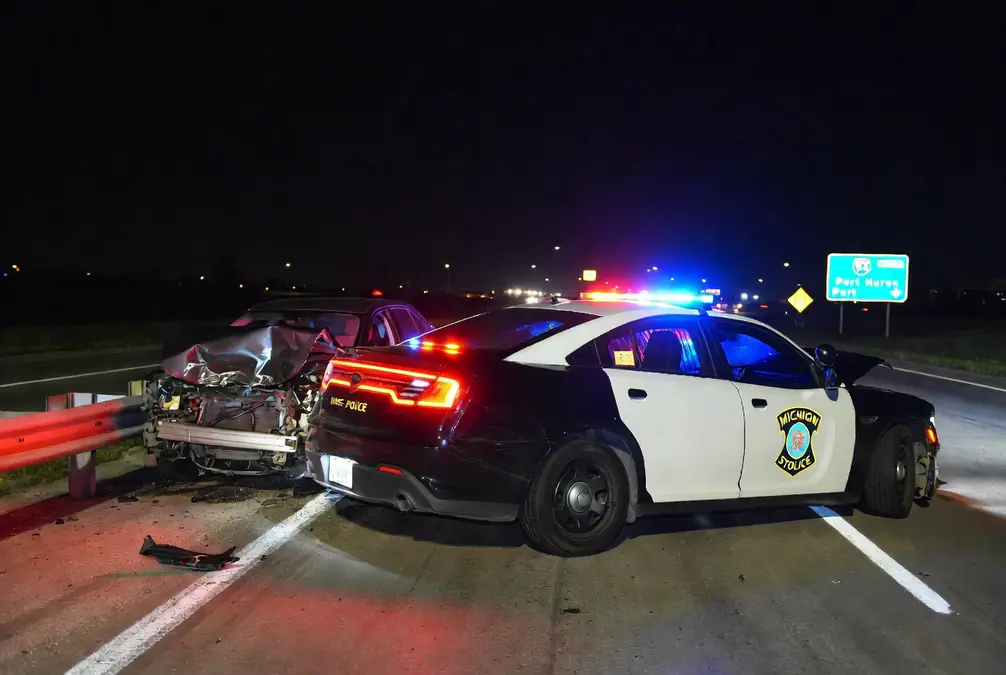
Michigan Legal Center News Desk | April 7, 2026 | Wayne County, Michigan
Source: WDIV ClickOnDetroit, reporter Samantha Sayles, published April 6, 2026
| QUICK ANSWER: What Happened on I-94 in Wayne County on April 6, 2026 | |
|---|---|
| When and where | Just after 1:00 a.m. on Monday April 6, 2026, on westbound I-94 near Merriman Road in Wayne County. |
| What happened | A 32-year-old driver lost control of a Lincoln and crashed into the passenger side door of a fully-marked Michigan State Police patrol car with emergency lights and spotlights activated. The Lincoln then spun out and struck two additional vehicles before stopping in the middle lanes of the freeway. |
| The trooper | The trooper, a woman, had to be extracted from her patrol car by Romulus fire crews. She was transported to a local hospital with non-life-threatening injuries. |
| The driver | The 32-year-old driver was transported to a local hospital for a blood draw and was lodged. Police reported the driver showing signs of intoxication. The investigation is ongoing. |
| Laws at issue | Michigan's Move Over law (MCL 257-653a) requires drivers to slow down and move over for emergency vehicles with lights activated. Operating while intoxicated (MCL 257.625) carries criminal penalties and creates independent civil liability for all injured parties. |
| Your rights | Anyone injured in this crash, including the trooper, the occupants of the two other vehicles struck, or anyone whose vehicle was damaged, may have legal claims. Drunk driving crashes are among the clearest cases of third-party negligence under Michigan law. |
| Contact | The Michigan Legal Center, Law Offices of Christopher Trainor & Associates: (248) 886-8650 |
A Michigan State Police trooper is recovering after a suspected drunk driver crashed into her patrol car in the early hours of Monday morning on I-94 in Wayne County, injuring her and striking two other vehicles in the process.
According to the Michigan State Police, the trooper was stationary in her fully-marked patrol car with both emergency lights and spotlights activated on westbound I-94 near Merriman Road just after 1 a.m. on April 6, 2026. A 32-year-old driver operating a Lincoln lost control, struck the passenger side door of the patrol car, spun out, and hit two additional vehicles before coming to rest in the middle lanes of the freeway.
Romulus fire crews had to remove the trooper from her vehicle. She was transported to a local hospital and treated for non-life-threatening injuries. The suspected drunk driver was also transported to the hospital for a blood draw and was lodged by police. No other injuries were reported.
F/Lt. Mike Shaw of the Michigan State Police addressed the crash directly,
"We were extremely lucky that [there] were only minor injuries in this preventable crash," Shaw said. "This crash serves as a reminder of two things. One, that if you see emergency vehicles on the side of the road to slow down and move over a lane. And two, there is never a reason to drive impaired. Ever."
The crash remains under investigation.
Two Law, One Crash: Move Over and OWI in Michigan
This crash is notable because it puts two of Michigan's most important traffic safety statutes in direct collision with each other, sometimes literally. One governs how drivers must respond to emergency vehicles on the road. The other governs the legal consequences of driving while impaired.
Michigan's Move Over Law: MCL 257.653a
Michigan's Move Over law, codified at MCL 257.653a, requires drivers approaching a stationary authorized emergency vehicle with lights activated to slow to a speed that is safe and reasonable, and, where possible, move over one lane away from the vehicle.
Violations of the Move Over law are a civil infraction at minimum. When a violation causes injury, it becomes a misdemeanor. When it causes serious injury or death, it becomes a felony carrying up to 15 years in prison.
The trooper in this crash was exactly where the law envisions: stationary, lights on, fully visible. The Move Over law exists precisely for situations like this one. A driver who strikes a stationary emergency vehicle on a well-lit freeway is not simply unlucky. That failure is the kind of conduct the statute is designed to address.
Operating While Intoxicated in Michigan: MCL 257.625
Michigan's OWI statute, MCL 257.625, makes it a crime to operate a motor vehicle while under the influence of alcohol, drugs, or a controlled substance. A blood draw at a hospital, which officers can require when they have probable cause to believe a driver is impaired, will establish the driver's blood alcohol content and can serve as key evidence in both the criminal case and any resulting civil litigation.
First-offense OWI in Michigan carries up to 93 days in jail, fines, and license sanctions. When an OWI crash causes serious injury, the charge escalates to a five-year felony under MCL 257.625(5). When it causes death, it becomes a 15-year felony.
Criminal charges and civil liability are entirely separate tracks. A driver can be convicted of OWI and still face a civil lawsuit from everyone injured in the crash. A driver can also be acquitted, or have charges reduced, and still be held liable in civil court, where the burden of proof is lower.
Who Can Pursue a Claim After This Crash
Three categories of people may have legal claims arising from this crash.
The Two Motorists in the Other Vehicles
Michigan operates under a no-fault system, meaning every driver carries Personal Injury Protection benefits that pay for medical expenses and wage loss regardless of fault. But when injuries meet the serious impairment threshold under MCL 500.3135, injured drivers and passengers can also pursue a third-party negligence claim directly against the at-fault driver for pain and suffering and non-economic losses.
A crash of this severity, at freeway speed, involving a drunk driver running into multiple vehicles, strongly suggests that injured occupants of the other two cars will meet that threshold. Their no-fault claims and their third-party negligence claims proceed on separate tracks, and missing either set of deadlines has consequences that cannot always be undone.
One additional concern for anyone hit by a drunk driver: impaired drivers frequently carry the minimum required insurance coverage, or none at all. If the 32-year-old driver's policy limits are inadequate to cover the injuries he caused, the injured parties may be able to turn to their own uninsured or underinsured motorist coverage. This is one of the most overlooked protections in a Michigan auto policy, and one of the most valuable when a crash like this one happens.
The Trooper
Michigan State Police troopers injured in the line of duty are entitled to workers' compensation benefits through the state. That covers medical expenses and wage replacement during recovery. However, workers' compensation does not cover pain and suffering or non-economic losses.
Under Michigan law, a public employee injured by a third party while performing their duties may be able to pursue a civil negligence claim against that third party in addition to their workers' compensation benefits. The interplay between the two requires careful analysis, and the trooper's legal options will depend on the specific facts of the investigation.
What About the Drunk Driver Herself
The driver was also transported to the hospital. If his injuries were serious, he may be entitled to no-fault PIP benefits from his own insurer for medical expenses and wage loss. He would not, however, be able to pursue a third-party negligence claim against others in this crash given that his own conduct appears to have caused it. Any civil claims against him from the other parties will likely far exceed any recovery he could pursue.
What Drunk Driving Crash Victims in Michigan Need to Know
Crashes caused by impaired drivers are among the most legally straightforward cases in Michigan personal injury law. The driver's intoxication does not need to be proven beyond a reasonable doubt in a civil case. Evidence of impairment, including field sobriety test results, the blood draw, and officer observations, is admissible and powerful.
But straightforward does not mean simple. There are deadlines, procedural requirements, and insurance company tactics that can complicate even the clearest cases if they are not handled properly from the start.
What to Do If You Were Injured in This Crash
- File a no-fault PIP claim with your own insurer promptly. Michigan law requires timely notice of a claim.
- Document your injuries and treatment carefully. Every visit, every diagnosis, and every bill matters.
- Do not give a recorded statement to the other driver's insurer without speaking to an attorney first.
- Preserve any evidence you have: photos, dashcam footage, witness contacts, and repair estimates.
- Ask your attorney whether your own uninsured or underinsured motorist coverage applies.
For a deeper look at what Michigan insurance adjusters do after a serious crash, and the tactics they use to minimize claims, see our guide on how Michigan insurance adjusters handle injury claims.
I-94 in Wayne County: A Corridor with High Crash Frequency
Westbound I-94 near Merriman Road sits in one of the busiest stretches of freeway in Southeast Michigan, running through a corridor that connects Detroit Metro Airport to the rest of the region. Late-night and early-morning traffic on this stretch frequently involves shift workers, travelers, and, as this crash illustrates, impaired drivers operating well outside normal vigilance hours.
The timing matters legally. A drunk driver operating at 1 a.m. on a major freeway, striking a stationary emergency vehicle with lights activated, represents a set of circumstances that will almost certainly factor into how civil liability is assessed. Foreseeability is a core element of negligence. At 1 a.m. on I-94, the argument that striking a lit emergency vehicle was unforeseeable is a difficult one to make.
The Michigan Legal Center: We Hold Drunk Drivers Accountable
The Law Offices of Christopher Trainor and Associates have represented Michigan families and individuals seriously injured by impaired drivers throughout Southeast Michigan and across the state. We know how these cases are built, what evidence matters, and how to make sure the full impact of a crash, physical, financial, and personal, is documented and presented.
If you or someone you know was injured in this crash or in any drunk driving collision in Michigan, Christopher Trainor and his team are available to help you understand your options. There is no cost for the initial consultation, and no fee unless we recover for you.
Call (248) 886-8650 to speak with the Michigan Legal Center today.