
Hampton Township M-25 Head-On Crash Seriously Injures Two
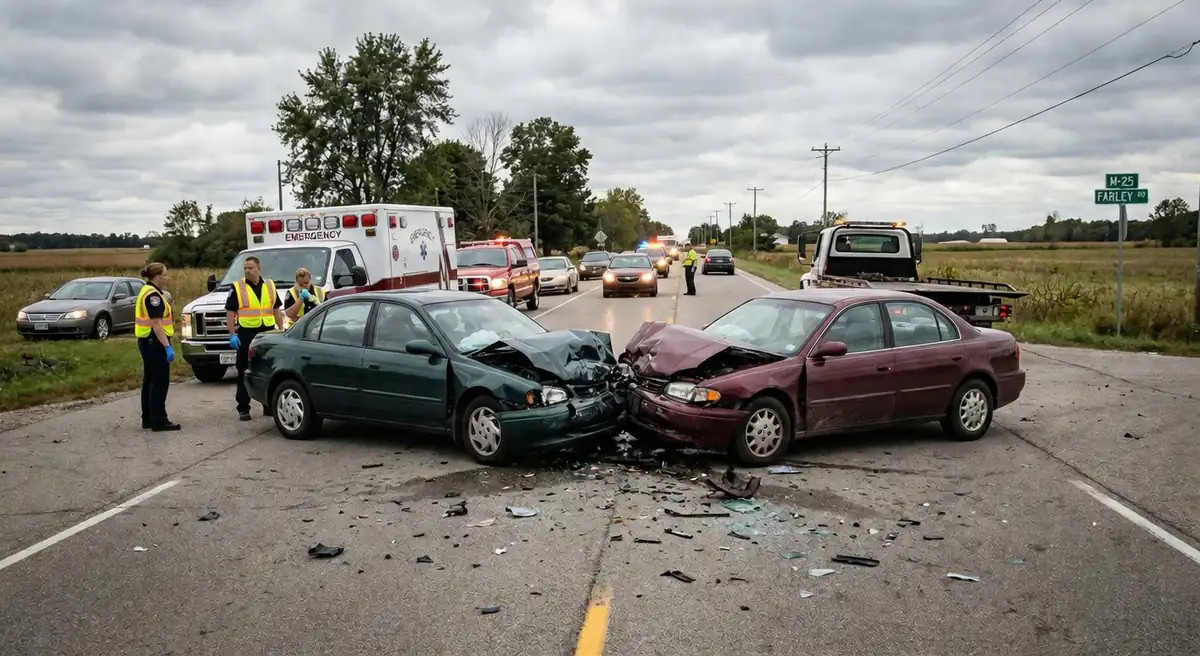
A head-on collision at M-25 and Farley Road in Hampton Township sent both drivers to the hospital with serious injuries on Monday afternoon. Police say the eastbound driver crossed into the oncoming lane. The investigation is ongoing. Michigan law already has answers for what happens to the person who was hit.
It was 3:50 in the afternoon on a Monday. Two people were driving on M-25 in Hampton Township, Bay County, in opposite directions, on the same two-lane road. One of them crossed the center line.
The result was a head-on collision at the intersection of M-25 and Farley Road that left both drivers with serious injuries. Hampton Township Public Safety Director Bryan Benchley confirmed that the eastbound vehicle crossed into the westbound lane, causing the crash. Both vehicles were occupied by only their drivers at the time of impact.
Investigators said alcohol or drugs are not believed to be a factor. The crash remains under investigation as of this report.
The driver who was in the westbound lane did nothing wrong. This crash represents an injury that was entirely someone else's doing. Michigan law recognizes that. And it provides a clear path to accountability.
What Happened at M-25 and Farley Road
M-25 is one of Bay County's primary state routes, running along the Saginaw Bay shoreline through Hampton Township and connecting communities across the Tri-Cities region. At Farley Road, it is a two-lane undivided highway. The only thing separating eastbound and westbound traffic is a painted center line.
When that line is crossed at speed, the physics are unforgiving. Head-on collisions concentrate the combined velocity of both vehicles into a single point of impact. At highway speeds, the forces involved are extreme. Serious injuries in this type of crash are the rule, not the exception.
According to Hampton Township Public Safety Director Bryan Benchley, the eastbound driver departed their lane and entered the path of the westbound vehicle. The investigation will work to determine why that happened: a medical episode, a momentary distraction, a mechanical failure, or another cause that sent that vehicle across the line.
What the investigation cannot change is what happened to the westbound driver. That person was where they were supposed to be, traveling in their lane. Someone else's departure from the rules of the road took that ordinary Monday afternoon and turned it into something far worse.
The cause of the lane departure is still being investigated. Under Michigan law, the fact of the lane departure is already evidence. You are not required to prove why someone crossed the center line. You are required to prove that they did, and that you were hurt because of it.
Crossing the Center Line in Michigan: What the Law Says
Michigan's rules of the road are not suggestions. Under MCL 257.634, drivers on two-lane roads are required to keep their vehicle to the right of the center of the roadway. Crossing into oncoming traffic's lane is a violation of that statute.
That statutory violation carries weight in a civil lawsuit. When a driver breaks a specific rule of the road and causes injury as a direct result, Michigan courts can treat that violation as evidence of negligence. The injured party still needs to prove causation and damages, but the act of crossing the line, causing the collision, and injuring another person can strongly support the core of the claim.
The injured westbound driver may meet the "serious impairment of body function" threshold required to pursue full damages beyond No-Fault PIP benefits. Under MCL 500.3135, Michigan's third-party tort threshold requires that the injury affect the person's ability to lead their normal life. Given that both drivers were described as "seriously injured" and transported from the scene, this threshold requires fact-specific review.
Meeting that threshold opens the door to compensation that No-Fault PIP alone cannot provide.
What the Westbound Driver Is Entitled to Pursue
Michigan's No-Fault system was designed for exactly this situation. Regardless of fault, the injured driver has access to Personal Injury Protection benefits covering their medical expenses without limit (under most post-2019 policies), up to 85 percent of their lost wages for up to three years, and replacement services for household tasks they can no longer perform while recovering.
Those benefits are provided under MCL 500.3107 and usually begin with the injured person's own No-Fault policy, spouse's policy, or resident-relative policy under Michigan's priority rules. If no household policy applies, the Michigan Assigned Claims Plan may become part of the analysis. They begin independently of how long the investigation takes and regardless of whether criminal or civil proceedings are initiated.
Beyond PIP, the third-party claim against the driver who crossed the center line is where full accountability lives. That claim can recover:
- Pain and suffering, including the physical pain of the injuries, the emotional distress of the crash and recovery, and any anxiety or trauma resulting from the event.
- Permanent impairment or disfigurement, if the injuries cause lasting limitations on the person's physical function or appearance.
- Excess wage loss beyond what No-Fault covers, including promotions, career advancement, and earning capacity affected by long-term recovery.
- Replacement service losses if the injured person cannot perform household tasks, childcare, or other activities for an extended period.
- Future medical expenses for treatment, rehabilitation, surgery, or care that extends beyond what the initial No-Fault coverage addresses.
The at-fault driver's auto insurance carrier is the primary source of compensation for these damages. Under Michigan law, all drivers are required to carry liability coverage. That coverage is what stands between the injured driver and having to absorb the full cost of someone else's mistake.
What "Under Investigation" Means for the Injured Driver
When Hampton Township Public Safety says the crash is under investigation, what that means is that investigators are working to determine the cause of the lane departure. That determination matters for criminal or traffic proceedings. It has less bearing on the civil case than people assume.
The injured westbound driver does not need to wait for the investigation to conclude before consulting an attorney or protecting their legal rights. In fact, waiting is one of the most costly mistakes crash victims make. Call Michigan Legal Center today.
Here is what can disappear while an injured person waits:
- Vehicle data recorder (black box) information, which captures speed, braking, and steering inputs in the seconds before impact. This data can be overwritten. A legal preservation letter stops that.
- Cell phone records, showing whether the at-fault driver was using their phone at the time of the crash. These records require a timely legal demand to preserve.
- Traffic and surveillance camera footage from the M-25 corridor, nearby businesses, or other vehicles. Camera systems typically overwrite footage on 30 to 72-hour cycles.
- Witness recollections, which become less reliable with time. The people who saw this crash or stopped to help are most accessible now.
The at-fault driver's insurer is already working this case. They have claims investigators, accident reconstructionists, and defense attorneys. The injured driver deserves the same level of preparation on their side.
No Drugs or Alcohol: Does That Change the Legal Picture?
Hampton Township Public Safety confirmed that alcohol or drugs are not believed to be a factor in this crash. That is a relevant detail for potential criminal charges, but it does not diminish the civil case for the injured driver.
A negligence claim does not require the at-fault driver to have been impaired. It requires that they breached the duty of care owed to other road users. Crossing the center line of a two-lane road and striking an oncoming vehicle is a breach of that duty, regardless of whether it happened because of intoxication, distraction, a medical condition, falling asleep, or a tire failure the driver failed to maintain.
If the investigation reveals the driver experienced a medical episode, that may trigger questions about prior knowledge of the condition. This can affect both the driver's personal liability and their insurer's obligations. Michigan courts have addressed cases where a driver's known medical history contributed to a crash. The analysis is fact-specific.
If distracted driving is identified as the cause, it strengthens the negligence claim directly. Under MCL 257.602b, Michigan prohibits the use of a handheld mobile device while driving. A violation of that statute can be strong evidence of negligence.
The investigation's findings will shape the story. The legal path forward for the injured driver exists regardless of what those findings are.
You Were in Your Lane. Someone Else Made the Choice That Put You Here.
We are Michigan Legal Center, the Law Offices of Christopher Trainor & Associates. We represent people across Bay County, Saginaw County, and all of Michigan who were injured in crashes caused by someone else's failure to control their vehicle. Your location does not stop us. We will come to you at your home, the hospital, or wherever makes our consultation most convenient and comfortable for you.
A head-on collision is one of the most serious types of crashes on Michigan roads. The injuries tend to be severe, the recovery long, and the financial disruption starts the moment the ambulance arrives. The driver who was in the right lane, doing nothing wrong, should not have to absorb those costs alone. That is not how Michigan law works. And it is not how we work.
We have recovered more than $300 million for Michigan clients. Not because we advertise the most. Because we prepare the most. We know this law inside and out. And we refuse to let insurance companies minimize what our clients went through.
If you or someone you love was injured in a crash by a driver who crossed into your lane, call Christopher Trainor and the Michigan Legal Center at (248) 886-8650. Or visit michiganlegalcenter.com. We will tell you honestly what your case is worth and what your options are.
No jargon. No pressure. Just answers.
Frequently Asked Questions
The crash investigation is still open. Can I file a civil claim now?
Yes. A civil claim proceeds independently of any criminal or traffic investigation. You do not need to wait for the investigation to conclude, for charges to be filed, or for any official determination of fault before consulting an attorney or beginning the process of protecting your rights. In fact, starting earlier preserves evidence that may be critical to your case.
What if the driver who crossed the center line does not have enough insurance to cover my damages?
Michigan requires all drivers to carry liability coverage, but policy limits vary and are sometimes inadequate for serious injuries. If the at-fault driver's coverage is insufficient, your own underinsured motorist (UIM) coverage may provide additional compensation. Michigan Legal Center can identify all available coverage sources quickly. Under Michigan No-Fault law, your own PIP benefits are also available regardless of the other driver's insurance status, through the Michigan Assigned Claims Plan if the at-fault driver is uninsured.
I was the driver who crossed the line. I do not remember why. Can I still get PIP benefits?
Yes. Michigan's No-Fault PIP system provides benefits regardless of fault. Under MCL 500.3101, both drivers in a Michigan crash are entitled to PIP benefits from their own insurer for medical expenses and lost wages. Being at fault for a crash does not disqualify you from your own No-Fault coverage. You may face liability to the other driver for damages beyond PIP, but your own PIP benefits remain available to you.
What does "seriously injured" mean under Michigan No-Fault law?
The phrase "serious impairment of body function" is the legal threshold under MCL 500.3135 that must be met to pursue pain and suffering damages in a third-party tort claim. Michigan courts define it as an objectively manifested impairment of an important body function that affects the person's general ability to lead their normal life. A person who was seriously injured in a head-on crash, transported from the scene, and requiring ongoing medical treatment may satisfy that threshold, but the analysis depends on the medical record and effect on daily life.
Could the driver who crossed the center line face criminal charges?
Potentially, depending on the investigation's findings. If the cause is determined to be distracted driving, drowsiness, or a failure to maintain the vehicle, traffic citations or misdemeanor charges may follow. If the driver had a known medical condition that caused the lane departure and failed to disclose it, that could affect both civil and criminal exposure. At minimum, crossing the centerline and causing a serious injury crash is a civil infraction under Michigan traffic law. If the at-fault driver is found to have operated recklessly, charges under MCL 257.626 (reckless driving) are possible.
How long does a Michigan car accident victim have to file a lawsuit?
Michigan's general personal injury statute of limitations is three years from the date of injury under MCL 600.5805. However, No-Fault PIP benefit claims have separate and shorter notice and filing requirements. If the at-fault driver is uninsured, claims against the Michigan Assigned Claims Plan have specific deadlines. Three years is not a reason to wait. The evidence that proves your case is most accessible right now.
Sources and Further Reading
- MLive, March 2026: 2 men severely injured in head-on collision in Hampton Township
- WNEM TV5, March 31, 2026: Two drivers seriously injured in head-on crash
- MCL 257.634 – Keeping Right of Center: legislature.mi.gov
- MCL 257.626 – Reckless Driving: legislature.mi.gov
- MCL 257.602b – Distracted Driving/Mobile Device: legislature.mi.gov
- MCL 500.3101 – No-Fault Act: legislature.mi.gov
- MCL 500.3107 – PIP Benefits: legislature.mi.gov
- MCL 500.3135 – Serious Impairment Threshold: legislature.mi.gov
- MCL 600.5805 – Statute of Limitations: legislature.mi.gov
- Michigan Assigned Claims Plan: michacp.org