
East Lansing Stabbing Victim Identified as Attorney Douglas Mielock
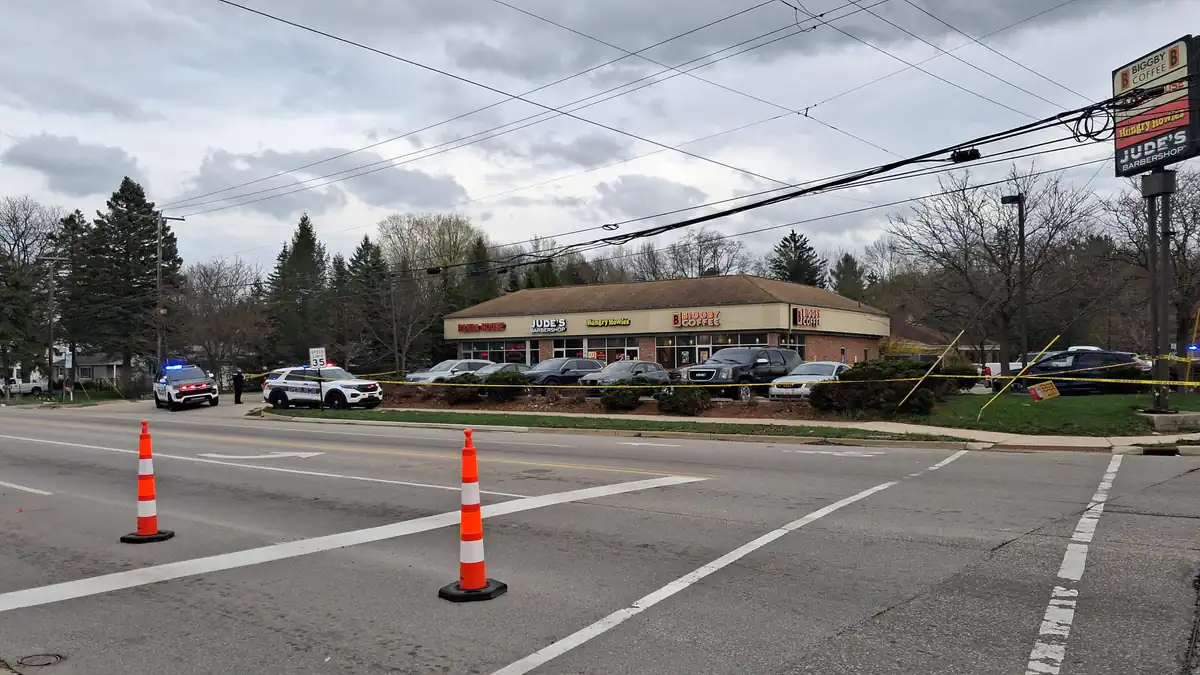
Michigan Legal Center News Desk | April 16, 2026 | East Lansing, Ingham County
Sources: WLNS 6 News (Shajaka Shelton, Todd Heywood, David Sackrider), WILX News 10, published April 15-16, 2026
NOTE: This incident is under active investigation by the Michigan State Police. The allegations and accounts below reflect official statements and documented reporting. No charges have been filed. This article will be updated as the investigation develops.
| QUICK ANSWER: What Happened in East Lansing on April 15, 2026 | |
|---|---|
| When and where | Wednesday evening, April 15, 2026, in the area of Lake Lansing Road and Abbott Road in East Lansing, Ingham County, Michigan. |
| What happened | East Lansing police were dispatched at 6:06 p.m. for a reported theft. While en route, a second call was received reporting a stabbing at a different nearby business. Officers arrived to find a suspect covered in blood holding a knife. The suspect charged at officers and refused to drop the weapon despite repeated commands. Officers shot the suspect, who was pronounced dead at the scene. |
| The stabbing victim | Douglas Mielock, 63, a shareholder attorney at Foster Swift Collins & Smith, one of Michigan's largest and oldest law firms, was stabbed multiple times. He required surgery and is currently recovering. Foster Swift described the attack as "a random act of violence." |
| Investigation status | The officers involved have been placed on paid administrative leave, as per policy. The Michigan State Police are investigating the officer-involved shooting. No charges have been announced. No names have been officially released by police. |
| Context | The shooting was announced during an East Lansing Independent Police Oversight Commission meeting, which Police Chief Jen Brown left to respond to the scene. Some ELIPOC commissioners were turned away from the subsequent press conference. |
| Legal significance | This incident involves two distinct legal questions: the rights of a victim of violent crime under Michigan law and the standards governing officer use of deadly force. Both are subject to ongoing legal scrutiny. The Michigan Legal Center has represented clients in both categories. |
| Contact | The Michigan Legal Center, Law Offices of Christopher Trainor & Associates: (248) 886-8650 |
A mid-Michigan attorney was stabbed multiple times on Wednesday evening in East Lansing, setting off a chain of events that ended with the suspect dead from a police shooting and two separate investigations now underway.
Douglas Mielock, 63, a shareholder at Foster Swift Collins & Smith, was identified Thursday afternoon by his firm as the victim of the attack near Lake Lansing Road and Abbott Road. Foster Swift, founded in 1902 and one of Michigan's most established law firms, described the assault as a random act of violence. Mielock required surgery. As of Thursday, he is recovering.
"Foster Swift wants to address the unfortunate incident involving Foster Swift attorney Douglas Mielock, who was the victim of a random act of violence yesterday evening near Abbott and Lake Lansing Roads. His injuries required surgery. Doug is currently recovering. Both Doug and his family are deeply grateful for the outpouring of care and concern from the community." -- Foster Swift Collins & Smith
East Lansing police were dispatched at 6:06 p.m. for a reported theft at a business in the area. Before officers arrived, a second call was received: someone at a different nearby business had been stabbed multiple times. When the officers reached the scene, they found a suspect covered in blood and holding a knife.
East Lansing Police Chief Jen Brown described what happened next at a press conference on Wednesday evening. The suspect ran toward the officers. Officers ordered him to drop the knife multiple times. He did not. Officers shot the suspect, who was pronounced dead at the scene by medical personnel.
Police radio traffic obtained by WLNS and sourced from Broadcastify includes what sounds like an officer reporting: "He's running right toward me in the middle of the road on Abbot." Shots fired were called moments later.
The officers involved were placed on paid administrative leave, as per the standard policy. The Michigan State Police are investigating the officer-involved shooting. No arrests have been made, and no names have been officially released by law enforcement. Authorities have stated that there is no ongoing threat to the public.
The Timing: A Police Oversight Meeting and a Shooting
One detail in this story adds a layer of institutional significance that goes beyond the incident itself. The officer-involved shooting was announced to the public during an East Lansing Independent Police Oversight Commission meeting -- a body created specifically to provide civilian oversight of the East Lansing Police Department.
According to WLNS reporting, East Lansing City Councilman Mark Meadows announced the shooting at the ELIPOC meeting after Police Chief Jen Brown left the gathering to respond to the scene. When a press conference was later held, most ELIPOC commissioners were turned away at the door, with only two allowed to attend.
This is not a detail that should be minimized. A police oversight commission exists to provide accountability and transparency for these kinds of incidents. Restricting access to oversight commissioners from a press conference about an officer-involved shooting on the same night raises questions that the investigation should address. The ELIPOC's role and whether it was afforded appropriate access to information is something to watch as this story develops.
WLNS has also previously reported a pattern of racial discrimination in policing within East Lansing, a finding that adds further institutional context to this incident, even as the immediate facts remain under investigation.
What Michigan Law Says About Officer Use of Deadly Force
Both Michigan law and the United States Constitution govern the circumstances under which a police officer may lawfully use deadly force. Understanding these standards is essential for evaluating any officer-involved shooting, including the one that occurred Wednesday in East Lansing.
The Federal Constitutional Standard: Graham v. Connor
Under the Fourth Amendment of the U.S. Constitution, a police officer's use of force must be objectively reasonable under the totality of the circumstances. The U.S. Supreme Court established this standard in Graham v. Connor, 490 U.S. 386 (1989). The analysis considers the severity of the crime, whether the suspect poses an immediate threat to the safety of officers or others, and whether the suspect is actively resisting arrest or attempting to flee.
According to the account given by Chief Brown, the suspect was covered in blood from the stabbing, armed with the knife used in that attack, charged at officers, and refused multiple commands to drop the weapon. If that account is accurate and supported by evidence, it describes the circumstances that courts have recognized as potentially justifying deadly force under the Graham standard. The Michigan State Police investigation will assess all of the available evidence against that legal framework.
Michigan's Standard for Police Use of Force
Michigan law, codified in MCL 776.16, permits law enforcement officers to use deadly force when they reasonably believe it is necessary to prevent death or great bodily harm to themselves or another person. The statute reflects a broader constitutional framework but specifically applies to Michigan prosecutions and civil proceedings.
The key word in Michigan law, as in federal law, is "reasonably." That standard is assessed objectively -- not from the perfect vantage point of hindsight, but from the perspective of a reasonable officer on the scene with the information available at the time.
In this case, the investigation will focus on the specific timeline of events: what the officers saw, what commands were given, how the suspect responded, the distance between the suspect and officers when force was applied, and what other options were available to the officers. Body camera footage, radio traffic, witness accounts, and physical evidence at the scene will all be part of that analysis.
Civil Liability and the Suspect's Family
When someone is killed in an officer-involved shooting in Michigan, two separate accountability processes run simultaneously: the criminal investigation (handled by the Michigan State Police) and any civil legal claims that may be brought by the deceased's family.
Civil claims arising from officer-involved shootings in Michigan are typically brought under 42 U.S.C. § 1983, the federal civil rights statute that allows individuals to sue government actors for violations of their constitutional rights. Depending on the facts, a Monell claim against the East Lansing Police Department as an institution may also be viable if departmental policies, training failures, or supervision practices contributed to the outcome. A wrongful death claim may also be brought under Michigan law, MCL 600.2922, if the family believes that the use of force was not legally justified.
At this stage, the investigation is in its early stages. The facts have not been fully established. It would be premature to assess whether civil claims are viable before the Michigan State Police complete their investigations. It is not premature to understand that these legal options exist and that families who lose someone in circumstances like these have the right to ask questions and seek an independent legal review of what happened.
The Rights of Crime Victims in Michigan: What Douglas Mielock and His Family Should Know
The focus on the officer-involved shooting is understandable. But at the center of this story is a man who was stabbed multiple times while going about his life near a commercial area in East Lansing. He survived. He required surgery. He is recovering. And he has legal rights that are entirely separate from the police investigation.
Michigan's Crime Victims Rights Act
Michigan's Crime Victims Rights Act, MCL 780.751 et seq., provides a framework of rights for individuals who are victims of violent crime, including the right to be notified of proceedings, treated with dignity throughout the process, and heard at critical points in the criminal case. As the victim of a violent assault, Douglas Mielock is protected by those rights regardless of how the criminal matter resolves -- including scenarios in which the perpetrator is deceased and no criminal trial will occur.
Civil Claims for Victims of Violent Crime
Beyond the criminal justice system, victims of violent assault in Michigan have the right to pursue civil claims for their injuries. When a living assailant causes harm, the victim can sue the assailant for damages. In cases where the assailant is deceased, the victim's civil claim may still be pursued against the assailant's estate if there are assets to recover.
Michigan also has the Crime Victim Compensation Program, administered by the Michigan Department of Health and Human Services, which provides financial assistance to victims of violent crime for out-of-pocket expenses not covered by insurance, including medical costs, lost wages, and counseling. This program exists specifically for situations like this one -- where the victim was targeted in a random act of violence and faces real financial consequences from their injuries.
No-Fault Coverage and the Stabbing Victim
If Douglas Mielock's injuries necessitated emergency transport to the hospital after the stabbing, Michigan's no-fault law could apply to his medical expenses. Michigan's Personal Injury Protection benefits cover medical expenses for people injured in motor vehicle accidents. If the response and transport involved a motor vehicle in a qualifying manner, coverage may apply. This is a nuanced question that an attorney should evaluate based on the specific facts of transport.
East Lansing, Police Oversight, and Accountability
East Lansing has been navigating a public conversation about policing and accountability that predates Wednesday's incident. WLNS has previously reported on findings of a pattern of racial discrimination in policing within the city. The East Lansing Independent Police Oversight Commission was created in part to provide civilian accountability over the kinds of decisions that are scrutinized after incidents like this one.
The fact that ELIPOC commissioners were largely excluded from the Wednesday press conference is a detail the commission should formally address. Accountability requires access. When oversight bodies are kept at arm's length from the very events they exist to review, it raises legitimate questions about whether oversight is functioning as designed.
None of this speaks to the merits of the officers' conduct on Wednesday evening. The investigation will determine that. But the process by which oversight works -- or does not work -- matters independently of any individual incident's outcome. It is exactly the kind of institutional question that a § 1983 and Monell analysis is designed to answer.
The Michigan Legal Center: We Have Held Law Enforcement Accountable in This State
We won $5.8 million when a police officer fractured a man's neck outside his own home. We won $6.2 million against a police department for a civil rights violation that the department tried to bury. We've litigated against departments across Southeast Michigan and beyond -- not because we're looking for a fight, but because families who lose someone, or survive something they shouldn't have had to survive, deserve more than a press conference.
We know what a lawful use of force looks like. We know what it does not look like. And we know that the difference between those two things is not always obvious at 6:06 p.m. on a Wednesday -- which is exactly why independent legal analysis matters.
We also know that victims of violent crime like Douglas Mielock deserve to have their rights fully explained. Being stabbed in a random attack is a trauma the criminal justice system alone cannot fully address.
If you or your family have questions about an officer-involved shooting, a victim's rights claim, or a civil rights violation by a Michigan law enforcement agency, Christopher Trainor and his team are available to help you understand what happened and what your options are. The consultation is free. There is no fee unless we recover for you.
Call (248) 886-8650 to speak with Michigan Legal Center today.