
Four Rescued After Detroit River Boat Capsizes Near Bridge
Michigan Legal Center News Desk | April 21, 2026 | Detroit River, Wayne County
| QUICK ANSWER: What Happened on the Detroit River on April 21, 2026? | |
|---|---|
| What happened | A pleasure craft carrying four people capsized in the Detroit River near the Gordie Howe International Bridge on the morning of Tuesday, April 21, 2026. All four were in the water or stranded when rescuers arrived. |
| The rescue | Bob Grimes, a retired police sergeant, was heading back to shore when he spotted the overturned boat and a second boat sitting against the seawall about 100 yards away. The group in the second boat could not reach the fourth person still in the water because their boat was too tall. Grimes pulled that person from the river and transported all four to shore at a boat launch near Delray Park. |
| Injuries | One man was transported to a hospital. Three others were treated at the scene and declined transport. No fatalities were reported. |
| Who responded | The U.S. Coast Guard, Detroit Police, and Detroit Fire Department all responded to the scene. |
| Coast Guard warning | The Coast Guard issued a public warning following the rescue: while air temperatures are warming this spring, Detroit River water temperatures remain dangerously cold. Falling into the water poses serious risk of cold water shock and incapacitation. Check conditions before going out. |
| Legal considerations | Boating accidents on the Detroit River involve both federal maritime and Michigan state tort law. Injured boaters may have claims against the boat owner or operator. Good Samaritans who assist in emergencies are protected from civil liability under Michigan law, MCL 691.1501. Michigan no-fault auto insurance does not cover watercraft injuries. |
| Contact | The Michigan Legal Center, Law Offices of Christopher Trainor & Associates: (248) 886-8650 |
The Detroit River does not forgive mistakes in April.
The water appears calmer at this time of year than it does in January. The air is warmer. The Gordie Howe International Bridge rises above the river in a way that makes the crossing feel safe and civilized. But the river temperature has not gotten that memo. On Tuesday morning, April 21, 2026, four people learned this lesson at close range.
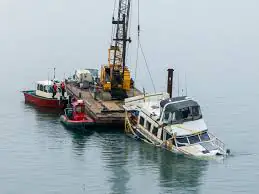
Their boat capsized in the Detroit River near the Gordie Howe International Bridge. One person ended up in the water. A second boat nearby was trying to help, but it sat too high to pull the person out. The river was winning.
That is when Bob Grimes came by.
Grimes, a retired police sergeant, was heading back to shore when he spotted the overturned boat. He saw the second boat sitting against the seawall about 100 yards away and saw someone still in the water who could not be reached. He went over. He got the fourth person out of the river. He brought all four of them to shore at a boat launch near Delray Park.
The U.S. Coast Guard later issued a direct warning to anyone planning to take a boat out on the Detroit River this spring: air temperatures are warming, but the water is still dangerously cold. Falling in is not a recoverable mistake without immediate help.
One man was transported to the hospital. Three others were treated at the scene and declined transport. The U.S. Coast Guard, Detroit Police, and Detroit Fire Department all responded. No one died.
That last fact is because a retired police sergeant happened to be on the water at the right moment, saw what was happening, and did not look away.
What the Coast Guard Wants Every Michigan Boater to Know Right Now
The rescue prompted a public warning from the U.S. Coast Guard that deserves to be read by anyone planning to take a boat onto any Southeast Michigan waterway in the coming weeks.
The warning is simple: warm air is not the same as warm water. The Detroit River, Lake St. Clair, and Lake Erie all carry water temperatures that remain dangerously low well into spring, even as temperatures on shore climb into the 60s and 70s. Cold water shock, the body's involuntary physiological response to sudden cold water immersion, can incapacitate an adult swimmer within minutes. It causes gasping, hyperventilation, and loss of motor control. It can kill people who know how to swim.
The Coast Guard specifically advised boaters to check water and weather conditions before heading out. That means more than looking at the forecast. It means understanding current water temperatures, wind conditions that can affect stability, and whether you have the right personal flotation devices for everyone on board.
Federal PFD Requirements: Who Must Have What
Under federal law enforced by the U.S. Coast Guard, every recreational vessel must carry a Coast Guard-approved life jacket for every person onboard. Children under 13 must wear life jackets at all times on moving vessels in federal waters, including the Detroit River. Adults are not currently required by federal law to wear life jackets — only to have one accessible. Many states go further.
The type of life jacket required depends on the size of the vessel:
- Type I provides the most buoyancy and is designed to turn an unconscious person face-up in the water.
- Type II and III are suitable for calmer waters where rescue is likely to be quick.
A Type II or III jacket on a person who loses consciousness from cold water shock in a river current is not the same protection as a Type I. We do not know what personal flotation equipment the four people on the capsized boat had. That detail matters enormously if the hospitalized man pursues a legal claim. It is exactly the kind of fact that needs to be documented and preserved before it disappears.
The Legal Landscape When a Boat Capsizes on the Detroit River
A boating accident on the Detroit River sits at the intersection of two legal frameworks that do not always point in the same direction: federal maritime law and Michigan state tort law. Understanding which applies and when determines how an injured person pursues recovery.
Federal Maritime Jurisdiction
The Detroit River is a navigable waterway of the United States. This classification brings it under federal maritime jurisdiction, meaning that claims arising from accidents on the river may be governed by federal admiralty law rather than — or in addition to — Michigan state law. Federal maritime law has its own negligence standards, statute of limitations, and damages framework.
The Jones Act, which protects maritime workers, does not apply here because these were recreational boaters. However, federal maritime general negligence principles apply to claims between private parties arising from the capsize. An attorney handling a Detroit River boating injury needs to be comfortable with both federal and state frameworks. Not all personal injury attorneys are.
Michigan State Claims and the Boat Owner's Liability
Separate from maritime law, Michigan state negligence principles apply to the boat's owner and operator. Under Michigan law, a boat owner owes a duty of reasonable care to passengers and others who may be affected by their operation of the vessel. If the capsize resulted from operator error, inadequate equipment, failure to check conditions, or overloading, those failures can support a negligence claim.
The boat owner may also face liability under a theory similar to Michigan's vehicle owner liability statute: a person who entrusts their vessel to an operator who causes injury through negligent operation can face direct liability. This matters in cases where the operator and owner are different people.
What Michigan No-Fault Does and Does Not Cover
This is the piece that surprises most Michigan residents: Michigan's no-fault auto insurance system does not cover watercraft accidents. MCL 500.3101 defines a motor vehicle for no-fault purposes as a vehicle primarily designed for travel on public roads. A boat is not a motor vehicle under this definition. The no-fault PIP benefits that activate automatically after a Michigan car accident do not apply here.
That means the injured boater from Tuesday's capsizing will not receive automatic medical expense coverage from a no-fault insurer. His recovery path runs through the boat owner's liability, his own health or accident insurance, and potentially federal maritime claims. This is a fundamentally different financial picture than a car accident, and anyone injured in a boating accident on the Detroit River needs legal advice tailored to that difference.
Michigan's Good Samaritan Law: Bob Grimes Is Protected
Michigan law, under MCL 691.1501, protects people who voluntarily render emergency care at the scene of an accident from civil liability for acts or omissions in providing that aid, as long as they act in good faith and without gross negligence or willful misconduct. This protection exists specifically so that people like Bob Grimes do not hesitate to help.
Grimes pulled a stranger from the Detroit River on a cold morning in April. Michigan law ensures that he does not face a lawsuit for trying. That is how the Good Samaritan statute is supposed to work.
Cold Water Shock: The Science Behind Why April on the Detroit River Kills
The Coast Guard's warning is grounded in physiology that most recreational boaters have never been taught. Cold water shock is not the same as hypothermia. It is faster, more sudden, and more debilitating.
When the body enters water below approximately 60°F, it triggers an involuntary gasp reflex. If the person's head is submerged during that gasp, they inhale water. Their breathing rate surges to three to four times normal. They lose the ability to hold their breath. Heart rate and blood pressure spike. These reactions happen in the first 30 to 90 seconds of immersion — before hypothermia, the gradual lowering of core body temperature, even begins.
The Detroit River water temperature in mid-to-late April typically ranges from the high 40s to the mid-50s Fahrenheit. That is cold enough to trigger cold water shock in virtually every adult within seconds of immersion. Cold enough to cause swimming failure — the inability to control limbs and stay afloat — within minutes. A person who goes into the Detroit River without a life jacket in April is betting their life that they can overcome their own body's involuntary responses long enough to reach a boat.
The four people rescued Tuesday appear to have survived because of Bob Grimes. Others have not been as fortunate. The National Safe Boating Council reports that a significant majority of boating fatalities involve victims who were not wearing life jackets. Cold water is almost always a contributing factor in spring boating deaths.
A Word About What Bob Grimes Did
It would be easy to move past the Good Samaritan detail in this story. It is not the legal hook. It is not the part that generates search traffic.
But a retired police sergeant was on his way back in. He was done for the morning. He saw something wrong, assessed the situation in seconds, moved his boat to where it needed to be, and pulled a stranger out of a dangerously cold river because no one else could reach them.
That is not luck. That is training, presence of mind, and a refusal to look away. Grimes spent his career as a police officer making those calls. He made one more on the Detroit River on a Tuesday in April, and four people are home because of it.
Michigan law protects him from liability for what he did. That is right. But what deserves more than protection is recognition.
If You Were Injured in a Michigan Boating Accident
Boating accidents are not the same as car accidents, and the lawyers who handle them need to understand why. Federal maritime jurisdiction, the absence of no-fault PIP, the specific standards governing boat operator negligence, and the evidentiary questions around what happened on the water before the capsize — these require a different legal analysis than a collision on I-94.
We have handled serious injury cases in Michigan courts for decades. We know how to gather the evidence that matters before it disappears into the river. We know how to build a maritime negligence case and how to pursue it in the right venue. And we know that the person who was transported to the hospital on Tuesday did not ask to end up in the Detroit River.
If you or someone you love was injured in a boating accident on the Detroit River, Lake St. Clair, or any Michigan waterway, Christopher Trainor and his team are available. The consultation is free. The fee comes only when we recover for you.
Call (248) 886-8650 to speak with the Michigan Legal Center today.