
Isaiah Kirby Family Seeks Unedited East Lansing Police Video
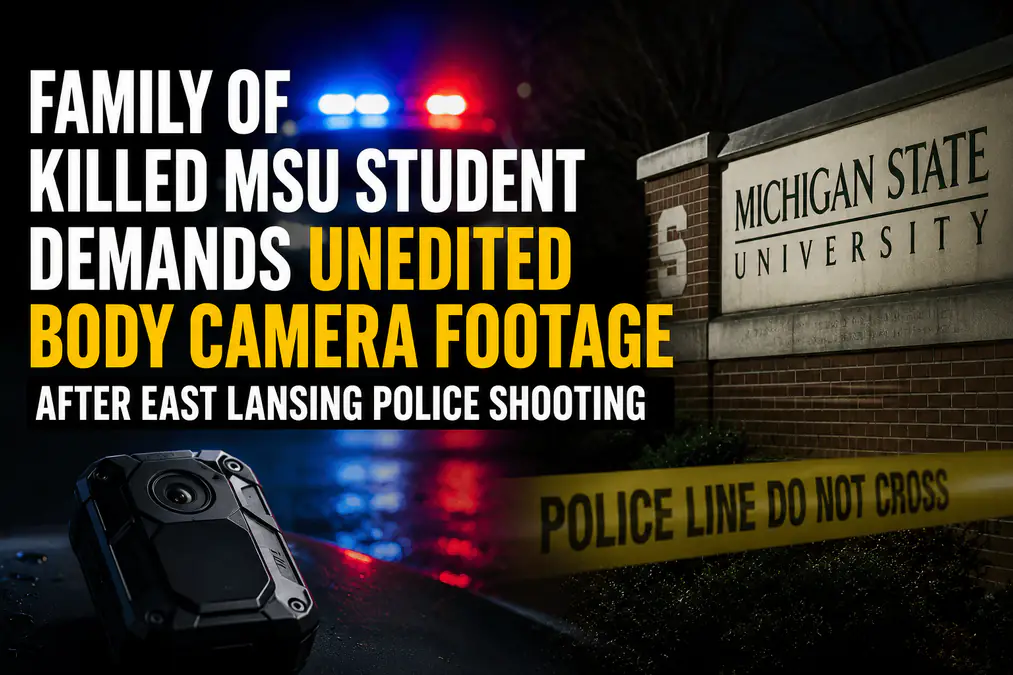
Isaiah Kirby's family is demanding complete, unedited police video after the 21-year-old Michigan State University senior was shot and killed by East Lansing officers during an April 15 incident now under Michigan State Police investigation.
The family of Isaiah Kirby, a 21-year-old Michigan State University senior who was weeks away from graduation, is demanding the release of unedited body camera and dash camera footage after he was shot and killed by East Lansing police officers on April 15, 2026.
The shooting happened near the intersection of Abbot and Lake Lansing roads in East Lansing. According to the City of East Lansing, officers were dispatched at 6:06 p.m. to a business for a theft call that later evolved into a stabbing and then an officer-involved shooting.
East Lansing police have said officers encountered Kirby after the reported stabbing. According to officials, Kirby had blood on him and an object that appeared to be a weapon. Police have said officers ordered him to drop the object before officers opened fire. Kirby was pronounced dead at the scene.
Kirby's family is now calling for truth, transparency, and the release of what they describe as complete, unedited video and audio evidence.
"All we ask for is truth and transparency," Karyn Kirby, Isaiah's mother, said during a May 12 press conference at Union Missionary Baptist Church in Lansing.
The family's attorneys have criticized the video presentation already shown to the family as edited and one-sided. Attorney Teresa Caine Bingman has said the family wants full body camera, dash camera, and audio evidence connected to the shooting.
East Lansing City Manager Robert Belleman said the city plans to release a narrated timeline, along with additional redacted body-worn camera and police vehicle footage. The City of East Lansing has also said the Michigan State Police is the lead agency investigating the incident.
What Happened on April 15?
According to East Lansing's official incident page, police were first dispatched to a business at Lake Lansing and Abbot roads for a theft. The city says that call evolved into a stabbing by a suspect, which then turned into an officer-involved shooting by East Lansing police officers.
The City of East Lansing identified Kirby as the person shot by police in an April 20 update. The city also said the stabbing victim had been released from the hospital and was recovering at home.
Police have said there is no official police video of the stabbing itself because officers were called after the reported stabbing and had not yet arrived at that location.
Why Does the Family Want Unedited Video?
In police shooting cases, body camera footage, dash camera footage, dispatch audio, 911 calls, witness statements, and police reports can become central evidence. Edited or narrated video may help the public understand a timeline, but it may not answer every question a family, attorney, investigator, or court needs to review.
Police video can also be incomplete. It may not show what happened before officers arrived, what each officer could see, or whether other camera angles captured different parts of the encounter. That is why families often ask for the complete recordings, not only a narrated or edited release.
Legally Explained: Why the Video Matters
An officer-involved shooting can involve several different reviews, including an internal administrative review, an outside investigation, and a prosecutor's review of whether criminal charges are warranted. In this case, the City of East Lansing says the Michigan State Police is the lead investigating agency.
A civil review is separate from any criminal charging decision. A family may ask whether the shooting violated constitutional rights under 42 U.S.C. Section 1983, whether the force was unreasonable under the Fourth Amendment, and whether a Michigan wrongful death claim may apply under MCL 600.2922.
Under Graham v. Connor, police use of force during a seizure is reviewed under an objective-reasonableness standard. That means the review looks at the facts and circumstances confronting officers at the time, including the suspected offense, whether there appeared to be an immediate threat, whether the person was resisting or fleeing, and what the available video and witness evidence show.
For families, the full video record can matter because edited or narrated footage may not show every angle, every officer's perspective, dispatch timing, audio, warnings, distance, lighting, or what happened immediately before force was used. FOIA may help request records, but FOIA is not the same as a preservation demand.
Talk to a Michigan Civil Rights Attorney
Michigan Legal Center reviews police use-of-force, civil rights, wrongful death, and serious injury cases throughout Michigan. If a loved one was killed or seriously injured during a police encounter, an attorney can evaluate the facts, send preservation demands, review available video, and explain possible civil claims and deadlines.
Call (248) 886-8650 or contact Michigan Legal Center for a consultation. No attorney fee unless we recover money for you. Case costs and fee terms are governed by the written fee agreement.