
Black Lake Ice Flooding Damages Cheboygan County Homes in Storms
Michigan Legal Center News Desk | April 22, 2026 | Cheboygan County, Northern Michigan
| QUICK ANSWER: What Is Happening at Black Lake and What Homeowners Need to Know? | |
|---|---|
| What happened | Large chunks of ice, driven by elevated water levels and wind, rammed through windows, doors, and walls of homes along the west side of Black Lake in Cheboygan County during the week of April 19, 2026. Photos and videos shared on social media show ice sitting inside living rooms after it broke through structural barriers. In some locations, ice was pushed as high as the rooftops. |
| Where | Black Lake and Mullett Lake in Cheboygan County in the northeastern Lower Peninsula. Both lakes feed into the Cheboygan River, which flows into Lake Huron through the Cheboygan Lock and Dam Complex. |
| What caused it | Record spring rainfall combined with snowmelt swelled every major waterway in Cheboygan County beyond its banks. With water levels this high, the lake ice that would normally melt in place had room to travel and became a battering ram against homes along the shore. NWS meteorologist Patrick Bak (Gaylord office) confirmed that the high water gave the ice far more range of movement than in any normal spring thaw. |
| Emergency status | Cheboygan County was the first county under Governor Whitmer's state of emergency, declared on April 10. That declaration was extended on April 15 to 32 more Michigan counties. The DNR Incident Management Team is working on the dam system. A large chunk of ice snapped the safety cable at the Cheboygan Lock and Dam Complex on April 9. |
| The coverage gap | Christopher Narsesian, a local resident who documented the damage, put it plainly: "Most people don't have any help or coverage. Flood insurance was never necessary. No one's ever seen this here." Standard homeowners' insurance does not cover flood damage. Most Black Lake homeowners did not carry separate flood insurance through the NFIP because historic flooding at this scale had never reached their homes before. |
| What homeowners should do now | File your homeowners' insurance claim immediately and document everything before any cleanup. Understand the difference between flood damage (not covered under standard policies) and ice or structural damage (potentially covered). If the ice physically broke through your home's structure, that coverage question is worth pursuing. MCL 500.2006 requires your insurer to respond promptly. Watch for a federal FEMA disaster declaration — Individual Assistance programs may follow. |
| Contact | The Michigan Legal Center, Law Offices of Christopher Trainor & Associates: (248) 886-8650 |
Christopher Narsesian grew up along Black Lake in Cheboygan County. He has spent his whole life watching the ice break up each spring: sheets floating in place, melting gradually, and a couple of feet washing over the break walls in front of houses. That is how it always goes.
The week of April 19, 2026, was different.
High water levels driven by record spring rainfall and snowmelt gave these ice sheets room to move. Wind pushed them. They moved like freight trains, straight into the homes of people Narsesian had known his entire life.
"These are ice sheets. They're massive. They're mini glaciers, if you will. They just run down everything in their path. Nothing can stop that kind of weight." — Christopher Narsesian, Black Lake resident
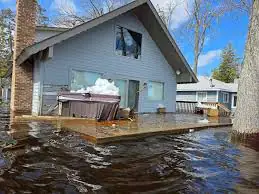
Photos and videos posted on social media showed the aftermath: chunks of ice sitting inside living rooms after smashing through windows and doors. Homes, garages, and sheds buried several feet under muddy brown water. Ice pushed to rooftop height in some locations. Shorelines familiar to Cheboygan County families for generations have become unrecognizable.
"We've never seen it that high," Narsesian said. "Typically, the ice would just come over the break walls in front of houses, like a couple of feet. People's homes don't typically flood. The ice just melts."
Residents on the west side of Black Lake were evacuated over the weekend. The Cheboygan County Sheriff's Office described it simply to the community it serves: "Black Lake, Black River, Cheboygan River, Burt Lake, Mullett Lake, the Sturgeon River (and nearly every waterway in the county) have overflowed beyond their banks, swallowing docks, roads, yards, and in far too many cases, homes. What should be familiar shorelines are now unrecognizable expanses of water."
The water is slowly receding. But Narsesian is worried. As long as the ice that remains on the lake is not pushed by more wind, the worst may be over. If it moves again, there is more to lose.
"If that ice does come back, it's going to do more damage," he said.
What Is Happening to the Dam System
Black Lake and Mullett Lake both feed into the Cheboygan River, which flows eastward to Lake Huron through the Cheboygan Lock and Dam Complex. Getting water moving is critical to relieving pressure throughout the county. The dam is the drain, and it has been struggling.
On April 9, a large chunk of ice snapped the safety cable at the Cheboygan Lock and Dam Complex, forcing the Michigan Department of Natural Resources to close access to the upstream and downstream areas. The DNR Incident Management Team has been working around the clock since then — adding pumps, restoring power to an old hydroelectric station to increase water flow, and deploying cranes to remove gates that hold back water. Two marine vessels have been working on the Cheboygan River, breaking up ice chunks to keep the gates clear.
"We can't have large chunks of ice flowing down blocking up the gates," said Patrick Ertel, a DNR spokesman. "The more water we can safely pass at the Cheboygan Dam, the faster we can bring relief to Mullett Lake. It's going as fast as it can. It is purely driven by gravity."
There is some relief in the geography: the Alverno Dam sits between Black Lake and the Cheboygan River. Ice from Black Lake cannot reach the Cheboygan River directly. It stops there. But the water behind it and the ice on Mullett Lake continue to stress a system that was designed for far more ordinary conditions.
NWS meteorologist Patrick Bak at the Gaylord office explained the physics: in a normal spring, the lake ice melts in place. The water is at its ordinary level in the river. There is no room to travel. This spring, with water levels elevated far above normal, the ice had a range of motion that it has never had in living memory. Wind did the rest.
The Coverage Gap That Is About to Devastate This Community
Narsesian said something at the end of his Associated Press account that deserves to be read slowly — because it describes the disaster that comes after the disaster.
"Most people don't have any help or coverage. Flood insurance was never necessary. No one's ever seen this here. It's a lot." — Christopher Narsesian
He describes a community of people who have lived along these lakes for decades, many for generations. Their homes have never flooded before, not like this. They bought homeowners' insurance to protect against the risks their homes faced. The homeowners were responsible; they were not negligent or taking unnecessary risks.
They never needed flood insurance because Black Lake had never flooded.
Now, the insurance framework that was supposed to protect them has a gap in it the size of a wave.
What Standard Homeowners' Insurance Covers and What It Doesn't
Standard homeowners policies in Michigan insure against a defined list of perils. Wind damage is typically included. Fire is covered. Structural damage caused by falling objects is also addressed. But damage caused by flooding (water that rises from the ground, rivers, and lakes) is not. It is explicitly excluded from virtually every standard homeowners' policy.
The National Flood Insurance Program, administered by FEMA, fills this gap. But you have to buy it separately, and you have to buy it before the disaster, not after. Many Cheboygan County families did not carry NFIP coverage because, as Narsesian said, flood insurance was never necessary.
Thousands of families in Cheboygan County are facing this situation.
The Ice Damage Question Is Worth Asking
Here is the coverage question every Black Lake homeowner should ask their attorney and insurance company before accepting any determination of coverage.
When ice physically breaks through a window, wall, or door, the direct cause of structural damage is the impact of the ice, not rising water. Ice crashing through your living room wall is not the same legal event as water seeping through your foundation. Homeowners' policies typically cover sudden and accidental physical damage to the structure. In some cases, ice driven by wind into a home's structure has been treated by courts and insurers as a covered peril separate from flooding.
This is not a guaranteed path. Insurers will argue that the ice was driven by flood conditions and that the exclusion applies. That argument has validity. But it is not automatically correct and should not be automatically accepted. The specific facts of how your home was damaged matter. Whether the ice broke through a structural element above the flood level matters. Whether the language of your policy explicitly excludes ice impact versus flood matters.
Get a written denial before you give up. Then have an attorney review it.
MCL 500.2006: Your Insurer Has Legal Obligations
Whether your claim is for wind damage, structural ice impact, or any other covered peril, Michigan law provides you with legal tools when your insurer is unresponsive. Under MCL 500.2006, your insurer must:
- Acknowledge your claim within 10 business days
- Complete its investigation within 30 days under normal circumstances
- Pay or deny the claim within 60 days of receiving sufficient proof of loss
Insurers that miss these deadlines face interest on delayed payments.
After a disaster of this scale, insurance companies receive enormous volumes of claims. That volume is not a legal excuse. Michigan's prompt-payment law applies. If your claim has been pending for weeks with no meaningful communication, that is not normal. That is an insurer using the chaos of a disaster to slow-walk what it owes you. A Michigan insurance attorney can address this directly.
The FEMA Path: Watch for a Federal Declaration
Governor Whitmer declared Cheboygan County under a state of emergency on April 10, the earliest of any county in this year's storm cycle. If she formally requests a federal disaster declaration and the President approves it, FEMA Individual Assistance programs are activated for residents.
These programs can provide grants for temporary housing, home repairs, replacement of personal property, and other uninsured losses. They do not fully replace what was lost. But for families who are looking at a living room full of ice and no flood insurance, they are the difference between having somewhere to go and having nothing.
The official resource is DisasterAssistance.gov. Registration is free. No one should charge you for applying for FEMA assistance.
What Cheboygan County Families Are Actually Facing
Narsesian described the community around Black Lake the way people who grew up somewhere always do:
"It's all friends and family. Everybody knows everyone."
These are not resort properties. They are not second homes belonging to wealthy downstate families. They are the houses that people in this part of northern Michigan have built their lives around, often over multiple generations. The families evacuated last weekend did not leave of their own accord. They left because the water and ice gave them no other option.
The physical damage can be seen in the photos: ice inside living rooms, unrecognizable shorelines, garages swallowed by muddy water. The financial damage is harder to photograph. It lives in the gap between what standard homeowners' insurance covers and what actually happened to these homes. It lives in the calls to FEMA, which may or may not yield adequate assistance. It raises the question of what comes next for people who never imagined they needed flood insurance because this had never happened before.
"It's a lot," Narsesian said. That is one of the most understated things anyone has said about anything that has happened in Michigan in April.
We Know These Situations. We Fight Them.
When insurers look at the devastation in Cheboygan County and start finding reasons why what happened to your home is not covered, we know how to answer.
We have taken on insurance companies in Michigan that denied legitimate claims, delayed payments under MCL 500.2006, and hid behind policy language to avoid paying what they owed. We do not accept those denials as the final word. We read the policy, the facts, and every available path to recovery for the people we represent.
If you are a Cheboygan County homeowner whose home was damaged by ice, flooding, or structural impacts during the April 2026 disaster and your insurer is not responding fairly or promptly, Christopher Trainor and his team want to hear from you. Conversations cost nothing. The fee is incurred only when we recover.
Call (248) 886-8650 to speak with the Michigan Legal Center today.